Showing posts with label NS 9TH SE EM. Show all posts

NCERT Solutions Class 9 Science Updated 2026-27 Exploration Textbook


๐Ÿ”ฌ NCERT Solutions for Class 9 Science (English Medium) 2026-27 ๐Ÿ“š

Welcome to Amresh Academy!

Get the latest NCERT Solutions for Class 9 Science (English Medium) based on the newly introduced Exploration Textbook 2026-27. These solutions are prepared according to the latest NCF-SE 2023 and NEP 2020 guidelines, helping students understand concepts clearly and perform better in examinations. ๐ŸŽฏ

The new Science textbook follows an integrated approach that combines ๐Ÿ”ฌ Biology, ⚗️ Chemistry, ⚙️ Physics, and ๐ŸŒ Earth Science into a single curriculum designed to develop scientific thinking and problem-solving skills.


๐Ÿ“š Class 9 Science Exploration NCERT Solutions 2026-27

๐Ÿš€ Chapter 1: Exploration – Entering the World of Secondary Science

๐Ÿงฌ Chapter 2: Cell – The Building Block of Life

๐ŸŒฟ Chapter 3: Tissues in Action

๐Ÿƒ Chapter 4: Describing Motion Around Us

⚗️ Chapter 5: Exploring Mixtures and Their Separation

๐Ÿ’ช Chapter 6: How Forces Affect Motion

⚙️ Chapter 7: Work, Energy and Simple Machines

⚛️ Chapter 8: Journey Inside the Atom

๐Ÿงซ Chapter 9: Atomic Foundations of Matter

๐Ÿ”Š Chapter 10: Sound Waves – Characteristics and Applications

๐ŸŒฑ Chapter 11: Reproduction – How Life Continues

๐Ÿฆ‹ Chapter 12: Patterns in Life – Diversity and Classification

๐ŸŒŽ Chapter 13: Earth as a System – Energy, Matter and Life


๐ŸŒŸ Why Use Amresh Academy NCERT Solutions?

✅ 100% Based on Latest NCERT Textbook (2026-27)
✅ Simple & Student-Friendly Explanations ๐Ÿ“š
✅ Accurate and Exam-Oriented Answers ๐ŸŽฏ
✅ Helpful for Homework, Revision & Exams ๐Ÿ“
✅ Updated According to New Curriculum Framework ๐Ÿš€


๐ŸŽ“ Study Smart with Amresh Academy and Master Every Chapter of Class 9 Science Exploration! ๐Ÿ”ฌ✨

SEO Title: NCERT Solutions for Class 9 Science Exploration 2026-27 (English Medium) | Amresh Academy

Meta Description: Download and read chapter-wise NCERT Solutions for Class 9 Science Exploration 2026-27 English Medium. Latest solved exercises based on the new NCERT textbook, available free on Amresh Academy. ๐Ÿ“š๐Ÿ”ฌ✨


NCERT Solutions for Class 9 Science Exploration Chapter 13 Earth as a System: Energy, Matter and Life


NCERT Class 9 Science Exploration Chapter 13 Solutions (2026-27 New Syllabus)

Class 9 Science Exploration Chapter 13 Question Answer

Revise, Reflect, Refine

1. Choose the most appropriate option to describe the role of biogeochemical cycles in an ecosystem.

(i) To provide food directly to all organisms.
(ii) To recycle essential nutrients between biotic and abiotic components.
(iii) To create new elements for use by living things.
(iv) To remove pollutants and toxins from the organism.
Answer:
(ii) To recycle essential nutrients between biotic and abiotic components.
Explanation:
Biogeochemical cycles are responsible for the continuous movement of matter and energy between the living (biotic) and non-living (abiotic) components of the Earth. They do NOT create new elements – elements like carbon, nitrogen, and oxygen simply move and change form. Their primary role is to recycle these essential nutrients so that life can continue to use them. This is why option (ii) is correct.

2. Which of the following is primarily responsible for warming of the Earth?

(i) Solar radiation is immediately absorbed by carbon dioxide, which then releases it as heat.
(ii) The atmosphere’s tiny particles absorb incoming solar radiation, which directly heats the Earth.
(iii) The Earth’s surface absorbs solar radiation, which is then re-radiated and trapped by greenhouse gases.
(iv) The Earth’s environment is heated only by the solar radiation reflected by the clouds.
Answer:
(iii) The Earth’s surface absorbs solar radiation, which is then re-radiated and trapped by greenhouse gases.
Explanation:
The correct process is: Step 1 – Solar radiation (especially visible light) reaches and is absorbed by the Earth’s surface. Step 2 – The Earth’s surface re-radiates this energy as infrared (heat) radiation back towards the atmosphere. Step 3 – Greenhouse gases like CO₂, CH₄ and water vapour absorb this outgoing infrared radiation, trapping heat and keeping the Earth warm. This is the greenhouse effect.

3. Explain how climate change affects the water cycle. Illustrate with examples.

Answer:
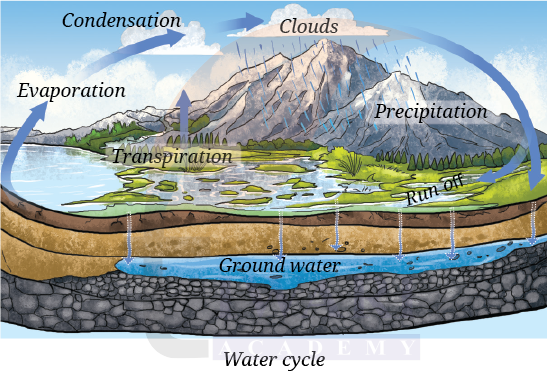
Climate change, driven mainly by the rise in atmospheric CO₂ and other greenhouse gases, is significantly disturbing the water cycle in the following ways:

Class 9 Science Exploration Chapter 13 Question 3
  1. Increased Evaporation: A warmer atmosphere causes more water to evaporate from oceans, lakes and rivers. The warmer air can hold more moisture, which intensifies the entire water cycle.
  2. More Intense rainfall and flooding: The extra moisture in the atmosphere leads to heavier rainfall in some regions. Example: India experiences more intense monsoon bursts, leading to devastating floods in states like Kerala and Assam.
  3. Droughts in other regions: While some areas flood, others receive far less rainfall, causing prolonged droughts. This disrupts agriculture and drinking water availability.
  4. Melting glaciers and rising sea levels: The Himalayan glaciers and polar ice caps melt faster, adding enormous amounts of freshwater to rivers and oceans. This threatens to flood low-lying coastal cities like Mumbai and Chennai in the long run.
  5. Reduced groundwater recharge: Sudden bursts of heavy rainfall cause more surface runoff and soil erosion, reducing the amount of water that slowly seeps underground to recharge groundwater. This makes it harder to sustain agriculture during dry months.

4. Describe how albedo affects the Earth’s surface temperature and its climate.

Answer:
Albedo is the fraction of incoming solar radiation that a surface reflects back into the atmosphere. The word comes from the Latin word for “whiteness”. It is measured on a scale of 0 (no reflection, complete absorption) to 1 (complete reflection).

SurfaceAlbedo ValueEffect on Temperature
Fresh Snow0.80 – 0.90Reflects most sunlight → stays very cold
Ice0.50 – 0.70Reflects much sunlight → remains cold
Crushed Rock0.25 – 0.30Moderate reflection → moderate temp.
Black Soil / Ocean WaterLow (0.05 – 0.10)Absorbs most sunlight → relatively warm

Effect on Climate:

  • High albedo surfaces (like snow and ice) reflect most sunlight and therefore stay cold. This is why polar regions are extremely cold – the ice itself keeps them cold by reflecting away solar energy.
  • Low albedo surfaces (like dark soil, roads and ocean water) absorb more solar energy, heating up quickly and raising local temperatures.
  • Climate feedback loop: When polar ice melts due to global warming, it exposes darker ocean water beneath, which has a lower albedo. This darker water absorbs more solar energy, causing further warming – which melts more ice. This is a dangerous positive feedback cycle.
  • Urban Heat Island: Cities have many dark-coloured surfaces – asphalt roads, concrete buildings – all with low albedo. They absorb and re-radiate more heat, making cities warmer than surrounding rural areas.

5. How are mountain and valley breezes formed? Suppose there are two mountains – one covered with grass and another covered with barren rocks. Would the temperature of the two mountain breezes be different? If so, how?

Answer:
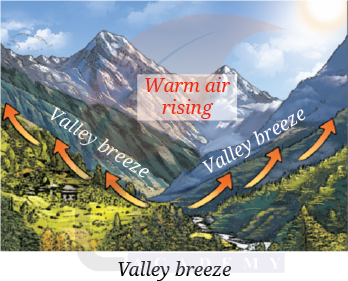
Formation of Valley Breeze (Daytime):

Class 9 Science Chapter 13 Showing Valley Breeze

Diagram showing Valley Breeze – warm air rising from slopes during day, cool air flowing up from valley
1. During the day, mountain slopes facing the Sun heat up much faster than the valley floor below them.
2 The heated air over the slopes becomes lighter and rises, creating a low pressure zone over the slopes.
3 Cooler, denser air from the valley flows upward to replace the rising warm air. This upward-blowing wind is called the Valley Breeze.
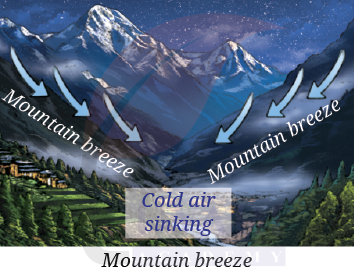
Formation of Mountain Breeze (Nighttime):

Class 9 Science Chapter 13 Showing Mountain Breeze

Diagram showing Mountain Breeze – cold air sinking from slopes at night, flowing down into the valley

  1. After sunset, mountain slopes lose heat rapidly (they cool faster than the valley floor).
  2. The air over the slopes becomes cold, dense, heavy and begins to flow downward into the valley.
  3. This downward-flowing cold wind is called the Mountain Breeze.

It is experienced in hilly regions like Shimla, Dehradun and Himalayan valleys.
Yes, the breezes would be different, and here is why:

  • The barren rocky mountain has a low albedo – dark rock absorbs more solar radiation and heats up faster and to a higher temperature during the day. Therefore, the valley breeze rising from it would be warmer and stronger. At night, bare rock also loses heat faster, creating a colder and stronger mountain breeze.
  • The grass-covered mountain has a slightly higher albedo and the vegetation provides cooling through transpiration (plants release water vapour, which cools the surface). So the slopes do not heat up as much. The valley breeze would be relatively cooler and gentler. Similarly, the mountain breeze at night would be less cold because vegetation retains some heat.

6. You have witnessed weather phenomena such as winds, storms, and rainfall. Which atmospheric layer is mainly responsible for such phenomena and what is the primary reason for its occurrence?

Answer:
Nearly all weather phenomena – winds, storms, clouds, rain, hail and snow – take place in the Troposphere, which is the lowest layer of the Earth’s atmosphere, extending from ground level to about 12 km in altitude.
Primary reason for weather in the Troposphere:

  • Heated from below: The troposphere is heated primarily from the Earth’s surface (not directly by the Sun from above). The surface absorbs solar radiation and re-radiates it as infrared heat into the air just above it.
  • Temperature decreases with height: As altitude increases in the troposphere, temperature drops at a rate of about 6.5°C per km. This creates an unstable situation – warm, lighter air near the surface tends to rise, while cooler, denser air above sinks. This constant vertical movement of air drives winds and storms.
  • Contains water vapour: The troposphere contains most of the atmosphere’s water vapour, which condenses as air rises and cools, forming clouds and ultimately precipitation.
  • Vertical mixing: Because warm air rises and cool air sinks, there is constant vertical mixing of air in the troposphere, which is the engine behind all weather systems.

7. Explain the processes involved in the nitrogen cycle. How would life on Earth be affected if nitrogen were not cycled?

Answer:
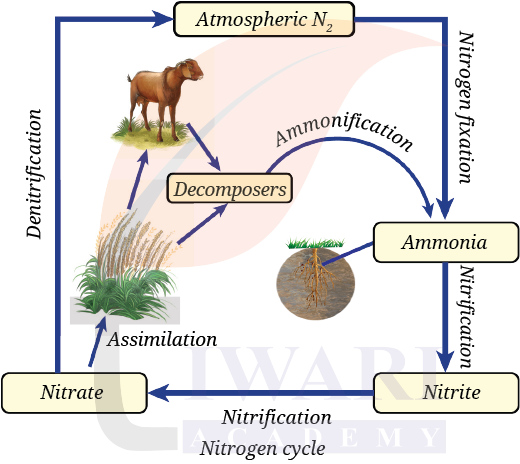
Nitrogen is essential for making proteins and nucleic acids (DNA and RNA) in all living organisms. The atmosphere contains about 78% nitrogen gas (N₂), but plants and animals cannot use it directly. It must first be converted into usable compounds. The complete pathway is called the Nitrogen Cycle.

Nitrogen Cycle - Class 9 Science Exploration Chapter 13 Question 8
ProcessWhat HappensOrganisms Involved
Nitrogen FixationAtmospheric N₂ is converted into ammonia (NH₃) in the soilRhizobium (legume root nodules), Azotobacter (free-living in soil); also by lightning
NitrificationAmmonia → Nitrite (NO₂⁻) → Nitrate (NO₃⁻), making it usable for plantsNitrosomonas (NH₃ → NO₂⁻), Nitrobacter (NO₂⁻ → NO₃⁻)
AssimilationPlants absorb nitrates from soil through roots and build proteins. Animals get nitrogen by eating plants or other animals.Plants, Herbivores, Carnivores
AmmonificationWhen plants and animals die, decomposers break down their organic matter, releasing nitrogen back as ammoniaBacteria and Fungi (decomposers)
DenitrificationSome nitrates are converted back to N₂ gas, returning nitrogen to the atmosphere and completing the cyclePseudomonas bacteria

If nitrogen were not cycled:

  • The limited nitrogen compounds in the soil would be used up quickly and not replenished. Plants would be unable to make proteins and would stop growing.
  • Without plant protein, animals would have no source of nitrogen and would also be unable to build their own proteins, enzymes, hormones or DNA.
  • Dead matter would pile up and never decompose fully, as the decomposers that depend on the cycle would also die off.
  • Ultimately, all life on Earth would cease to exist within a short period of time, as proteins and nucleic acids are absolutely fundamental to every life process.

8. What are the impacts of deforestation on the Earth’s oxygen and carbon cycles? What are the other consequences of deforestation?

Answer:
Impact on the Carbon Cycle:

  • Trees absorb CO₂ from the atmosphere through photosynthesis and store carbon in their wood, roots and leaves. They act as carbon sinks.
  • When forests are cut down and burned, all this stored carbon is released back into the atmosphere as CO₂, sharply increasing greenhouse gas levels.
  • With fewer trees, the atmosphere’s natural ability to absorb CO₂ is reduced, intensifying the greenhouse effect and global warming.
Carbon Cycle - Class 9 Science Exploration Chapter 13 Question 8

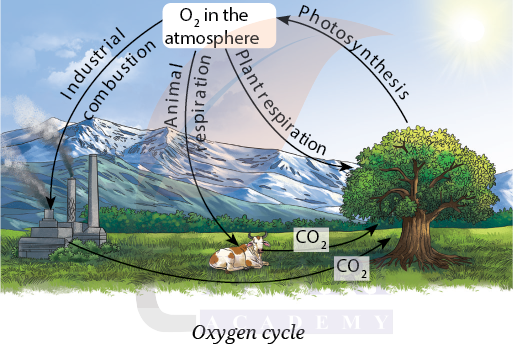
Impact on the Oxygen Cycle:

  • Trees are the primary producers of oxygen through photosynthesis. Deforestation significantly reduces the amount of oxygen produced.
  • With fewer trees, there is also reduced transpiration, meaning less water vapour is released into the atmosphere, which can decrease local cloud formation and rainfall.
Oxygen Cycle - Class 9 Science Exploration Chapter 13 Question 8

Other Consequences of Deforestation:

  • Decline in rainfall: Trees recycle water through transpiration. Removing them reduces local rainfall and can lead to desertification of the region.
  • Change in surface albedo: Forests are darker (low albedo). When cleared, they are often replaced by lighter-coloured soil or crops, which changes the energy absorption of the land.
  • Soil erosion: Tree roots hold soil together. Without them, rain washes away the topsoil, degrading agricultural land and silting up rivers.
  • Loss of biodiversity: Forests are habitats for millions of species. Destruction leads to extinction of many plants, animals and microorganisms.
  • Disruption of the nitrogen cycle: Loss of forest microbes reduces nitrogen fixation and nutrient recycling in the soil.
  • Flooding: Fewer trees mean less water absorption by roots, resulting in more runoff and increased risk of flooding.

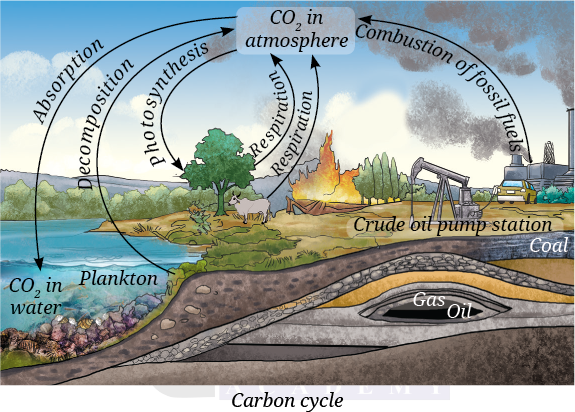
9. Explain with suitable diagram the path that carbon takes to go back to the atmosphere. You may start from plants using CO₂ from the atmosphere.

Answer:

Carbon Cycle - Class 9 Science Exploration Chapter 13 Question 8

Carbon Cycle Diagram – showing CO₂ in atmosphere → photosynthesis → plants → animals → respiration/decomposition/combustion → back to CO₂ in atmosphere; also showing fossil fuel pathway

The path of carbon from the atmosphere and back can be traced through two pathways – the fast cycle (days to years) and the slow cycle (millions of years).
Fast Carbon Pathway:

  1. Absorption: Plants absorb CO₂ from the atmosphere through their stomata and use it in photosynthesis (CO₂ + H₂O + sunlight → glucose + O₂). Carbon is now stored in the plant’s body as carbohydrates, proteins and fats.
  2. Respiration: Plants release some CO₂ back to the atmosphere through their own respiration. Animals eat plants (or other animals) and take in carbon. They too release CO₂ through respiration.
  3. Death and Decomposition: When organisms die, decomposers (bacteria and fungi) break down their organic matter, releasing CO₂ back into the atmosphere through their own respiration.

Slow Carbon Pathway:

  1. Over millions of years, dead organisms get buried under layers of sediment without fully decomposing. Their carbon-rich remains slowly transform into fossil fuels – coal, oil and natural gas.
  2. When humans burn these fossil fuels for energy, the long-stored carbon is released very rapidly as CO₂ into the atmosphere – a process that naturally would take millions of years is happening in just decades.

10. Why is an excess of CO₂ in the atmosphere considered undesirable even though it is required by plants?

Answer:
It is true that plants require CO₂ for photosynthesis – it is their “raw material” for making food. However, the current rapid rise in atmospheric CO₂ is undesirable for the following critical reasons:

  • Enhanced Greenhouse Effect and Global Warming: CO₂ is a major greenhouse gas. Excess CO₂ traps more outgoing infrared radiation from the Earth’s surface, raising the average global temperature. This leads to extreme weather events, melting of glaciers and rising sea levels.
  • Ocean Acidification: The oceans absorb excess atmospheric CO₂. This CO₂ reacts with seawater to form carbonic acid, making the oceans more acidic. This threatens coral reefs and shellfish, which cannot build their calcium carbonate shells in more acidic water, disrupting entire marine ecosystems.
  • Disruption of the carbon balance: The natural carbon cycle keeps CO₂ levels in balance. Human activities are releasing CO₂ at a rate far faster than natural processes (like photosynthesis and ocean absorption) can remove it. This imbalance is the core of the climate crisis.
  • Threats to agriculture and life: While more CO₂ might slightly boost some plant growth in controlled conditions, the associated extreme heat, droughts, floods and unpredictable monsoons caused by global warming would overall severely harm agriculture.

11. How is heat lost from the surface of the Earth? What is its significance?

Answer:
The Earth’s surface loses heat through the following mechanisms:

  1. Infrared (long-wave) radiation: The Earth’s surface, having absorbed shortwave solar radiation, re-radiates energy as longwave infrared radiation into the atmosphere. This is the primary way the Earth’s surface loses heat.
  2. Conduction and Convection: Heat is also transferred from the warm surface to the cooler air above it by direct contact (conduction). The warmed air then rises, carrying heat upward through convection currents, which also drives winds.
  3. Evaporation (Latent Heat): When water evaporates from oceans, rivers and land, it carries a large amount of heat energy (called latent heat) into the atmosphere. This is a very significant way the surface loses energy.

Significance:

  • The outgoing infrared radiation is partially trapped by greenhouse gases (CO₂, CH₄, water vapour), warming the lower atmosphere enough to sustain life. Without this, the Earth would be about 33°C colder.
  • The balance between incoming solar energy and outgoing heat radiation determines the Earth’s energy balance – which governs global climate.
  • The heat lost drives the water cycle (through evaporation) and atmospheric circulation (through convection), both of which are essential for life.
  • If too much heat is trapped (by excess greenhouse gases), it leads to global warming. If too much escapes, the Earth would freeze. Maintaining this balance is crucial.

12. If the Earth were a flat disc instead of a sphere, how would the patterns of solar radiation and temperature be different?

Answer:
The spherical shape of the Earth is fundamental to how solar energy is distributed. If the Earth were a flat disc, the following changes would occur:

  • Uniform sunlight (facing side): On a flat disc, all points on the sun-facing surface would receive sunlight at the same angle – essentially perpendicular (90°). Solar radiation would be concentrated equally over the entire surface, unlike the sphere where it is spread over a larger area near the poles. The entire facing side would receive similar insolation and would be uniformly warm.
  • No temperature gradient from equator to poles: On the real spherical Earth, the curved surface means sunlight hits equatorial regions at nearly 90° (concentrated, intense heat) and polar regions at very shallow angles (spread over more area, less intense). This creates the temperature gradient that drives winds and ocean currents. On a flat disc, this gradient would not exist.
  • No seasons: Seasons on Earth are caused by the tilt of the Earth’s spherical axis as it orbits the Sun. A flat disc’s geometry would not produce seasonal changes in the way a tilted sphere does.
  • Extreme temperature contrast: The back side (facing away from the Sun) of the flat disc would receive no sunlight at all and would be at temperatures close to absolute zero. This would create an extreme hot-cold divide, unlike the gradual temperature gradient on a sphere.
  • No global wind circulation patterns: Since equator-to-pole temperature differences drive planetary winds (trade winds, westerlies, polar easterlies), a flat disc with no such temperature gradient would have completely different – or absent – large-scale wind systems.

13. Suppose there is a rise in atmospheric temperature on Earth. How would this affect the cryosphere, hydrosphere, and biosphere?

Answer:
A rise in atmospheric temperature would trigger a cascade of effects across multiple spheres of the Earth system:
Effect on the Cryosphere (Ice and Snow)

  • Glaciers and polar ice caps would melt at a faster rate. The Himalayan glaciers, which feed major rivers like the Ganga and Brahmaputra, would shrink, threatening freshwater supply for hundreds of millions of people.
  • Snow cover in mountains like Ladakh would reduce, affecting the ecology of those regions.
  • The melting of sea ice (like Arctic ice) would expose darker ocean water, further reducing albedo and accelerating warming (positive feedback loop).

Effect of the Hydrosphere (Water Bodies)

  • Melting glaciers and ice sheets would add vast amounts of freshwater to the oceans, causing a significant rise in sea levels, threatening coastal cities like Mumbai, Chennai and Kolkata.
  • The water cycle would intensify – more evaporation would lead to heavier rainfall in some areas (more intense monsoons, flooding) and severe droughts in others.
  • Ocean temperatures would rise, making the water absorb less CO₂ (warmer water holds less dissolved gas), reducing the ocean’s capacity to act as a carbon sink.
  • Ocean acidification would increase as more CO₂ enters seawater.

Effect on the Biosphere (Living Organisms)

  • Habitats would be disrupted – many species might go extinct if they cannot adapt or migrate quickly enough.
  • Coral reefs would suffer from coral bleaching due to warmer and more acidic ocean water.
  • Agricultural patterns would shift – some crops might fail due to heat stress, unpredictable monsoons or changed growing seasons.
  • Coastal marine ecosystems (mangroves, fisheries) would be threatened by rising sea levels and flooding.
  • Tropical diseases might spread to new regions as warmer temperatures expand the habitat of disease-carrying insects.

14. Explain how the Earth’s atmosphere helps in maintaining a suitable temperature for life to survive on the Earth.

Answer:
The Earth’s atmosphere plays two crucial and complementary roles in maintaining a life-supporting temperature – it acts as both a shield and a blanket.

  1. As a Shield (Filtering Incoming Radiation)
    • The upper atmosphere filters out harmful gamma rays and X-rays, which would be lethal to living organisms.
    • The ozone layer in the stratosphere (12–50 km) absorbs most of the harmful ultraviolet (UV) radiation. UV can cause cancer, damage DNA and harm ecosystems. Without the ozone layer, life as we know it could not exist on land.
    • Clouds and atmospheric particles also reflect some incoming solar radiation back into space, preventing overheating.
  2. As a Blanket (The Greenhouse Effect)
    • The Earth’s surface absorbs visible sunlight and re-radiates the energy as infrared (heat) radiation.
    • Greenhouse gases – mainly CO₂, CH₄ and water vapour – absorb this outgoing infrared radiation and re-emit it back towards the Earth’s surface, preventing heat from escaping into space.
    • This natural greenhouse effect raises the average surface temperature from what would be about −18°C (without it) to the actual average of about +15°C – a difference of 33°C, which is entirely due to the atmosphere. This range supports liquid water and life.

15. Describe the interrelationship between different spheres of the Earth. Illustrate with an example how these spheres function in a delicate balance.

Answer:
The Earth system is made up of five major interacting spheres, each of which is deeply connected to the others:

SphereWhat it Includes
GeosphereSolid rocks, soil, landforms (Deccan Plateau, Thar Desert), Earth’s interior
HydrosphereLiquid water – oceans, rivers (Ganga–Brahmaputra), lakes, groundwater
CryosphereSolid water – Himalayan glaciers, snow in Ladakh, polar ice caps
AtmosphereAir surrounding the Earth – nitrogen, oxygen, CO₂, water vapour, other gases
BiosphereAll living organisms and their habitats – forests, mangroves, coral reefs, ocean plankton

Illustrative Example – The Himalayan Glacier System:
This example shows how a change in one sphere cascades through all others:

  1. Atmosphere: Rising CO₂ from burning fossil fuels (human activity) increases the atmospheric temperature through the greenhouse effect.
  2. Cryosphere: The warmer atmosphere causes Himalayan glaciers (cryosphere) to melt faster. The snow cover in high-altitude regions reduces.
  3. Hydrosphere: Meltwater floods rivers in summer (short term), but as glaciers shrink, rivers like the Ganga eventually receive less water. At the same time, rising sea levels threaten coastal river deltas. Warmer Arabian Sea water increases evaporation, intensifying or disrupting the southwest monsoon.
  4. Geosphere: More intense rainfall causes soil erosion and landslides in mountain regions. Decreased river flow reduces the deposition of fertile silt on plains, degrading agricultural soil.
  5. Biosphere: Less water in rivers and changing rainfall patterns threaten agriculture and food security. Habitats are lost. Coral reefs die from acidic, warm ocean water. Biodiversity declines as many species cannot adapt fast enough.

Class 9 Science Exploration Chapter 13 – Extra Questions for Revision

NCERT Class 9 Science Exploration Chapter 13 Very Short Answer Type Questions with Explanation.

Very Short Answer Type Questions

  1. Define albedo.
    Answer:
    Albedo is the fraction of solar radiation reflected by a surface. High albedo surfaces (like snow) reflect more light and stay cooler, while low albedo surfaces (like black soil) absorb more and become warmer.
  2. What is insolation?
    Answer:
    Insolation is the amount of solar radiation that actually reaches the Earth’s surface. Its maximum value under clear sky conditions is approximately 1 kWm⁻².
  3. What is the solar constant?
    Answer:
    The solar constant is the average solar energy received per unit time per unit area perpendicular to the Sun’s rays at the top of Earth’s atmosphere. Its value is approximately 1.4 kWm⁻².
  4. Name the five spheres of the Earth system.
    Answer:
    The five spheres are: (1) Geosphere, (2) Hydrosphere, (3) Cryosphere, (4) Atmosphere and (5) Biosphere.
  5. What is a valley breeze?
    Answer:
    A valley breeze blows during the day when mountain slopes heat up faster than the valley floor, causing warm air on slopes to rise and cooler valley air to move upward replacing it.
  6. What is a mountain breeze?
    Answer:
    A mountain breeze blows at night when slopes cool faster than the valley floor. Cooler, denser air from the slopes flows downward into the valley.
  7. Name the greenhouse gases that trap outgoing heat from Earth.
    Answer:
    The main greenhouse gases are carbon dioxide (CO₂), methane (CH₄) and water vapour. They absorb infrared radiation re-emitted by Earth’s surface, preventing heat from escaping to space.
  8. What is eutrophication?
    Answer:
    Eutrophication is the excessive growth of algae in water bodies due to overuse of fertilisers, which adds excess nitrates. Algal blooms deplete oxygen and kill fish, threatening aquatic ecosystems.
  9. Name the bacteria involved in nitrogen fixation.
    Answer:
    Rhizobium (found in root nodules of legumes) and Azotobacter (free-living in soil) are the main nitrogen-fixing bacteria that convert atmospheric N₂ into ammonia (NH₃).
  10. What is the role of denitrifying bacteria in the nitrogen cycle?
    Answer:
    Denitrifying bacteria such as Pseudomonas convert nitrates (NO₃⁻) back into nitrogen gas (N₂), releasing it into the atmosphere and completing the nitrogen cycle.
  11. What are gyres?
    Answer:
    Gyres are large circular ocean current patterns formed due to the deflection of moving water masses by Earth’s rotation. They rotate clockwise in the Northern Hemisphere and counter-clockwise in the Southern Hemisphere.
  12. What is the Urban Heat Island effect?
    Answer:
    Cities are warmer than surrounding rural areas because buildings, roads and concrete absorb and re-radiate solar heat. This increases the local temperature and energy demand for air conditioning.
  13. What is the Haber-Bosch process?
    Answer:
    The Haber-Bosch process (early 1900s) is an industrial method of fixing atmospheric nitrogen to produce ammonia (NH₃), which is used to make most fertilisers that sustain modern agriculture.
  14. What is the ozone hole?
    Answer:
    The ozone hole is a region of severe ozone loss over Antarctica caused by CFCs (chlorofluorocarbons) released from refrigerators and aerosols. It allows harmful UV radiation to reach Earth’s surface.
  15. What are CFCs and why are they harmful?
    Answer:
    CFCs (chlorofluorocarbons) are human-made chemicals used in refrigerators and aerosols. They destroy ozone molecules in the stratosphere faster than they form, thinning the protective ozone layer.

NCERT Class 9 Science Exploration Chapter 13 Short Answer Type Questions with Explanation.

Short Answer Type Questions

  1. Explain how the shape of the Earth causes uneven heating of its surface.
    Answer:
    Earth is spherical, so the Sun’s rays strike different latitudes at different angles. At the equator, rays fall more directly over a smaller area, making it warmer. At the poles, rays are spread over a larger area, making them much colder. This uneven heating drives global atmospheric and oceanic circulation.
  2. Describe the role of the ozone layer in protecting life on Earth.
    Answer:
    The ozone layer in the stratosphere (12–50 km) absorbs harmful short-wavelength UV radiation from the Sun. This prevents UV rays from reaching Earth’s surface, where they can damage skin and eyes, cause cancer and harm ecosystems. The Montreal Protocol has helped the ozone layer recover by banning CFCs.
  3. How does albedo affect the Earth’s surface temperature?
    Answer:
    Albedo is the fraction of solar radiation a surface reflects. High-albedo surfaces like snow (0.80–0.90) reflect most incoming radiation and remain cold – which is why polar regions stay frozen. Low-albedo surfaces like black soil (0.08–0.15) absorb most radiation and heat up quickly. Changes in albedo – such as melting snow – create feedback loops that accelerate warming.
  4. How do ocean currents help regulate Earth’s climate?
    Answer:
    Ocean currents transport warm water from the equatorial regions toward the poles and return cold water at deeper levels toward the equator. This redistributes heat globally, reducing temperature differences between equatorial and polar regions. For example, the North Atlantic Drift (extension of Gulf Stream) keeps northwestern European ports ice-free even in winter, moderating their climate significantly.
  5. What is a biogeochemical cycle? Why is it important?
    Answer:
    A biogeochemical cycle is the cyclic movement of matter and energy between the abiotic (non-living) and biotic (living) components of the Earth. It ensures that essential nutrients like carbon, nitrogen and oxygen are continuously recycled and remain available to sustain life. These cycles also regulate climate, maintain atmospheric composition, and balance ecosystems across all of Earth’s spheres.
  6. Explain the fast carbon cycle in simple steps.
    Answer:
    In the fast carbon cycle (operating over days to years): (1) Plants absorb atmospheric CO₂ through photosynthesis and convert it to glucose; (2) Animals eat plants, obtaining carbon; (3) Both plants and animals release CO₂ through respiration; (4) When organisms die, decomposers break down their bodies and release CO₂ back into the atmosphere. This cycle operates continuously and keeps carbon moving through the biosphere rapidly.
  7. How does deforestation affect multiple Earth’s spheres?
    Answer:
    Deforestation affects all spheres simultaneously. In the biosphere, habitats are destroyed and biodiversity declines. In the atmosphere, less photosynthesis means more CO₂ and reduced transpiration lowers local rainfall. In the hydrosphere, reduced tree roots increase soil erosion and reduce groundwater recharge. Surface albedo also changes. This illustrates how damage in one sphere cascades across others.
  8. What is the difference between the troposphere and stratosphere in terms of temperature variation?
    Answer:
    In the troposphere (0–12 km), temperature decreases with height at about 6.5°C per km, because this layer is heated from below by Earth’s warm surface. In the stratosphere (12–50 km), temperature increases with height because the ozone layer absorbs UV radiation from the Sun, heating this layer from above. This temperature inversion in the stratosphere suppresses vertical air mixing, keeping weather confined to the troposphere.
  9. What is the significance of the Keeling Curve?
    Answer:
    The Keeling Curve is a graph showing the continuous rise in atmospheric CO₂ concentration from 1960 to the present. It clearly demonstrates that human activities – especially burning fossil fuels and deforestation — have increased CO₂ by about 35% (from ~315 ppm in 1960 to ~420 ppm by 2025). The sawtooth pattern on the curve reflects seasonal fluctuations caused by plant growth absorbing CO₂ in summer in the Northern Hemisphere.
  10. How does warmer Arabian Sea water affect India’s monsoon?
    Answer:
    When Arabian Sea water warms, evaporation increases significantly. This extra moisture in the atmosphere causes fluctuations in the southwest monsoon. It can bring heavy floods to some regions while leaving others in drought. The disruption occurs because monsoon intensity and distribution are closely tied to the temperature gradient between the ocean and the land. As global warming intensifies, such disruptions in India’s monsoon pattern are expected to increase.

NCERT Class 9 Science Exploration Chapter 13 Long Answer Type Questions with Explanation.

Long Answer Type Questions

1. Describe the five spheres of the Earth and explain, with one example, how a disturbance in one sphere leads to changes in others.

Answer:
The Earth system is made up of five major interacting spheres:

  1. Geosphere: Solid rocks, soil, landforms, and Earth’s interior (e.g., Deccan Plateau, Thar Desert)
  2. Hydrosphere: All liquid water including oceans, rivers, lakes, and groundwater (e.g., the Ganga–Brahmaputra river system)
  3. Cryosphere: Solid water in the form of ice and snow (e.g., Himalayan glaciers, polar ice caps, Ladakh snowfields)
  4. Atmosphere: The layer of air surrounding Earth held by gravity, composed mainly of nitrogen (78%) and oxygen (21%)
  5. Biosphere: All living organisms and their habitats (e.g., mangroves, forests, coral reefs, ocean plankton)

These five spheres are not independent — they continuously interact. A disturbance in one inevitably affects the others, often in a chain reaction.
Example — Arabian Sea Warming:

  • Warmer Arabian Sea (hydrosphere) increases evaporation
  • More moisture enters the atmosphere → fluctuations in southwest monsoon
  • Monsoon disruption causes floods in some regions and drought in others → affects the hydrosphere (river levels change)
  • Rising atmospheric temperature accelerates melting of Himalayan glaciers (cryosphere) → raises river flows initially, then reduces them long term
  • Melting glaciers raise sea levels → threatens coastal cities → destroys habitats in the biosphere
  • Soil erosion from floods affects the geosphere

This chain shows that the Earth functions as one integrated system where no sphere can be disturbed in isolation.

NCERT Solutions for Class 9 Science Exploration Chapter 12 Patterns in Life: Diversity and Classification


NCERT Class 9 Science Exploration Chapter 12 Solutions

Class 9 Science Exploration Chapter 12 Question Answer

Revise, Reflect, Refine

1. Meena and Hari observed an animal in their garden. Hari called it an insect while Meena said it was an earthworm. Choose the correct option which confirms that it is an insect:

(i) Bilateral symmetrical body
(ii) Body with jointed legs
(iii) Cylindrical body
(iv) Body with little segmentation
Answer:
The correct option is:
(ii) Body with jointed legs
Explanation:
Insects belong to the phylum Arthropoda, which is characterized by the presence of jointed legs. Earthworms do not have legs; they have a cylindrical segmented body. Therefore, the presence of jointed legs confirms that the animal is an insect.

2. Sponges represent one of the simplest animal body plans. Their bodies lack true tissues and organs. Which feature of sponge cells supports its classification under the animal kingdom?

(i) Absence of mitochondria
(ii) Ability to photosynthesise
(iii) Presence of a cell membrane
(iv) Presence of a cell wall
Answer:
The correct option is:
(iii) Presence of a cell membrane
Explanation:
Animals have cells with a cell membrane and do not have a cell wall. Sponges also show this feature, which supports their classification under the animal kingdom. They do not perform photosynthesis and do not have a cell wall like plants.

3. Observe two different animals in your immediate environment. What features help you distinguish between them? How do these features help place them into different groups?

Answer:
Let us consider two animals: a dog and a butterfly.

FeaturesDogButterfly
1. Body structureVertebrate (has backbone)Invertebrate (no backbone)
2. Body coveringHair/furWings covered with scales
3. Mode of movementWalks/runs on legsFlies using wings
4. ReproductionGives birth to young ones (viviparous)Lays eggs (oviparous)
5. Level of organisationComplex organ systems (mammal)Simpler compared to mammals (insect)
6. GroupingDog is placed in the group Vertebrata → Mammalia.Butterfly is placed in the group Arthropoda → Insecta.

Conclusion:
These features such as presence of backbone, body covering, movement and reproduction help in classifying organisms into different groups.

4. How would a scientist justify choosing cellular organisation as a more fundamental characteristic for the basis of classification rather than the presence of xylem and phloem?

Answer:
Cellular organisation is a more fundamental characteristic because it reflects the basic structure and complexity of an organism. It distinguishes organisms at a deeper level, such as prokaryotic (without true nucleus) and eukaryotic (with true nucleus) or unicellular and multicellular forms.
In contrast, the presence of xylem and phloem is a specific feature found only in certain plants. It is not applicable to all living organisms.
Therefore, cellular organisation provides a broader and more universal basis for classification compared to xylem and phloem.

5. You find an unlabelled slide of a single-celled organism that has a well-defined nucleus and multiple cilia. Which group would it most likely belong to? Give reasons.

Answer:
The organism most likely belongs to the kingdom Protista.
Reasons:

  • It is unicellular → characteristic of Protista
  • It has a well-defined nucleus → indicates it is eukaryotic
  • Presence of cilia → common in protozoans like Paramecium (Protista)

Thus, these features clearly place it in the kingdom Protista.

6. How does the diversity of organisms contribute to the balance and stability of an ecosystem?

Answer:
Diversity of organisms plays an important role in maintaining ecosystem balance and stability:

  1. Different organisms perform different roles (producers, consumers, decomposers).
  2. It ensures proper flow of energy and cycling of nutrients.
  3. Greater diversity increases the ability of ecosystems to withstand disturbances.
  4. If one species is affected, others can help maintain balance.

Thus, biodiversity ensures the smooth functioning and long-term stability of ecosystems.

7. If all unicellular organisms were grouped into a single kingdom, what problems would arise?

Answer:
Grouping all unicellular organisms into a single kingdom would create several problems:

  1. It would ignore important differences such as prokaryotic and eukaryotic cells.
  2. It would mix organisms with very different structures and functions.
  3. It would make classification less accurate and less useful.
  4. It would not reflect evolutionary relationships properly.

Therefore, such grouping would lead to confusion and reduce scientific clarity.

8. Viruses were studied in earlier classes. Why are they not placed in any of the five kingdoms? Give reasons.

Answer:
Viruses are not placed in any of the five kingdoms because:

  1. They are not made of cells (lack cellular organisation).
  2. They can reproduce only inside a host cell.
  3. Outside a host, they behave like non-living particles.
  4. They do not carry out metabolic activities independently.

Thus, viruses show both living and non-living characteristics, so they are not included in the five-kingdom classification.

9. If you were asked to revise the five kingdom classification, would you create a separate category for viruses or keep them outside the system? Justify your answer and explain what this indicates about the evolving nature of scientific classification.

Answer:
It is better to create a separate category for viruses.
Justification:

  • Viruses are unique as they show both living and non-living characteristics.
  • They do not fit into any of the existing kingdoms.
  • A separate category would help in better understanding and studying them.

This indicates that scientific classification is not fixed. It evolves with new discoveries and improved understanding. Scientists continuously revise classification systems to make them more accurate.

10. Viruses contain genetic material like living organisms but lack cellular organisation. Which features prevent them from fitting into the five kingdom system? What does this tell us about the limitations of classification systems?

Answer:
Features that prevent viruses from fitting into the five-kingdom system:

  1. Lack of cellular structure
  2. No independent metabolism
  3. Dependence on host for reproduction
  4. Inactive outside host cells

This shows that classification systems have limitations. They are based on current knowledge and may not include all types of organisms. As new information is discovered, classification systems need to be updated.

11. Both pteridophytes and bryophytes lack flowers and seeds, yet they are placed in different groups. Explain this classification using their key features.

Answer:
Bryophytes:

  • Non-vascular plants (no xylem and phloem)
  • Small and simple structure
  • Depend on water for reproduction
  • Examples: moss, liverworts

Pteridophytes:

  • Vascular plants (have xylem and phloem)
  • More developed body with roots, stems and leaves
  • Less dependent on water compared to bryophytes
  • Examples: ferns

Conclusion:
Although both lack flowers and seeds, the presence or absence of vascular tissues is the key factor that separates them into different groups.

12. In the classification hierarchy, which group—class or genus—has fewer members but more features in common? Explain your answer.

Answer:
Genus has fewer members but more features in common.
Explanation:
In the classification hierarchy, as we move from higher levels (like kingdom, phylum, class) to lower levels (like genus and species), the number of organisms decreases while similarities increase.

  • A class contains many different organisms with fewer common features.
  • A genus contains closely related organisms that share many similar characteristics.

Therefore, genus has fewer members but more features in common compared to class.

13. A scientist discovers a new organism with the characteristic features of locomotion and autotrophic nutrition. Which character(s) would help the scientist identify the organism belonging to Protista according to the five kingdom classification?

Answer:
The key character that would help identify the organism as Protista is that it is unicellular and eukaryotic.
Explanation:
Although locomotion and autotrophic nutrition are seen in some Protists (like Euglena), these features alone are not sufficient.
Important identifying features of Protista:

  1. Unicellular organisation
  2. Eukaryotic cell (well-defined nucleus)
  3. May show both autotrophic and heterotrophic nutrition
  4. Some possess locomotory structures like cilia or flagella

Thus, if the organism is unicellular and eukaryotic with these features, it can be classified under Protista.

14. A researcher identified a unicellular eukaryotic organism as fungi. What identification key would you suggest according to the five kingdom classification to keep a unicellular organism in the Kingdom Fungi?

Answer:
The identification key to classify a unicellular organism under Kingdom Fungi is its mode of nutrition and cell structure.
Explanation:
Even though most fungi are multicellular, some (like yeast) are unicellular.
To identify it as fungi, the organism should have:

  1. Heterotrophic mode of nutrition (absorptive nutrition)
  2. Cell wall made of chitin
  3. Lack of chlorophyll (non-photosynthetic)
  4. Reproduction by budding or spores

Thus, if a unicellular organism shows these features, it can be classified under Kingdom Fungi.

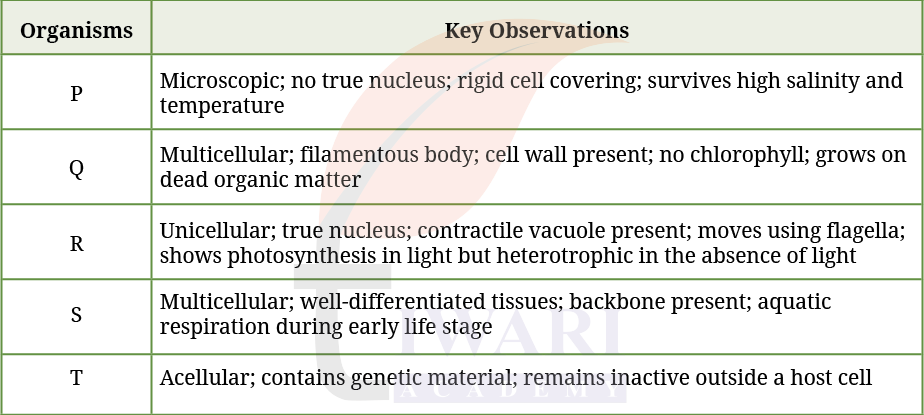
15. During a long-term ecological study, students examined organisms collected from three different environments—a freshwater pond, damp soil near decaying logs and the digestive tract of animals. Instead of naming organisms directly, scientists recorded only structural, cellular and nutritional features as given in the table below.

Class 9 Science Exploration Chapter 12 Question 15

The students realised that some organisms fit neatly into Whittaker’s five kingdom classification, while others challenged the very basis of this classification.
Based on the case study, answer the following questions:
(i) Identify one organism that clearly belongs to the Kingdom Fungi. State one observation that supports your answer.
Answer:
Organism Q belongs to Kingdom Fungi.
Reason:
It grows on dead organic matter (saprophytic nutrition), which is a key characteristic of fungi.

(ii) Which organism would be placed in the Kingdom Monera? Mention one characteristic that justifies this placement.
Answer:
(ii) Organism P belongs to Kingdom Monera.
Reason:
It has no true nucleus (prokaryotic cell), which is the main feature of Monera.

(iii) Organisms R and Q are both eukaryotic, yet they are placed in different kingdoms. Analyse the criteria that separate them.
Answer:
Although both are eukaryotic, they differ in:

  • Level of organisation:
    • R is unicellular
    • Q is multicellular
  • Mode of nutrition:
    • R can be autotrophic (photosynthesis) and heterotrophic
    • Q is heterotrophic (absorptive)
  • Kingdom classification:
    • R → Protista
    • Q → Fungi

Thus, organisation and nutrition separate them into different kingdoms.

(iv) Explain why organism S cannot be classified using the mode of nutrition alone.
Answer:
Organism S has:

  • Multicellular body
  • Well-differentiated tissues
  • Backbone (vertebrate)

These features show it belongs to Animalia.
Mode of nutrition alone is not enough because many organisms share similar nutrition types. Structural features like presence of backbone and tissues are more important for classification.

(v) Organism T does not fit into any of the five kingdoms. Which fundamental characteristic used in classification does it lack and what does this reveal about the limitations of classification systems?
Answer:
Organism T lacks cellular organisation.
Explanation:

  • It is acellular (like a virus)
  • Cannot carry out life processes independently

This reveals that classification systems have limitations because some entities (like viruses) do not fit into existing categories. Classification must evolve with new discoveries.

(vi) If classification were based only on habitat, which organisms might be incorrectly grouped together? Explain the scientific consequences of such a classification.
Answer:
Organisms like P (bacteria), R (protist) and S (animal) might be grouped together if they share the same habitat (e.g., water).
Consequences:

  1. It would ignore structural and cellular differences
  2. It would mix unrelated organisms
  3. It would not reflect evolutionary relationships
  4. It would reduce accuracy and usefulness of classification

Thus, habitat alone is not a reliable basis for classification.

(vii) Imagine scientists discover a new organism that is multicellular, eukaryotic, lacks chlorophyll and absorbs nutrients from a host externally. Should it be placed under fungi or animalia? Justify your reasoning using classification criteria.
Answer:
It should be placed under Kingdom Fungi.
Justification:

  • Multicellular and eukaryotic
  • Lacks chlorophyll
  • Shows absorptive nutrition  (key feature of fungi)

Animals ingest food internally, whereas fungi absorb nutrients externally.
Hence, this organism fits the characteristics of fungi.

Class 9 Science Exploration Chapter 12 – Extra Practice Question for Exam

NCERT Class 9 Science Exploration Chapter 12 Very Short Answer Type Questions with Explanation.

Very Short Answer Type Questions

  1. What is biodiversity?
    Answer:
    Biodiversity is the immense variety of living organisms on Earth, from microscopic bacteria to giant trees, found across diverse habitats from the Himalayas to coral reefs.
  2. What are endemic species? Give one example from India.
    Answer:
    Endemic species are those found only in a specific region and nowhere else in the world. Examples from India include the Nilgiri tahr and Neelakurinji.
  3. What is a biodiversity hotspot?
    Answer:
    A biodiversity hotspot is a region that supports a large number of endemic species and has undergone significant habitat loss. Examples include India’s Western Ghats and the Himalayas.
  4. What is biological classification?
    Answer:
    Biological classification is the scientific system of grouping living organisms based on their similarities, differences, and evolutionary relationships to make their study systematic and organised.
  5. Name the five kingdoms proposed by Robert H. Whittaker in 1969.
    Answer:
    Whittaker’s Five Kingdom Classification includes Monera, Protista, Fungi, Plantae and Animalia, proposed in 1969 based on cell type, organisation and nutrition.
  6. What is the key difference between Monera and Protista?
    Answer:
    Monera contains unicellular prokaryotes (no true nucleus), such as bacteria and cyanobacteria. Protista contains unicellular eukaryotes (true nucleus), such as Amoeba, Paramecium and Euglena.
  7. Why are fungi not placed in kingdom Plantae?
    Answer:
    Fungi have heterotrophic nutrition (they absorb from dead organic matter) and their cell wall is made of chitin, not cellulose. They do not perform photosynthesis, unlike plants.
  8. What are the five classes of Kingdom Plantae?
    Answer:
    Kingdom Plantae is divided into Thallophyta (algae), Bryophyta (mosses), Pteridophyta (ferns), Gymnosperm (pines) and Angiosperm (flowering plants).
  9. Why are bryophytes called the ‘amphibians of the plant kingdom’?
    Answer:
    Bryophytes live on moist land but require water for reproduction – their male gametes must swim to fertilise the egg. This dual dependence makes them the plant kingdom’s amphibians.
  10. What is a notochord and what is its significance in classifying animals?
    Answer:
    A notochord is a flexible rod-shaped internal structure. Its presence or absence is a major criterion for classifying animals into Chordata (with notochord) and non-Chordata (without).
  11. What is binomial nomenclature? Who introduced it?
    Answer:
    Binomial nomenclature is a universal two-part scientific naming system using genus and species names in Latin. It was introduced by Carolus Linnaeus in the 18th century.
  12. Write the scientific name of tiger and state the rules used.
    Answer:
    The scientific name of tiger is Panthera tigris. The genus name (Panthera) begins with a capital letter; the species name (tigris) is in lowercase; both are written in italics.
  13. What are fossils and how do they serve as evidence of evolution?
    Answer:
    Fossils are preserved remains of past organisms found in rock layers. Older layers contain simpler forms; newer layers show complex forms, providing evidence of how life changed over millions of years.
  14. Name the invertebrate phylum with the simplest body organisation and state its key feature.
    Answer:
    Porifera (sponges) has the simplest body – multicellular but with no true tissues or organs. Water flows through numerous pores, bringing food and oxygen directly to individual cells.
  15. What is the hierarchical sequence of classification from broadest to most specific?
    Answer:
    The hierarchy from broadest to most specific is: Kingdom → Phylum → Class → Order → Family → Genus → Species. Each lower level shares more features in common.

NCERT Class 9 Science Exploration Chapter 12 Short Answer Type Questions with Explanation.

Short Answer Type Questions

  1. What criteria do scientists use to classify living organisms? List any four.
    Answer:
    Scientists use: (1) Cell type – prokaryote or eukaryote; (2) Level of organisation – unicellular or multicellular; (3) Mode of nutrition – autotrophic or heterotrophic; (4) Cell structure – presence or absence of cell wall and its composition (chitin or cellulose). Additional criteria include ecological role, reproduction method and genetic similarity via DNA analysis.
  2. Why was the two kingdom classification (Plantae and Animalia) insufficient?
    Answer:
    The two kingdom system failed to accommodate organisms like Amoeba and Paramecium, which move like animals but are unicellular; bacteria, which are prokaryotic; and fungi, which are heterotrophic decomposers rather than photosynthetic plants. These could not be clearly placed in either Plantae or Animalia, necessitating additional kingdoms.
  3. Explain the key advancement Pteridophyta shows over Bryophyta.
    Answer:
    Pteridophytes (e.g., ferns) possess true roots, stems and leaves – unlike bryophytes which only have root-like rhizoids and lack true differentiation. More importantly, pteridophytes have vascular tissues – xylem (transports water) and phloem (transports food) – enabling them to grow taller and live on drier land, though they still need water for reproduction and do not produce seeds.
  4. How do Gymnosperms represent a major advance in plant evolution over Pteridophytes?
    Answer:
    Gymnosperms produced seeds, which protect the embryo and provide stored food for germination – a major advantage for land survival. More critically, gymnosperms do not require water for fertilisation (unlike pteridophytes), making reproduction possible in cold and dry environments. Their needle-like leaves also reduce water loss. Their only limitation over angiosperms is that their seeds are not enclosed in fruits.
  5. What is the ecological role of fungi? Why would their absence be harmful?
    Answer:
    Fungi are saprophytic decomposers – they break down dead organic matter (fallen leaves, dead organisms) into simpler substances, recycling nutrients back into the soil. Without fungi, dead organic matter would accumulate, soil fertility would decline severely and nutrient cycling in ecosystems would be disrupted. Some fungi (like Aspergillus and Penicillium) also produce medically important antibiotics.
  6. Distinguish between Porifera and Cnidaria in terms of body organisation and feeding.
    Answer:
    Porifera (sponges) are multicellular but lack true tissues – they are at the cellular level of organisation. They feed passively by drawing water through pores. Cnidaria (hydra, jellyfish) have tissue-level organisation with specialised cells. They feed actively using tentacles to capture prey. However, cnidarians have a single opening that serves for both food intake and waste removal, unlike more advanced animals.
  7. Why are Arthropods the most successful invertebrate group on Earth?
    Answer:
    Arthropods have a hard exoskeleton that provides protection, reduces water loss and supports powerful muscles – allowing them to survive in dry and exposed environments. Their segmented bodies with specialised segments, jointed appendages (allowing diverse movement) and organ-system-level organisation enable them to occupy land, water and air habitats. This combination makes them the most diverse and numerically abundant animal group on Earth.
  8. What is the significance of binomial nomenclature in science?
    Answer:
    Binomial nomenclature provides every organism a unique, universally recognised two-part scientific name regardless of language or region. A tiger is called bagh in Hindi, puli in Tamil, and tiger in English, but scientists worldwide recognise it as Panthera tigris. This prevents confusion in scientific communication, allows accurate identification and reveals evolutionary relationships – organisms sharing a genus name (e.g., Panthera tigris and Panthera leo) are closely related.
  9. How does the classification of Kingdom Plantae show an evolutionary progression from water to land?
    Answer:
    The five classes of Plantae show a clear evolutionary sequence in reducing water dependence: Thallophyta lives in water; Bryophyta colonised moist land but still needs water for reproduction and lacks vascular tissue; Pteridophyta developed vascular tissue (xylem/phloem) for land life but still needs water for reproduction; Gymnosperms produced seeds and freed fertilisation from water; Angiosperms developed flowers and enclosed seeds in fruits, becoming the most diverse and successful land plants.
  10. Why did scientists add a separate kingdom for Fungi instead of keeping them in Plantae?
    Answer:
    Though fungi do not move like animals, they cannot be placed in Plantae because they are heterotrophic (not autotrophic) – they absorb nutrients from dead or decaying matter rather than producing food through photosynthesis. Their cell wall is made of chitin (not cellulose like plant cells) and they reproduce mainly by spore formation. These fundamental differences in nutrition, biochemistry and reproduction warranted a separate kingdom.

NCERT Class 9 Science Exploration Chapter 12 Long Answer Type Questions with Explanation.

Long Answer Type Questions

1. Trace the evolution of biological classification systems from Aristotle to Whittaker. Why did each system need to be revised?

Answer:
Biological classification has been an evolving framework, continually refined as scientific tools and knowledge improved.

  • Aristotle (4th Century BCE) – Artificial System:
    Aristotle classified animals based on habitat (land, water, air) and external appearance. While a useful starting point, this system was flawed because it grouped unrelated organisms together simply because they shared a habitat. A fish and a whale, for instance, would be grouped together as “aquatic” despite being fundamentally different.
  • Carolus Linnaeus (1758) – Two Kingdom System:
    Linnaeus divided all living organisms into Plantae (non-moving, autotrophic) and Animalia (moving, heterotrophic). This was an improvement, but created problems for organisms like Amoeba and Paramecium – they move like animals but are single-celled and both were multicellular kingdoms. Bacteria and fungi also didn’t fit clearly.
  • Ernst Haeckel (1866) – Three Kingdom System:
    Haeckel added a third kingdom, Protista, for microscopic unicellular organisms. This solved the problem of Amoeba and Paramecium, but bacteria remained problematic – they were structurally very different from Amoeba even though both are unicellular.
  • Herbert F. Copeland (1938) – Four Kingdom System:
    When improved microscopes revealed that bacteria lack a true nucleus (prokaryote) while Amoeba has a true membrane-bound nucleus (eukaryote), bacteria were moved to a new kingdom called Monera. This gave: Monera, Protista, Plantae, Animalia.
  • Robert H. Whittaker (1969) – Five Kingdom System:
    Whittaker recognised that fungi, though non-moving like plants, are heterotrophic decomposers and have chitin cell walls, not cellulose. They obtain nutrients by absorption from dead matter – fundamentally different from photosynthetic plants. A fifth kingdom, Fungi, was created. This system – Monera, Protista, Fungi, Plantae, Animalia – remains the most widely used in school education.
  • Carl Woese (1977) – Three Domain System (Ready to Go Beyond):
    Genetic studies (DNA comparisons) revealed that even within prokaryotes, there are two fundamentally different groups – Bacteria and Archaea (which survive in extreme environments). Woese proposed a three domain system: Bacteria, Archaea, and Eukarya. This showed that microscopic life is far more diverse than previously understood and demonstrated how molecular genetics continues to refine classification beyond what morphology alone can reveal.

Conclusion: Each revision occurred because new tools (microscopes, staining techniques, genetic analysis) revealed previously invisible differences among organisms. This shows that classification is not fixed but an evolving framework – a reflection of how science progresses.

2. Describe the classification of Kingdom Plantae into five classes. Explain the evolutionary significance of this progression from Thallophyta to Angiosperm.

Answer:
Kingdom Plantae includes all multicellular, autotrophic eukaryotes with cellulose cell walls that perform photosynthesis. It is divided into five classes that show a clear evolutionary sequence of increasing complexity and decreasing dependence on water.

  1. Thallophyta (Algae) – Primitive plants:
    The simplest plants, found mainly in water or very moist environments. They form a thallus – an undifferentiated body without distinct roots, stems or leaves. This simple structure allows direct exchange of gases and nutrients with surroundings, making them perfectly adapted to aquatic life. Examples: Spirogyra. Limitation: Cannot live on land.
  2. Bryophyta – First steps on land:
    Mosses and liverworts (e.g., Marchantia) represent the first plants to colonise moist land. They have root-like rhizoids (for anchorage and water absorption) and simple stem-like and leaf-like structures, but lack true vascular tissue (xylem and phloem). They are called the ‘amphibians of the plant kingdom’ because they live on moist land but still require water for their male gametes to swim and fertilise eggs. Limitation: Always need moisture; cannot grow tall.
  3. Pteridophyta – Adaptation to land with transport:
    Ferns represent a significant advance – they possess true roots, stems and leaves, and crucially, vascular tissues: xylem (transports water) and phloem (transports food). These allow efficient transport throughout the plant, enabling growth on drier land and greater height. However, pteridophytes still require water for reproduction (male gametes must swim) and do not produce seeds. Example: Fern. Limitation: Reproduction tied to water.
  4. Gymnosperm – Reproduction freed from water:
    Gymnosperms (e.g., pine, cycads) made the critical breakthrough of seed production, where the embryo is protected and provided stored food – enormously improving survival on land. More importantly, water is not required for fertilisation, as pollen is transferred through air. Their needle-like leaves reduce water loss, enabling survival in cold and dry environments. Limitation: Seeds are not enclosed in fruits – they are “naked” (gymnos = naked), exposed on cones, making dispersal less efficient.
  5. Angiosperm – Most successful land plants:
    Angiosperms (flowering plants) represent the peak of plant evolution. They produce flowers (which attract pollinators, increasing reproductive efficiency) and fruits (which enclose seeds and aid dispersal by wind, water, animals and birds). This combination allows angiosperms to occupy virtually every land environment. Examples: Gulmohar, rose, wheat, mango.

Evolutionary Significance:
The progression from Thallophyta to Angiosperm reflects the story of plant life moving from complete dependence on water toward independence – developing vascular transport, seeds and finally flowers and fruits. Each structural innovation solved a specific survival challenge of land life, making plants progressively more diverse and widespread.

3. Describe the classification of Kingdom Animalia, distinguishing between invertebrates and vertebrates. Give the key features of any four invertebrate phyla.

Answer:
Kingdom Animalia includes all multicellular, heterotrophic eukaryotes without cell walls. Animals exhibit locomotion, rapid response to stimuli, and coordinated behaviour. The primary criterion for classifying animals is the presence or absence of a notochord – a flexible rod-shaped internal support structure.
Major Division:

  • Non-Chordata (Invertebrates): Lack a notochord; include the vast majority of animal species.
  • Chordata: Possess a notochord at least once in their life. Chordata is further divided into Protochordata (primitive, with notochord but no backbone, e.g., Amphioxus) and Vertebrata (have a vertebral column or backbone).

Vertebrate Groups:
Vertebrates have a vertebral column that supports the body and protects vital organs. They are classified into five groups: Fish (aquatic, gills, scales), Amphibians (live in water and on land, e.g., frogs), Reptiles (land, dry scaly skin, internal fertilisation), Birds (feathers, hollow bones, warm-blooded) and Mammals (body hair, mammary glands, warm-blooded).
Key Features of Four Invertebrate Phyla:

  1. Porifera (Sponges)
    The simplest multicellular animals, at the cellular level of organisation – they have no true tissues or organs. Their bodies are filled with numerous pores through which water continuously flows, bringing food and oxygen directly to individual cells. They are non-motile and found in aquatic (mainly marine) environments. One kilogram of sponge can filter up to 24,000 litres of seawater per day.
  2. Cnidaria (Hydra, Jellyfish, Corals):
    Cnidarians show tissue-level organisation – specialised cells perform specific functions. They have tentacles to capture prey (unlike sponges that depend on water currents). However, a single opening serves both food intake and waste elimination. They live in fresh and marine water.
  3. Annelida (Earthworms, Leeches):
    Annelids represent a major organisational advance – organ system level, cylindrical bodies divided into segments. Segmentation allows greater flexibility and precise movement control. They possess a body cavity, muscles for locomotion and a nerve cord for control and coordination. Earthworms live in moist soil and play a vital role in soil health.
  4. Arthropoda (Insects, Crabs, Spiders):
    The most diverse and successful animal phylum. Arthropods have segmented bodies with specialised segments, jointed appendages (arthro = limbs), and a defining feature: a hard exoskeleton that provides protection, reduces water loss and supports powerful muscles. This exoskeleton allowed arthropods to conquer dry, exposed land environments. They show organ-system-level organisation and occupy land, water and air.

4. What is binomial nomenclature? Explain its rules, advantages and give four examples of scientific names with their common names.

Answer:
What is Binomial Nomenclature?
Binomial nomenclature is the universal, internationally accepted system of giving every known living organism a unique two-part scientific name. It was introduced by the Swedish botanist Carolus Linnaeus in the 18th century. The name is derived from or written in Latin (or a Latinised form), making it language-neutral and universally understood by scientists worldwide.
Why was it needed?
The same organism has different common names in different languages and regions. A tiger is called bagh in Hindi, puli in Tamil, tiger in English, and tigre in French. This creates confusion in scientific communication. A single, unique scientific name eliminates this confusion and allows scientists across the world to discuss the same organism precisely, regardless of their native language.
Rules of Binomial Nomenclature:

  1. The scientific name has exactly two parts – the Genus name (first) and the Species name (second).
  2. The Genus name begins with a capital letter; the species name is written entirely in lowercase.
  3. When printed, the scientific name is written in italics (e.g., Panthera tigris).
  4. When handwritten, both words are underlined separately.
  5. The name is written in Latin or a Latinised form.

Understanding Genus and Species:

  • The genus groups closely related species that share important common features. For example, Panthera tigris (tiger) and Panthera leo (lion) share the genus Panthera because they are both large roaring cats with similar skull structures.
  • The species name indicates a group of organisms that are similar and capable of interbreeding to produce fertile offspring.

Advantages of Binomial Nomenclature:

  • Provides a unique, globally recognised name for every organism.
  • Eliminates language-based confusion in scientific communication.
  • Reveals evolutionary relationships through shared genus names.
  • Allows scientists to identify, compare and study organisms accurately anywhere in the world.
  • New organisms can be named systematically within this framework.

5. What is biodiversity? Explain India’s importance as a biodiversity hotspot, the threats to biodiversity and why conservation is critical.

Answer:
What is Biodiversity?
Biodiversity refers to the immense variety of living organisms on Earth – from microscopic bacteria and algae invisible to the naked eye, to giant trees and complex animals – found across an extraordinary range of habitats, from snow-clad Himalayan peaks to tropical coral reefs. Every organism in this diversity plays a role in keeping ecosystems functioning: algae produce oxygen, fungi decompose dead matter and recycle nutrients, bees and birds pollinate plants and plants capture sunlight to feed nearly all other life.
India as a Biodiversity Hotspot:
India’s geography makes it one of the world’s most biologically rich nations. Its diverse landscapes – northern Himalayas, western deserts, northeastern rainforests, southern plateaus and long coastlines along both the Arabian Sea and the Bay of Bengal – create a wide range of habitats with distinct climates and soils, each supporting unique communities of species.
India is home to numerous endemic species — organisms found nowhere else on Earth – such as:

  • Nilgiri tahr (mountain goat of the Western Ghats)
  • Lion-tailed macaque (primate of the Western Ghats)
  • Nepenthes khasiana (pitcher plant of Northeast India)
  • Neelakurinji (flowering plant of the Nilgiri Hills)

Regions with high endemism and significant habitat loss are called biodiversity hotspots. India’s biodiversity hotspots include the Western Ghats, Indo-Burma region (including Northeast India), the Himalayas and Sundaland (including the Nicobar Islands). These areas are particularly critical for conservation.
India also has remarkable cultural traditions of biodiversity awareness – the Sangam Tinai classification of landscapes, protection of sacred groves and the Rigveda’s and Brihat Samhita’s classification of animals by habitat and ecological role. The 17th-century botanical compendium Hortus Malabaricus, compiled with the help of Indian herbalists, documented hundreds of plant species and their medicinal uses.
Threats to Biodiversity:
Today, human activities are rapidly eroding Earth’s biodiversity:

  • Deforestation destroys habitats and fragments ecosystems.
  • Pollution (air, water, soil) degrades habitats and poisons organisms.
  • Overuse of resources (overgrazing, overfishing, over-harvesting) depletes populations.
  • Climate change alters temperature, rainfall, and seasonal patterns, forcing species to shift ranges or face extinction.
  • Invasive species introduced by human activity can outcompete native species.

When one species disappears, others that depend on it – for food, pollination, seed dispersal or predator control – may also decline and eventually vanish. The extinction of even one species can cascade through an ecosystem. The Sangai deer of Manipur’s phumdis (floating grasslands of Loktak Lake), currently listed in the IUCN Red Data list, illustrates how habitat degeneration threatens endemic species.
Why Conservation is Critical:
Biodiversity conservation protects the ecological services all life depends on: oxygen production, water purification, nutrient cycling, crop pollination, climate regulation and disease control. Forests with rich biodiversity, like mangroves, protect coastlines from cyclones – as evidenced when mangrove diversity reduced destruction during Odisha’s 1999 super cyclone. The Western Ghats’ rich biodiversity acts as a biological barrier against tick-borne diseases like Kyasanur Forest Disease.
Classification science directly serves conservation – it helps identify species under threat of extinction, understand their ecological relationships and design targeted protection strategies. Without knowing what exists and how it is organised, conservation is impossible.