
NCERT Class 9 Science Exploration Chapter 7 Solutions
Class 9 Science Exploration Chapter 7 Question Answer
Revise, Reflect, Refine
1. State whether True or False.
(i) Work is said to be done when a force is applied, even if the object does not move.
(ii) Lifting a bucket vertically upward results in positive work done on the bucket.
(iii) The SI unit for both work and energy is joule (J).
(iv) A motionless stretched rubber band has kinetic energy.
(v) Energy can change from one form to another.
Answer:
(i) False
Explanation: Work is done only when force causes displacement. If there is no movement, no work is done.
(ii) True
Explanation: The force applied and displacement are in the same direction, so work done is positive.
(iii) True
Explanation: Both work and energy are measured in joules (J) in SI units.
(iv) False
Explanation: A motionless object has no kinetic energy. A stretched rubber band has potential energy.
(v) True
Explanation: Energy can be converted from one form to another (law of conservation of energy).
2. Fill in the blanks.
(i) Work done = ________________ × ________________ (in the direction of force).
(ii) 1 joule of work is done when a force of ________________ newton displaces an object by 1 metre in the direction of the force.
(iii) The expression for kinetic energy of a body of mass m and velocity 𝘷 is ________________.
(iv) The potential energy of an object of mass 𝘮 at a small height 𝘩 from the Earth’s surface is ________________.
(v) Power is defined as the ________________ at which work is done.
Answer:
(i) Work done = Force × displacement (in the direction of force).
(ii) 1 joule of work is done when a force of 1 newton newton displaces an object by 1 metre in the direction of the force.
(iii) The expression for kinetic energy of a body of mass m and velocity 𝘷 is ½mv².
(iv) The potential energy of an object of mass 𝘮 at a small height 𝘩 from the Earth’s surface is mgh.
(v) Power is defined as the rate at which work is done.
3. When a ball thrown upwards reaches its highest point, tick which of the following statement(s) are correct?
(i) The force acting on the ball is zero.
(ii) The acceleration of the ball is zero.
(iii) Its kinetic energy is zero.
(iv) Its potential energy is maximum.
Answer:
Correct statements: (iii) and (iv)
Explanation:
- Force is not zero (gravity acts downward)
- Acceleration is not zero (g acts downward)
- Velocity becomes zero ⇒ KE = 0
- Height is maximum ⇒ PE is maximum
4. For each of the following situations, identify the energy transformation that takes place:
(i) A truck moving uphill
(ii) Unwinding of a watch spring
(iii) Photosynthesis in green leaves
(iv) Water flowing from a dam
(v) Burning of a matchstick
(vi) Explosion of a firecracker
(vii) Speaking into a microphone
(viii) A glowing electric bulb
(ix) A solar panel
Answer:
(i) A truck moving uphill
When a truck moves uphill, it gains height. Its kinetic energy is gradually converted into gravitational potential energy.
Energy transformation: Kinetic energy ⇒ Potential energy
(ii) Unwinding of a watch spring
A wound spring stores potential energy. When it unwinds, this stored energy is used to produce motion.
Energy transformation: Potential energy ⇒ Kinetic energy
(iii) Photosynthesis in green leaves
Plants use sunlight to prepare food. Light energy is converted into stored chemical energy in food.
Energy transformation: Light energy ⇒ Chemical energy
(iv) Water flowing from a dam
Water stored at a height has potential energy. As it flows downward, this energy changes into motion.
Energy transformation: Potential energy ⇒ Kinetic energy
(v) Burning of a matchstick
The chemical energy stored in the matchstick is released as heat and light when it burns.
Energy transformation: Chemical energy ⇒ Heat energy + Light energy
(vi) Explosion of a firecracker
Firecrackers contain chemical energy which is suddenly released as heat, light, sound, and kinetic energy.
Energy transformation: Chemical energy ⇒ Heat + Light + Sound + Kinetic energy
(vii) Speaking into a microphone
When a person speaks, sound energy is produced and converted into electrical signals by the microphone.
Energy transformation: Sound energy ⇒ Electrical energy
(viii) A glowing electric bulb
Electrical energy supplied to the bulb is converted into light and heat.
Energy transformation: Electrical energy ⇒ Light energy + Heat energy
(ix) A solar panel
Solar panels convert sunlight directly into electrical energy.
Energy transformation: Light energy ⇒ Electrical energy.
5. A student is slowly lifted straight up in an elevator from the ground level to the top floor of a building. Later, the same student climbs the staircase, all the way to the top. Given that the height of the building is h = 72.5 m, acceleration due to gravity is g = 10 m s⁻², and student’s mass is m = 50 kg.
(i) Find the gain in the potential energy if the student is lifted straight up to the top.
(ii) Find the gain in the potential energy when the student climbs the stairs to the same top.
(iii) What do you conclude about the dependence of the potential energy on the path taken?
Answer:
(i) The gain in gravitational potential energy is given by:
PE = mgh
Substituting the values:
PE = 50 × 10 × 72.5
= 50 × 725
= 36250 J
The gain in potential energy = 36,250 J
(ii). The gain in potential energy will be the same as in part (i), because the height reached is the same.
So, Gain in potential energy = 36,250 J
Explanation:
Potential energy depends only on mass, gravity, and height, not on how the height is reached.
(iii) The potential energy does not depend on the path taken.
It depends only on the initial and final positions (height).
Whether the student goes straight up in an elevator or climbs the stairs, the gain in potential energy remains the same because both reach the same height.
6. A crane lifts a mass m to the 10th floor of a building in a certain time. It then raises the same mass to the 20th floor of the same building in double the time. How much more energy and power are required? Assume that the height of all floors is equal.
Answer:
Let height of each floor = h
Height to 10th floor = 10h
Height to 20th floor = 20h
Energy = mgh
For 10th floor:
E₁ = mg(10h) = 10mgh
For 20th floor:
E₂ = mg(20h) = 20mgh
So, E₂ = 2E₁
Energy required is double.
Power = Work / Time
Let time for 10th floor = t
Time for 20th floor = 2t
P₁ = E₁ / t = 10mgh / t
P₂ = E₂ / 2t = 20mgh / 2t = 10mgh / t
So, P₂ = P₁
Power required remains the same.
- Energy required is doubled.
- Power required remains the same.
7. Which factors determine the energy required to raise a flag from the ground to the top of a tall flagpole using a pulley? Does raising the flag slowly or quickly change the amount of work done? If the speed at which the flag is raised is doubled, how does the power requirement change? Explain your answers.
Answer:
Factors determining the energy required:
The energy required to raise the flag is equal to the gain in its gravitational potential energy.
Potential energy (PE) = mgh
Therefore, the factors are:
- Mass of the flag (m)
- Height of the flagpole (h)
- Acceleration due to gravity (g)
Effect of speed on work done:
Raising the flag slowly or quickly does NOT change the amount of work done.
Work done depends only on force and displacement (W = mgh in this case), not on time or speed.
Since the flag is raised to the same height, the work done remains the same in both cases.
Effect on power when speed is doubled:
Power is defined as:
Power = Work / Time
If the speed of raising the flag is doubled, the time taken becomes half.
So,
New power = Work / (Time/2) = 2 × (Work/Time)
Therefore, power becomes double.
Conclusion :
- Energy depends on mass, height, and gravity.
- Work done remains the same whether the flag is raised slowly or quickly.
- If speed is doubled, the power required also doubles.
8. A man of mass 60 kg rides a scooter of mass 100 kg. He accelerates the scooter to a velocity v. The next day, his son with a mass of 40 kg joins him as a passenger. If the scooter reaches the same speed on both days in the same time interval, what is the ratio of the fuel of the tank used on the two days? Assume that the energy transfer to the scooter happens entirely due to fuel, and no other losses occur due to air resistance and friction.
Answer:
Fuel used ∝ energy required
Energy required = Kinetic Energy (KE)
KE = 1/2 mv²
Since the final velocity is the same on both days, KE depends only on the total mass.
Day 1:
Mass of man = 60 kg
Mass of scooter = 100 kg
Total mass = 60 + 100 = 160 kg
Kinetic energy: KE₁ = 1/2 × 160 × v²
Day 2:
Mass of man = 60 kg
Mass of son = 40 kg
Mass of scooter = 100 kg
Total mass = 60 + 40 + 100 = 200 kg
Kinetic energy: KE₂ = 1/2 × 200 × v²
Ratio of fuel used: Fuel ∝ KE
KE₁ : KE₂ = 160 : 200 = 4 : 5
The ratio of fuel used on the two days is 4 : 5.
9. On a seesaw with sliding seats, a child is sitting on one side and an adult on the other side. The adult weighs twice that of the child. The seesaw however is balanced. Draw a figure which depicts this situation showing the distances from the fulcrum where the child and the adult are seated.
Answer:
For a seesaw to be balanced, the clockwise moment must be equal to the anticlockwise moment.
Moment = Force × Distance from fulcrum
Let:
Weight of child = W
Weight of adult = 2W
Distance of child from fulcrum = d₁
Distance of adult from fulcrum = d₂
For balance: W × d₁ = 2W × d₂
Dividing both sides by W: d₁ = 2d₂
Conclusion:
- The child must sit at twice the distance from the fulcrum compared to the adult.
- The adult sits closer to the fulcrum.
- The child sits farther away from the fulcrum.

Where:
d₁ = 2d₂
For the seesaw to remain balanced, the lighter child sits farther from the fulcrum and the heavier adult sits closer, such that the child’s distance is twice that of the adult.
10. A ball of mass 2 kg is thrown up with a velocity of 20 m s⁻¹.
(i) Identify the sign of the work done by gravity on the ball during its upward motion and its downward motion.
(ii) If the ball reaches a height of 19.4 m, how much work was done by air resistance (assume g = 10 m s⁻²)?
Answer:
(i) Upward motion: Work done by gravity is negative (force opposite to motion)
Downward motion: Work done by gravity is positive (force in direction of motion)
(ii) Initial KE = ½mv² = ½ × 2 × (20)² = 400 J
Potential energy at height:
PE = mgh = 2 × 10 × 19.4 = 388 J
Work done by air resistance:
= Change in mechanical energy
= Final energy − Initial energy
= 388 − 400 = −12 J
Work done by air resistance = −12 J
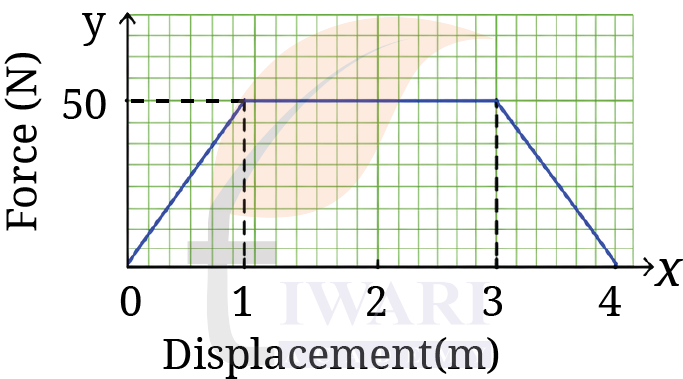
11. A 10.0 kg block is moving on a horizontal floor with negligible friction. As shown in Fig. 7.37, a variable force is applied on the block in its direction of motion from its position at 0 m till 4 m. If the block had a kinetic energy of 180 J when it was at 0 m, find the block’s speed (i) at 0 m, and (ii) at 4 m. Does the block have negative acceleration in any portion of its motion?
Answer:
Given: Mass = 10 kg
Initial KE = 180 J
(i) Speed at 0 m:
KE = ½mv²
⇒ 180 = ½ × 10 × v²
⇒ v² = 36
⇒ v = 6 m/s
Work done = Area under force-displacement graph
From graph:
0–1 m ⇒ triangle = ½ × 1 × 50 = 25 J
1–3 m ⇒ rectangle = 2 × 50 = 100 J
3–4 m ⇒ triangle = ½ × 1 × 50 = 25 J
Total work = 25 + 100 + 25 = 150 J
Final KE = Initial KE + Work = 180 + 150 = 330 J
(ii) Speed at 4 m:
330 = ½ × 10 × v²
⇒ v² = 66
⇒ v = √66 ≈ 8.12 m/s
Negative acceleration:
No, because the force is always in the direction of motion.
12. The gravitational attraction on the surface of the Moon is about 1/6th of that on the surface of the Earth. An astronaut can throw a ball up to a height of 8 m from the surface of the Earth. How far up will the ball thrown with the same upward velocity travel from the surface of the Moon?
Answer:
The maximum height reached by a ball thrown upward depends on the acceleration due to gravity.
Using the relation: h = u² / (2g)
For the same initial velocity (u), height is inversely proportional to g: h ∝ 1/g
Given: Height on Earth = 8 m
Acceleration due to gravity on Moon = (1/6) × g (Earth)
Since gravity on the Moon is 1/6th of that on Earth, the height reached will be 6 times greater.
Height on Moon:
hₘ = 6 × 8
⇒ hₘ = 48 m
The ball will rise up to a height of 48 m on the surface of the Moon.
Due to lower gravitational pull on the Moon, the ball experiences less downward acceleration, allowing it to rise to a greater height for the same initial velocity.
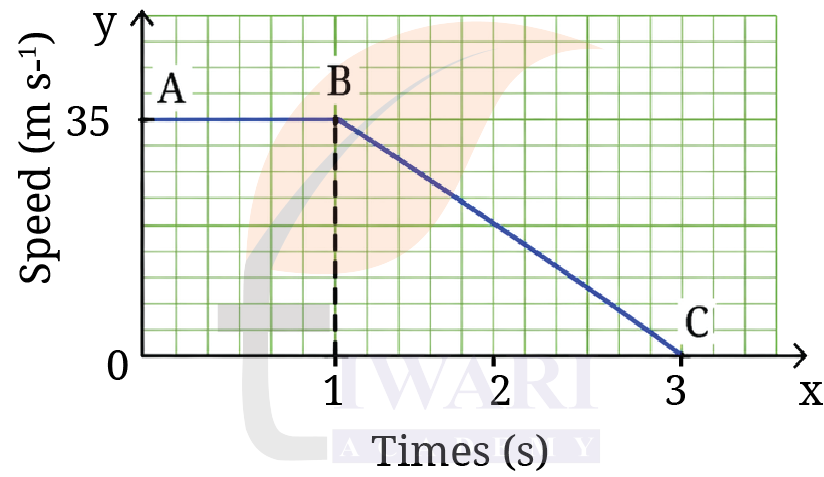
13. A 1000 kg car is moving along a road at a constant speed. Suddenly, the driver notices some obstruction ahead and applies the brakes to come to a complete stop. The graphical representation of motion of the car starting from the instant the driver spots the traffic ahead is shown in Fig. 7.38.
(i) Describe how the car moves between positions A and B.
(ii) Calculate the kinetic energy of the car at A.
(iii) State the work done by the brakes in bringing the car to a halt between B and C.
(iv) What does the kinetic energy of the car transform into?
Answer:
(i) Between A and B, the car moves with a constant speed of 35 m s⁻¹.
This is because the speed-time graph is a horizontal straight line in this interval, which shows that the speed does not change with time. Therefore, the car is in uniform motion and no acceleration acts on it during this part of the motion.
(ii) Given:
Mass of the car, m = 1000 kg
Speed at A, v = 35 m s⁻¹
Kinetic Energy = 1/2 mv²
= 1/2 × 1000 × (35)²
= 500 × 1225
= 612500 J
The kinetic energy of the car at A is 6,12,500 J.
(iii) When the brakes are applied, the car slows down and finally stops at C.
The work done by the brakes is equal to the change in kinetic energy of the car.
Initial kinetic energy at B = 6,12,500 J
Final kinetic energy at C = 0 J
Work done by brakes = Final KE − Initial KE
= 0 − 612500
= −612500 J
The work done by the brakes is −6,12,500 J.
The negative sign shows that the braking force acts opposite to the direction of motion of the car.
(iv) The kinetic energy of the car is mainly transformed into heat energy due to friction between the brake pads and the wheels and also between the tyres and the road. A small part may also be converted into sound energy.
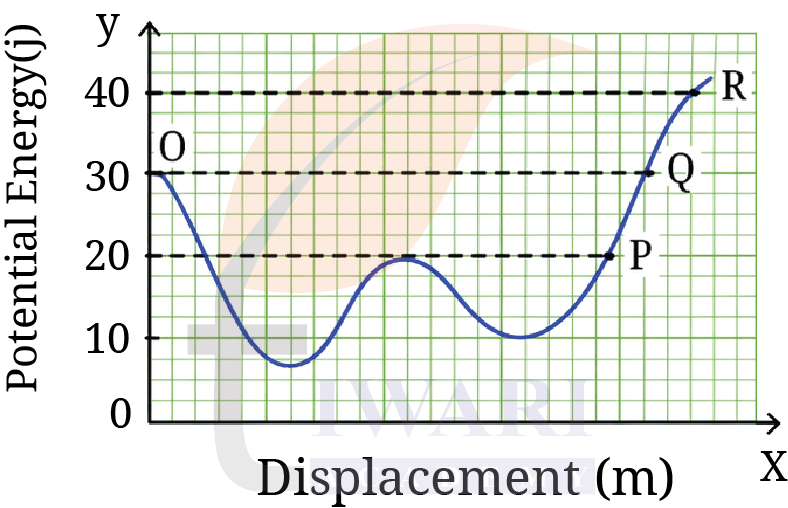
14. The potential energy-displacement graph of a 0.5 kg ball moving along a frictionless track is shown in Fig. 7.39. At O, the velocity of the ball is 0 m s⁻¹ and potential energy is 30 J. Calculate the velocity of the ball at P, Q and R.
Answer:
Mass of the ball, m = 0.5 kg
At point O:
Velocity = 0 m s⁻¹
Potential energy = 30 J
Since the track is frictionless, the total mechanical energy of the ball remains constant.
At O:
Kinetic energy at O = 1/2 mv² = 0
So, total mechanical energy = Potential energy + Kinetic energy
= 30 + 0
= 30 J
Therefore, at every point on the track:
Potential energy + Kinetic energy = 30 J
From the graph:
Potential energy at P = 20 J
Potential energy at Q = 30 J
Potential energy at R = 40 J
Now we calculate the velocity at each point.
At P:
Kinetic energy at P = Total energy − Potential energy at P
= 30 − 20
= 10 J
Using, KE = 1/2 mv²
10 = 1/2 × 0.5 × v²
⇒ 10 = 0.25v²
⇒ v² = 40
⇒ v = √40
⇒ v ≈ 6.32 m s⁻¹
So, velocity at P = 6.32 m s⁻¹
At Q:
Kinetic energy at Q = 30 − 30 = 0 J
Thus, v = 0 m s⁻¹
So, velocity at Q = 0 m s⁻¹
At R: Potential energy at R = 40 J, which is greater than the total mechanical energy (30 J).
This is not possible for the ball because its total energy remains constant at 30 J.
Hence, the ball cannot reach point R.
So, velocity at R cannot be calculated because the ball never reaches R.
Velocity at P = 6.32 m s⁻¹
Velocity at Q = 0 m s⁻¹
The ball cannot reach R.
15. A coconut of mass 1.5 kg falls from the top of a coconut tree onto the wet sand on a beach. The height of the tree is 10 m. On impact, the coconut comes to rest by making a depression in the sand.
(i) Calculate the velocity of the coconut just before it hits the sand.
(ii) Assume that the average resistive force of sand is 3000 N and all of the coconut’s energy is used to create the depression in the sand. Calculate the depth of the depression the coconut makes in the sand. Assume g = 10 m s⁻².
Answer:
(i). Given:
Mass of coconut, m = 1.5 kg
Height, h = 10 m
Acceleration due to gravity, g = 10 m s⁻²
Initial velocity, u = 0
Using the equation: v² = u² + 2gh
⇒ v² = 0 + 2 × 10 × 10
= 200
⇒ v = √200
= 10√2
⇒ v ≈ 14.14 m s⁻¹
The velocity of the coconut just before hitting the sand is 14.14 m s⁻¹.
(ii). Just before striking the sand, the coconut has kinetic energy equal to the loss in potential energy during the fall.
Kinetic energy on impact:
KE = mgh
= 1.5 × 10 × 10
= 150 J
This entire energy is used to do work against the resistive force of sand.
Work done = Force × distance
So, 150 = 3000 × d
d = 150 / 3000
d = 0.05 m
Converting into centimetres:
0.05 m = 5 cm
Exploration Chapter 7 Section-wise Notes
Section 7.1 Work Done by a Constant Force
Scientific definition: Work done = force × displacement in the direction of force
W = F × s
Key conditions for work to be done:
- A force must act on the object
- The object must be displaced
- There must be a component of displacement in the direction of the force
SI Unit: Joule (J)
1 J = 1 N × 1 m = 1 kg m² s⁻²
Work from a force-displacement graph = area under the graph.
7.1.1 When is work done equal to zero?
- Force is zero (F = 0)
- Displacement is zero (s = 0), e.g., pushing a rigid wall
- Force is perpendicular to displacement, e.g., carrying a box while walking horizontally
7.1.2 Positive and Negative Work Done
- Positive work: force and displacement in the same direction, e.g., pushing a wheelchair forward
- Negative work: force and displacement in opposite directions, e.g., goalkeeper stopping a football
Section 7.2 The Work-Energy Theorem
When positive work is done on an object, it gains energy. When negative work is done, it loses energy.
Work-energy theorem: Work done on an object = change in its energy
W = ΔE
This theorem holds for a system of objects and even when forces are not constant.
SI Unit of Energy = Joule (J) — same as work.
The joule is named after scientist James Prescott Joule, who studied the relationship between mechanical and thermal energy.
Section 7.3 Forms of Energy
Energy can exist in many forms:
| Form | Description |
|---|---|
| Mechanical energy | Energy due to motion or position of objects |
| Kinetic energy | Energy due to motion |
| Potential energy | Energy due to position or deformation |
| Thermal energy | Energy that makes things warm or hot |
| Light energy | Energy that allows us to see |
| Sound energy | Energy of vibrations of air or other molecules |
| Electrical energy | Energy related to position or motion of charges |
| Chemical energy | Energy stored in fuels and food (chemical bonds) |
| Nuclear energy | Energy stored in the nuclei of atoms |
Energy can be converted from one form to another. For example:
- Electric bulb: electrical → light + thermal energy
- Ringing bell: mechanical → sound energy
- Food in muscles: chemical → mechanical energy
Section 7.4 Mechanical Energy
Mechanical energy = Kinetic energy + Potential energy
7.4.1 Kinetic Energy
Energy possessed by an object due to its motion.
K = ½mv²
Where m = mass (kg), v = velocity (m/s)
SI Unit: joule (J)
Key points:
- Stationary object: KE = 0
- If velocity doubles, KE becomes 4 times (KE ∝ v²)
- Positive work done → velocity increases → KE increases
- Negative work done → velocity decreases → KE decreases
Derivation: Using W = F × s, F = ma, and v² = u² + 2as:
W = ½mv² − ½mu²
Change in KE = Work done by net force
7.4.2 Potential Energy
Energy stored by an object due to its deformation or due to relative positions in a system.
Types:
- Gravitational potential energy: U = mgh (energy due to height)
- Elastic potential energy: energy stored in stretched/compressed spring, rubber band, bow
- Magnetic potential energy: energy in separated unlike poles
- Electrostatic potential energy: energy in separated charges
Gravitational Potential Energy: U = mgh
Where m = mass (kg), g = 9.8 m/s², h = height (m)
Greater height → greater potential energy
Derived from work-energy theorem: Work done to raise object = mgh = gain in PE
Note: U = mgh is valid only near Earth’s surface where g is approximately constant.
7.4.3 Conservation of Mechanical Energy
For a freely falling object (no friction):
Mechanical energy = KE + PE = constant = mgh at all points
At any point during fall:
Decrease in PE = Increase in KE
Total mechanical energy remains mgh
This is the Law of Conservation of Mechanical Energy:
“When no external forces other than gravity act on an object, its total mechanical energy remains constant.”
Demonstrated by: freely falling object, simple pendulum (bob almost reaches the same height on both sides).
In real life: pendulum slows down due to friction at support and air resistance, some mechanical energy converts to thermal energy.
Section 7.5 Power
Power = Rate at which work is done
P = W/t
SI Unit: watt (W), where 1 W = 1 J/s
Other unit: horsepower (hp); 1 hp = 746 W (named after James Watt who invented the efficient steam engine)
Key points:
- More work in same time → more power
- Same work in less time → more power
- Power does not depend on how much work is done, but how fast it is done
Section 7.6 Simple Machines
Simple machines change the magnitude or direction of the force needed to do a task. They do NOT reduce total work done.
Effort: Force applied to the machine
Load: Force to be overcome
Mechanical Advantage (MA) = load/effort
7.6.1 Pulley
- Fixed pulley: changes direction of force only; MA = 1
- Movable pulley: MA > 1; reduces effort needed
- System of pulleys: even greater MA; used in cranes, elevators
7.6.2 Inclined Plane
- Reduces effort needed to raise a load to a height
- MA = L/h (length of inclined plane / height)
- Longer, shallower incline → greater MA → less effort needed
- Trade-off: less force, but applied over greater distance
Derivation: F’ × L = mgh → MA = mg/F’ = L/h
7.6.3 Lever
- A rigid bar rotating about a fixed point (fulcrum)
- Three parts: fulcrum, load, effort
- Load arm: distance of load from fulcrum
- Effort arm: distance of effort from fulcrum
Principle: effort × effort arm = load × load arm
F1 × d1 = F2 × d2
MA = load/effort = effort arm/load arm
Classes of Levers:
| Class | Position of Fulcrum | Examples |
|---|---|---|
| Class I | Fulcrum in between load and effort | Scissors, seesaw, crowbar, pliers, balance scale |
| Class II | Load in between fulcrum and effort | Lemon squeezer, wheelbarrow, bottle opener |
| Class III | Effort in between fulcrum and load | Tongs, tweezers, broom, hammer, oar |
Machines do not create energy. They only help use energy more effectively.
Quick Revision for Exam Day
- W = F × s — know units; identify positive, negative, zero work
- K = ½mv² — KE doubles when v increases √2 times; quadruples when v doubles
- U = mgh — valid near Earth’s surface only
- Work-energy theorem: W = change in energy
- Conservation of ME: KE + PE = constant (no friction)
- v = √(2gh) — velocity at base of slide; independent of mass
- P = W/t — 1 watt = 1 J/s; 1 hp = 746 W
- MA = load/effort for all machines
- Inclined plane: MA = L/h
- Lever: effort × effort arm = load × load arm; MA = effort arm/load arm
- Three classes of levers — position of fulcrum, load, effort; examples of each
- Machines do NOT reduce total work — only change force magnitude or direction
- Area under force-displacement graph = work done
- Simple pendulum: PE max at extremes; KE max at centre; total ME constant.
Extra Question Answer for Exam Point of View
NCERT Class 9 Science Exploration Chapter 7 Very Short Answer Type Questions with Explanation.
Very Short Answer Type Questions
- Define work done by a constant force.Answer:Work done by a constant force on an object = force applied × displacement in the direction of force. W = F × s. SI unit is joule (J). Work has no direction.
- When is work done on an object equal to zero?Answer:Work done is zero when: (i) force is zero, (ii) displacement is zero (e.g., pushing a wall) or (iii) force acts perpendicular to displacement (e.g., carrying a box horizontally while walking).
- Define 1 joule of work.Answer:One joule of work is done when a constant force of 1 newton displaces an object by 1 metre in the direction of the force. Mathematically: 1 J = 1 N × 1 m = 1 kg m² s⁻².
- What is kinetic energy? Give its formula.Answer:Kinetic energy is the energy possessed by an object due to its motion. Formula: K = ½mv², where m is mass in kg and v is velocity in m/s. SI unit is joule (J).
- What is gravitational potential energy? Give its formula.Answer:Gravitational potential energy is the energy stored in an Earth-object system due to the object’s height above the ground. Formula: U = mgh, where m = mass, g = 9.8 m/s², h = height.
- State the work-energy theorem.Answer:Work done on an object equals the change in its energy: W = ΔE. When positive work is done, energy increases; when negative work is done, energy decreases. It holds for variable forces too.
- Define power and give its SI unit.Answer:Power is defined as the rate at which work is done: P = W/t. SI unit of power is watt (W), where 1 watt = 1 joule per second (1 J/s). Named after James Watt.
- What is mechanical energy?Answer:Mechanical energy is the sum of kinetic energy and potential energy of an object: ME = K + U = ½mv² + mgh. For a freely falling object, mechanical energy remains constant if no friction acts.
- What is a simple machine?Answer:A simple machine is a device that makes work easier by changing the magnitude or direction of an applied force. Simple machines do not reduce total work done. Examples: pulley, inclined plane, lever.
- Define mechanical advantage.Answer:Mechanical advantage is the ratio of load to effort applied on a machine: MA = load/effort. A mechanical advantage greater than 1 means the machine multiplies the applied force to overcome a larger load.
- What is the mechanical advantage of a fixed pulley?Answer:A fixed pulley only changes the direction of the applied force — it does not reduce the magnitude of force needed. Since effort equals load, the mechanical advantage of a fixed pulley is exactly 1.
- Write the formula for mechanical advantage of an inclined plane.Answer:Mechanical advantage of an inclined plane = L/h, where L is the length of the inclined surface and h is the vertical height gained. A longer, shallower incline gives a higher mechanical advantage.
- What is the principle of a lever?Answer:The lever principle states: effort × effort arm = load × load arm. Or F1 × d1 = F2 × d2. By increasing the effort arm, a smaller effort can overcome a larger load. Mechanical advantage = effort arm/load arm.
- If velocity of an object doubles, how does its kinetic energy change?Answer:Kinetic energy K = ½mv². If velocity doubles (2v), KE = ½m(2v)² = 4 × ½mv². Kinetic energy becomes 4 times the original value. KE is proportional to the square of velocity.
- Name the three classes of levers with one example each.Answer:Class I: Fulcrum between load and effort — seesaw, scissorsClass II: Load between fulcrum and effort — wheelbarrow, bottle openerClass III: Effort between fulcrum and load — tweezers, broom
NCERT Class 9 Science Exploration Chapter 7 Short Answer Type Questions with Explanation.
Short Answer Type Questions
- Explain why a person pushing a rigid wall does no work on the wall, yet feels tired.Answer:Scientific work requires both force and displacement. Although the person applies force on the wall, the wall does not move — displacement is zero. Therefore, W = F × s = F × 0 = 0.However, the person’s muscles repeatedly expand and contract internally, consuming the body’s chemical energy. This internal energy expenditure causes tiredness even though no scientific work is done on the wall.
- Why does a goalkeeper do negative work on the football while stopping it?Answer:The goalkeeper applies a force on the ball in the direction opposite to the ball’s motion (backward force on a forward-moving ball). Since force and displacement are in opposite directions, the work done by the goalkeeper is negative: W = F × (−s) = negative. This negative work removes energy from the ball, reducing its velocity to zero.
- Distinguish between kinetic energy and potential energy with one example each.Answer:Kinetic Energy: Energy possessed by an object due to its motion. Formula: K = ½mv². Example: a moving cricket ball possesses kinetic energy and can knock down wickets.Potential Energy: Energy stored due to an object’s position or deformation. Formula: U = mgh (gravitational). Example: a flowerpot raised to a height stores gravitational potential energy; when it falls, this converts to kinetic energy.Both are measured in joules (J).
- A child of mass m slides down a frictionless slide of height h. What is the velocity at the bottom? Does it depend on the mass or shape of the slide?Answer:At the top: PE = mgh, KE = 0. At the bottom: PE = 0, KE = ½mv².By conservation of mechanical energy: mgh = ½mv²Cancelling m from both sides: v = √(2gh)Since mass cancels, the velocity depends only on height h, not on the mass of the child. The shape of the slide also does not matter as long as height h and the absence of friction are the same.
- Explain conservation of mechanical energy using a simple pendulum.Answer:At the extreme position P, the pendulum bob has maximum potential energy (mgh) and zero kinetic energy. As it swings to the lowest position Q, PE converts entirely to kinetic energy — KE is maximum and PE is zero. At the other extreme R, KE converts back to PE. Throughout, total mechanical energy (KE + PE) remains constant at mgh, demonstrating conservation of mechanical energy. In reality, friction at the support and air resistance gradually reduce the total mechanical energy, causing the pendulum to eventually stop.
- How does an inclined plane act as a simple machine? Why does a longer, shallower incline require less effort?Answer:An inclined plane reduces the force needed to raise a heavy object to a height by spreading the work over a longer distance. Using the work-energy theorem: F’ × L = mgh, so F’ = mgh/L. Mechanical advantage = L/h. A longer inclined plane (larger L) for the same height h means a larger MA, so the effort F’ required is proportionally smaller. The total work done (mgh) remains the same — the machine redistributes force and distance but cannot reduce the work itself.
- State the three classes of levers with their characteristic feature and two real-life examples of each.Answer:Class I — Fulcrum lies between load and effort. The effort and load are on opposite sides of the fulcrum. MA can be greater or less than 1. Examples: seesaw, scissors, crowbar, pliers, balance scale.Class II — Load lies between fulcrum and effort. Effort arm is always longer than load arm. MA is always greater than 1. Examples: wheelbarrow, bottle opener, lemon squeezer.Class III — Effort lies between fulcrum and load. Load arm is always longer than effort arm. MA is always less than 1, but speed and range of movement increase. Examples: tweezers, broom, hammer, oar.
- A man runs up a flight of stairs in 10 seconds. His friend walks up the same stairs in 50 seconds. Who does more work and who has more power?Answer:Both the man and his friend travel the same height h and have the same mass m (assume). Therefore, work done = mgh is the same for both. Neither does more work than the other.However, power = W/t. The man takes only 10 seconds while his friend takes 50 seconds for the same work. The man’s power = W/10, and his friend’s power = W/50. Therefore, the man expends 5 times more power than his friend, even though total work is equal.
- Explain energy transformations in a watermill (gharat or panchakki) as described in the chapter.Answer:In a traditional Himalayan watermill (gharat or panchakki), water stored at a height possesses gravitational potential energy. As water flows downhill through a pipe (A), this potential energy converts to kinetic energy. The fast-moving water strikes a wheel (B), transferring its kinetic energy to set the wheel into rotational motion. This rotational kinetic energy is transmitted via a shaft to drive the grinding stone (C) above, which converts rotational energy to mechanical energy for grinding grain. Modern hydroelectric dams use the same principle — stored water’s PE converts to KE which drives turbines to generate electrical energy.
- Why do roads on hills wind around in gentle slopes rather than going straight up? Explain using the concept of inclined planes.Answer:A straight vertical road up a hill would require vehicles to exert a force equal to the full weight of the vehicle (F = mg) to climb — a very large effort. A winding road acts as a long inclined plane with a gentle slope. By increasing the path length L while keeping the height h the same, the mechanical advantage (MA = L/h) increases significantly. This means the engine needs to apply a much smaller force to climb the same height. The total work done (mgh) is the same either way, but the winding road spreads this work over a larger distance, making the effort (force) at any point much smaller and the climb achievable.
NCERT Class 9 Science Exploration Chapter 7 Long Answer Type Questions with Explanation.
Long Answer Type Questions
- Define work done. When is work done zero? Distinguish between positive and negative work with one example each.Answer:Work done by a constant force on an object is the product of the force and the displacement in the direction of the force: W = F × s. SI unit is joule (J).Work done is zero when: (i) force is zero, (ii) displacement is zero (pushing a rigid wall), or (iii) force is perpendicular to displacement (carrying a box horizontally).Positive work: Force and displacement are in the same direction. Example — pushing a wheelchair forward; the applied force and displacement both point forward, so work done by the person on the wheelchair is positive.Negative work: Force and displacement are in opposite directions. Example — a goalkeeper stopping a football; the force applied on the ball is opposite to its motion, so work done is negative.
- Derive the expression for kinetic energy using the work-energy theorem. What happens to kinetic energy when velocity doubles?Answer:Consider an object of mass m starting from rest (u = 0), acted upon by constant force F over displacement s, attaining velocity v.Using kinematics: v² = u² + 2as → s = v²/2aWork done: W = F × s = ma × v²/2a = ½mv²By the work-energy theorem, this work equals the kinetic energy gained:K = ½mv²If velocity doubles from v to 2v:New KE = ½m(2v)² = ½m × 4v² = 4 × ½mv²Kinetic energy becomes 4 times the original. This is because kinetic energy is proportional to the square of velocity (K ∝ v²). This explains why doubling the speed of a vehicle makes it four times harder to stop — the brakes must do four times more work.
- State and explain the Law of Conservation of Mechanical Energy for a freely falling object. Show that mechanical energy remains constant at every point.Answer:Law of Conservation of Mechanical Energy: When no external force other than gravity acts on an object, the total mechanical energy (KE + PE) remains constant.For an object of mass m dropped from height h:At Point A (top): KE = 0, PE = mgh → Total ME = mghAfter falling for time t, reaching Point B at height h’:PE = mgh’ = mgh − ½mg²t²KE = ½mv² = ½mg²t²Total ME = mgh − ½mg²t² + ½mg²t² = mghAt ground (h = 0): KE = mgh, PE = 0 → Total ME = mghAt every point, ME = mgh — constant. The lost potential energy exactly equals the gained kinetic energy, proving conservation of mechanical energy.
- Explain the three simple machines studied in Chapter 7 — pulley, inclined plane, and lever. Give the formula for mechanical advantage of each.Answer:Pulley: A wheel with a groove guiding a rope. A fixed pulley changes only the direction of force — it is easier to pull down than lift directly upward. Since effort equals load, MA = 1. Movable pulleys have MA > 1 and can lift heavier loads with less effort.Inclined Plane: A sloped surface used to raise heavy loads to a height. Using work-energy theorem: F’ × L = mgh → MA = L/h. A longer, shallower incline gives greater MA — the force needed decreases but distance increases. Total work remains constant.Lever: A rigid bar rotating about a fulcrum. Principle: effort × effort arm = load × load arm. MA = effort arm/load arm. Greater effort arm → smaller effort needed. Levers exist in three classes based on relative positions of effort, fulcrum, and load. In all cases, machines reduce force but not total work done.
- Define power. Calculate power in two practical examples from the chapter. Why is the unit watt named after James Watt?Answer:Power is the rate at which work is done: P = W/t. SI unit is watt (W), where 1 W = 1 J/s. The unit honours James Watt, who invented an efficient steam engine capable of generating continuous rotational motion — a landmark in the Industrial Revolution.Example 1 — Weightlifter: A weightlifter lifts a 75 kg mass by 2 m in 5 seconds.Work done = mgh = 75 × 10 × 2 = 1500 JPower = 1500/5 = 300 WExample 2 — Car Engine: A 1000 kg car accelerates from rest to 20 m/s in 10 seconds.Work done = ½mv² = ½ × 1000 × 400 = 200000 JPower = 200000/10 = 20000 W = 20 kWThe key distinction: two workers doing the same work but in different times have the same total energy expenditure but different power outputs. Power measures the speed of energy delivery, not the total amount.
Important Formulae – Class 9 Science Exploration Chapter 7
| Formula | Meaning |
|---|---|
| W = F × s | Work done by constant force |
| 1 J = 1 N × 1 m | Definition of joule |
| K = ½mv² | Kinetic energy |
| W = ½mv² − ½mu² | Work-energy theorem (change in KE) |
| U = mgh | Gravitational potential energy |
| ME = K + U = constant | Conservation of mechanical energy |
| P = W/t | Power |
| 1 W = 1 J/s | Definition of watt |
| MA = load/effort | Mechanical advantage (all machines) |
| MA = L/h | Mechanical advantage of inclined plane |
| MA = effort arm/load arm | Mechanical advantage of lever |
| F1 × d1 = F2 × d2 | Lever principle |
| effort × effort arm = load × load arm | Lever balance condition |
| v = √(2gh) | Velocity at bottom of slide/during free fall from height h |