Showing posts with label SSIQ 9TH EM. Show all posts

Important Questions for Class 9 Social Science


Important Questions for CBSE Class 9 Social Science

Important Questions for Class 9 Social Science History

Important Questions for Class 9 Social Science Geography

Important Questions for Class 9 Social Science Civics

Important Questions for Class 9 Social Science Economics

Food Security in India Class 9 Important Questions Social Science Economics Chapter 4


Food Security in India Class 9 Important Questions Social Science Economics Chapter 4

Important Questions for Class 9 Social Science Economics Chapter 4 Food Security in India

Food Security in India Class 9 Important Questions Very Short Answer Type Questions

Question 1.
What is food security?
Answer:
Food security means availability, accessibility and affordability of food to all people at all times.

Question 2.
Name any two factors on which the food security depends upon.
Answer:

  • Buffer stock.
  • Public Distribution System (PDS).
  • Vigilancy of the government at the time of natural calamity.
  • Food production.

Question 3.
Name the two dimensions of hunger.
Answer:
Chronic: It is a consequence of diets persistently inadequate in terms of quantity and/or quality.
Seasonal: It is related to the cycles of food growing and harvesting.

Question 4.
Mention any two factors responsible for seasonal hunger.
Answer:

  • Seasonal hunger is related to the cycle of food growing and harvesting. This is prevalent in rural areas because of the seasonal nature of agricultural activities.
  • Seasonal hunger is prevalent in urban areas due to lack of job opportunities.

Question 5.
What is chronic hunger? Name any one factor responsible for chronic hunger.
Answer:
It is a consequence of diets persistently inadequate in terms of quantity and/or quality. Very low income is one of the basic cause of chronic hunger.

Question 6.
Define Green Revolution.[CBSE 2015]
Answer:
The Green Revolution implies large increase in agricultural production due to use of high yielding varieties of seeds and other inputs such as manure, fertilizers, etc.

Question 7.
What is buffer stock?
Answer:
Buffer stock is the stock of foodgrains, namely wheat and rice procured by the government through Food Corporation of India (FCI).

Question 8.
What is minimum support price?[CBSE 2015]
Answer:
The farmers are paid a pre-announced price for their crops. This price is called Minimum Support Price. The MSP is before the sowing season to provide incentives to the farmers for raising the production of these crops declared by the government every year.

Question 9.
What is issue price? [CBSE 2015]
Answer:
It is a price at which foodgrains are distributed in the deficit areas and among the poorer strata of society at a price lower than the market price.

Question 10.
What are the functions of the FCI? Mention any two.
Answer:

  • The Food Cooperation of India or FCI purchases wheat and rice from the farmers in the states, where there is surplus production.
  • It also builds the buffer stock.

Question 11.
What is Public Distribution System (PDS)?
Answer:
Under public distribution system or the PDS, the Government has opened more than 4.6 lakh ration shops all over the country to distribute foodgrains and other essential goods to the poor people at reasonable rates.

Question 12.
What is the Targeted Public Distribution System?
Answer:
In order to ensure availability of minimum quantity of food grains to the families living below the poverty line, the Government launched the TPDS or the Targeted Public Distribution System in June 1997. It was intended to benefit about six crore poor families in the country for whom a quantum of 72 lakh tonnes of foodgrains was earmar- ked annually at the rate of 10kg per family per month.
It was introduced to adopt the principle of targeting the ‘poor in all areas’.

Question 13.
Name any two Yojanas introduced with one objective of each for food security.
Answer:

  • National Food for Work Programme: Under this, foodgrains are provided to the states free of cost.
  • Antyodaya Anna Yojana: Under this 25 kg of food- grains were made available to each eligible family at a subsidised price.

Question 14.
Mention any two limitations of the Public Distribution System (PDS).
Answer:

  • Resorting of PDS dealers to malpractices.
  • Irregular opening of shops.

Question 15.
What are cooperative societies?
Answer:
The cooperative societies are the societies which are run by the local people, who are democratically elected by the people. These cooperative societies provide people the basic necessities of life like foodgrains, milk, vegetables, etc. at reasonable rates.

Question 16.
Mention the names of any four cooperative societies working in different states of India.
Answer:

  • Mother Dairy- Delhi
  • Amul-Gujarat
  • Verka-Punjab
  • Academy of Development Science- Maharashtra

Question 17.
What is a subsidy?
Answer:
A subsidy is a payment that a government makes to a producer to supplement the market price of a commodity. Subsidies can keep consumer prices low while maintaining a higher income for domestic producers.

Food Security in India Class 9 Important Questions Short Answer Type Questions

Question 1.
Explain the major dimensions of food security.
Answer:
Food security has the following dimensions:

  • Availability of food: It means food production within the country, food imports and the previous years stock stored in government granaries.
  • Accessibility: It means food is within reach of every person.
  • Affordability: It implies that an individual has enough money to buy sufficient, safe and nutritious food to meet one’s dietary needs.

Question 2.
Mention the major features of Public Distribution system of India.
Answer:

  • The PDS has proved to be the most effective instrument of government policy over the years in stabilising prices and making food available to consumers at affordable prices.
  • It has been instrumental in averting widespread hunger and famine by supplying food from surplus regions of the country to the deficit ones.
  • The system, including the minimum support price and procurement has contributed to an increase in foodgrain production and provided income security to farmers in certain regions.
  • It has minimized hoarding and black marketing.

Question 3.
What are the limitations of the public distribution system?  [CBSE 2015]
Answer:

  • Failed to remove hunger: The PDS has been working for many years but still hunger is prevailing in the Indian society.
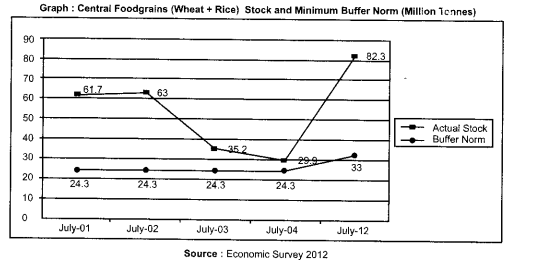
  • Overflowing godowns: The FCI godowns are overflowing with foodgrains. In 2012 the stock of wheat and rice was 82.3 million tonnes which was much more than the minimum stock. There is a general consensus that high level of buffer stock of foodgrains is very undesirable and can be wasteful.
  • Poor foodgrain quality: As most of godowns have more stock than their capacity, this leads to deterioration in grain quality.
  • Adverse impact on the environment: Due to incentive by the government most of the states are producing only rice and wheat. The intensive utilization of water in the cultivation of rice has led to environmental degradation and fall in the water level, threatening the sustain- ability of the agricultural development in many states.

Question 4.
How is food security ensured in India?
Answer:
Food security in India has two components:
(a) Buffer stock
(b) Public distribution system.
(a) Buffer Stock: Buffer Stock is the stock of foodgrains, namely wheat and rice procured by the government through Food Corporation of India (FCI). The FCI purchases wheat and rice from the farmers in states where there is surplus production.

The purchased foodgrains are stored in granaries. This is done to distribute foodgrains in the deficit areas and among the poorer strata of society at a price lower than the market price, also known as Issue Price. This helps in resolving the problem of shortage of food.

(b) Public distribution system: The stored food is distributed to the poor people through ration shops. The items are sold to the poor people at a price lower than the market price.
Other schemes: Over the years, several new programmes have been launched like mid-day meal, Antyodaya Ana Yojana, etc. for food security.

Question 5.
Why is buffer stock created by the Government?
Answer:

  • Food security: The main objective of the buffer stock is to distribute the foodgrains in the deficit areas and among the poorer strata of society at a price lower than the market price.
  • Disaster or Calamity: The second objective of the buffer stock is to resolve the problem of shortage of food during adverse weather conditions or during the period of calamity.
  • To save the farmers from the ups and downs of the market: The third important objective of the buffer stock is to save the farmers from ups and downs of the market. Under this farmers are paid a preannounced price for their crops. This price is declared by the government before the sowing season to provide incentives to the farmers.
  • Uninterrupted supply of foodgrains: Buffer stocks are also created by the government to maintain uninterrupted supply of foodgrains throughout India and throughout the year.

Question 6.
Write a note on the role of cooperatives in providing food and related items.
Answer:

  • The cooperatives are also playing an important role in food security in India especially in the southern and western parts of the country.
  • The cooperative societies set up shops to sell low priced goods to poor people. For example, out of all fair price shops running in Tamil Nadu, around 94 per cent are being run by the cooperatives.
  • Many milk purchasing cooperatives like Verka, Mother Dairy, Amul, etc. have brought about the White Revolution in the country.
  • These are a few examples of many more cooperatives running in different parts of the country ensuring food security of different sections of society.

Food Security in India Class 9 Important Questions Long Answer Type Questions

Question 1.
Discuss the major reasons for poverty in India/CBSE March 2012]
Or
Explain any three causes for the widespread poverty in India.[CBSE March 2012,13,15]
Answer:

  • British Rule: Britishers ruled India more than 100 years. Prior to the British rule, traditional industries, for instance, textiles, flourished in India. During the British rule, the government adopted policies to discourage such industries. This left millions of weavers poor. Even after fifty years of independent India, we can find a major section of the people engaged handicraft industries as downtrodden.
  • Lack of industrialisation: India is very backward from the industrial point of view. Hardly 3 per cent of the total working population is engaged in the large- scale industry.
  • Over dependence on agriculture: Even after more than 60 years of independence more than 60 per cent of our total population still depends on agriculture for its livelihood. Due to shortage of inputs, our agriculture is backward.
  • Inflationary pressure: Upward trend in prices adversely affects the poor sections of the society.
  • Unemployment: Due to lack of job opportunities, more than 90 lakhs of our total working force is unemployed.

Question 2.
Explain the major limitations of Public Distribution System.
Answer:

  • Stock higher than buffer norms: The actual stock has always remained higher than the buffer. There is a general consensus that high level of buffer stocks of food- grains is very undesirable and can be wasteful. The storage of massive food stocks has been responsible for high carrying costs, in addition to wastage and deterioration in grain quality.
  • High burden on the economy: The Minimum Support Price for food grains has risen very sharply in the recent years leading to a very high burden on state exchequer.
  • Threat to sustainability of agriculture: The intensive utilisation of water in the cultivation of rice has also led to environmental degrada-tion and fall in the water level, threatening the sustainability of the agricultural development in many states.
  • Marked ineffectiveness: Another major area of concern is the marked ineffectiveness of PDS, which is apparent from the fact that the average consumption of PDS grain at the all-India level is only 1 kg per person per month. The average consumption figure is as low as less than 300 gm per person per month in the states of Bihar, Orissa and Uttar Pradesh.
  • Corrupt dealers: PDS dealers are sometimes found resorting to malpractices like diverting the grains to open market to get better margin, selling poor quality grains at ration shops, irregular opening of the shops, etc. It is common to find that ration shops regularly have unsold stocks of poor quality grains left.

Food Security in India Class 9 Important Questions Higher Prefer Thinking Skills (Hots) Questions

Question 1.
Study the graph and answer the following questions:
Food Security in India Class 9 Important Questions Economics Chapter 4 1
(i) In which recent year foodgrain stock with the government was maximum?
(ii) What was the minimum buffer stock norm in 2012?
(iii) Why were the FCI granaries overflowing with foodgrains?
(iv) What is buffer stock?
(v) Why is there general consensus that high level of buffer stock of foodgrains is very undesirable?
Answer:

  • July, 2012.
  • 33 million tonnes.
  • The PDS or the Public Distribution System has failed to distribute foodgrains through the fair price shops.
  • A stock of foodgrains procured by the government to distribute in deficit areas and among the poor strata of society.
  • The higher level of buffer stock can be wasteful. The storage of massive food stock has been responsible for high carrying costs in adition to wastage and deterioration in grain quality.

Question 2.
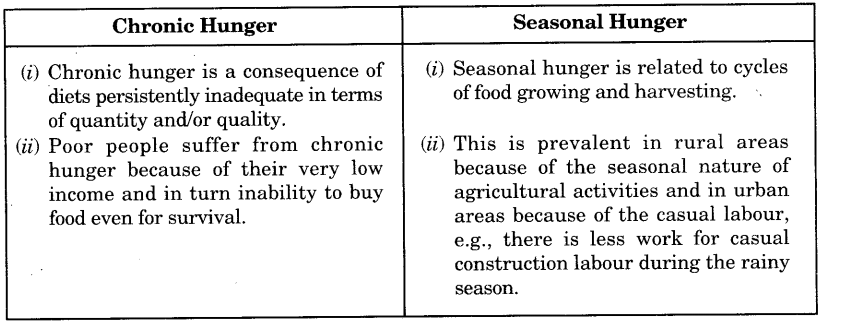
Distinguish between chronic and seasonal hunger.
Answer:
Food Security in India Class 9 Important Questions Economics Chapter 4 2

Food Security in India Class 9 Important Questions Value Based Questions

Question 1.
Which are the people who are prone to food insecurity in India?
Answer:

  • Food insecure in rural areas: Although a large section of people suffer from food and nutrition insecurity in India, the worst affected groups are landless people , with little or no land to depend upon, traditional artisans, providers of traditional services, petty self employed workers and destitutes including beggars.
  • Food insecure in urban areas: In the urban areas, the food insecure families are those whose working members are generally employed in ill-paid occupations and casual labour market. These workers are largely engaged in seasonal activities and are paid very low wages that just ensure bare survival.
  • Social composition and food insecurity: The social composition along with the inability to buy food also plays a role in food insecurity. The SCs, STs and some sections of the OBCs (lower castes among them) who have either poor land-base or very low land productivity are prone to food insecurity.
  • Migrants and people affected by natural disasters: The people affected by natural disasters, who have to migrate to other areas in search of work, are also among the most food insecure people.
  • Food insecurity within a family: A high incidence of malnutrition prevails among women. This is a matter of serious concern as it puts even the unborn baby at the risk of malnutrition. A large proportion Of pregnant and nursing mothers and children under the age of 5 years constitute an important segment of the food insecure population.

Question 2.
Explain the role of Public Distribution System in food security.
Or
How does PDS ensures food security in India? (CBSE 2014)
Or
Mention major features of Public Distribution System in India.[CBSE 2012,13]
Answer:

  • Government regulated shops: The food procured by the FCI is distributed through government regulated ration shops among the poorer section of the society. This is called the public distribution system (PDS). Ration shops are now present in most localities, villages, towns and cities. There are about 5.5 lakh ration shops all over the country.
  • Food at lower cost: Ration shops also known as Fair Price Shops keep stock of foodgrains, sugar, kerosene oil for cooking. These items are sold to people at a price lower than the market price.
  • Stabilising prices: The PDS has proved to be the most effective instrument of government policy over the years in stabilising prices and making food available to consumers at affordable prices. It has been instrumental in averting widespread hunger and famine by supplying food from surplus regions of the country to the deficit ones.
  • Increase in food production: The system, including the minimum support price and procurement has contributed to an increase in foodgrain production and provided income security to farmers in certain regions.

Question 3.
Name the place a poor person should go to purchase essential goods at reasonable rates.
Answer:
Fair price shop

Question 4.
Your family comes under poorest of the poor. Under which of the government scheme you can get cheap ration?
Answer:
Antyodaya Anna Yojana.

Question 5.
Why is there a need for food security in India? Suggest any two points.
Answer:

  • Poverty.
  • Hoarding and black marke- ting.

Question 6.
What are the functions of the FCI? Mention any two functions.
Answer:

  • To make the foodgrains available to the poor a reasonable price.
  • To maintain a price stability of foodgrains.

Poverty as a Challenge Class 9 Important Questions Social Science Economics Chapter 3


Poverty as a Challenge Class 9 Important Questions Social Science Economics Chapter 3

Important Questions for Class 9 Social Science Economics Chapter 3 Poverty as a Challenge

Poverty as a Challenge Class 9 Important Questions Very Short Answer Type Questions

Question 1.
What is poverty? [CBSE 2015]
Answer:
Poverty is a situation in which a person is unable to get the minimum basic necessities of life, i.e., food, clothing and shelter for his or her sustenance.

Question 2.
What is mass poverty?
Answer:
Mass poverty is a situation in which a large section of people in economy are deprived of the basic necessities.

Question 3.
What is BPL?
Or
What is Poverty Line?
Answer:
In India, the concept of Poverty line is used as a measure of absolute poverty. So BPL (Below Poverty Line) is a line which demarcate the people, who are living below the poverty from those, who are living above the poverty line.

Question 4.
Mention any two indicators of poverty.
Answer:

  • Level of income.
  • Level of consumption.

Question 5.
Name any two poverty and unemployment alleviation programmes which have been initiated by the government to remove poverty and unemployment in rural areas.
Answer:

  • The Rural Landless Employment Guarantee Programme.
  • Integrated Rural Development Programmer of IRDP.

Question 6.
What is the accepted average calorie requirement in India
(i) In rural areas
(ii) In urban areas
(iii) Why calorie requirement is higher in the rural areas?
Answer:
(i) 2400 calories
(ii) 2100 calories
(iii) Since people living in rural areas engage themselves in more physical work, so calorie requirement in rural areas is higher than in the urban areas.

Question 7.
How is the poverty line estimated periodically? Name an organisation which is responsible for estimating poverty. [CBSE 2015]
Answer:
The poverty line is estimated periodically by conducting sample surveys.
These surveys are carried out by the National Sample Survey Organisation. (NSSO).

Question 8.
Name any four poverty ridden states.
Answer:
Odisha, Bihar, Assam and Tripura.

Question 9.
Define poverty with contest to World Bank. Name any four countries which have high percentage of population living below poverty.
Answer:
All those persons who live on less than $1.25 per day are considered living below poverty line.

  • Nigeria
  • Bangladesh
  • India
  • Pakistan

Question 10.
‘The current anti- poverty strategy of the government is based broadly on two planks’. Name the two planks.
Answer:

  • Promotion of economic growth.
  • Targeted anti-poverty programmes.

Question 11.
Name a poverty alleviation programme for rural areas with its objectives.
Answer:
Rural Employment Generation Programme.

  • The aim of the programme is to create self-employment opportunities in rural areas and small towns.
  • A target for creating 25 lakhs new jobs has been set for the programme under the Tenth Five Year plan.

Question 12.
Name any two social groups which are most vulnerable to poverty.
Answer:
Scheduled Caste(SC) and Scheduled Tribe(ST).

Question 13.
Mention any one historical reason for poverty.
Answer:
Low level of economic development under the British.

Question 14.
Name the Act through which a poor person can get 100 days assured employment.
Answer:
National Rural Employment Guarantee Act.

Question 15.
Name a scheme which was launched to create self-employment opportunities for the educated youth in the rural areas.
Answer:
The Prime Minister Rozgar Yojana.

Poverty as a Challenge Class 9 Important Questions Short Answer Type Questions

Question 1.
‘One historical reason is the low level of economic development under the British colonial administration.’ Explain.
Answer:

  • The policies of the colonial government ruined traditional handicrafts and discouraged development of industries like textiles.
  • The low rate of growth persisted until the nineteen eighties. This resulted in less job opportunities and low growth rate of incomes.
  • This was accompanied by a high growth rate of population. The two combined to make the growth rate of per capita income very low. The failure at both the fronts: promotion of economic growth and population control perpetuated the cycle of poverty.

Question 2.
Discuss the major reasons for poverty in India.
Answer:

  • Lack of industrialisation: India is very backward from the industrial point of view. Hardly 3 per cent of the total working population is engaged in the large- scale industry.
  • Over dependence on agri-culture: Even after more than 60 years of independence more than 60 per cent of our total population still depends on agriculture for its livelihood. Due to shortage of inputs, our agriculture is backward.
  • Inflationary pressure: Upward trend in prices adversely affects the poor sections of the society.
  • Unemployment: Due to lack of job opportunities, more than 90 lakhs of our total working force is unemployed.

Question 3.
What are the major objectives of the Prime Minister Rozgar Yojana?
Answer:

  • The Yojana was launched in 1993.
  • The aim of the programme is to create self-employment opportunities for educated unemployed youth in rural areas and small towns.
  • Under this unemployed are helped in setting up small business and industries.

Question 4.
Which of the main factor responsible for the reduction of poverty in the following states:
(i) Punjab
(ii) Kerala
(iii) West Bengal
(iv) Tamil Nadu
Answer:
(i) Punjab: Povety has been reduced due to high agricultural growth rate.
(ii) Kerala: Poverty has been reduced through human resource development.
(iii) West Bengal: Poverty has been . reduced through land reform measures.
(iv) Tamil Nadu: Poverty has been reduced through proper public distribution system.

Question 5.
Give an account of the inter-state disparities in poverty in India.[CBSE2014]
Answer:

  • States with poverty ratio more than the national average: Orissa, Bihar, Assam, Tripura and Uttar Pradesh are the most poverty ridden states of India. The poverty ratio in these states is much higher than the national average. Orissa and Bihar are the poorest states with poverty ratio of 47 and 43 respectively. Most of these states are facing rural as well as urban poverty.
  • States with poverty ratio less than the national average: Recent studies show that in 20 states and union territories, the poverty ratio is less than the national average. There has been a significant decline in poverty ratio in Kerala, Andhra Pradesh, Tamil Nadu, Gujarat and West Bengal.
  • States with low poverty ratio: States like Punjab, Haryana, Goa, Himachal Pradesh and Jammu Kashmir have very low percentage of population living below the poverty line.

Question 6.
Answer the following questions briefly:
(i) What do you understand by human poverty?
(ii) Who are the poorest of the poor?
(iii) What are the main features of the National Rural Employ¬ment Guarantee Act, 2005?
Answer:
(i) Human poverty is a broader concept of poverty. Along with food it also includes other necessities of life like education, shelter, health care, job, security, social equality, etc.
(ii) Apart from the social groups, there is also inequality of incomes within a family. In poor families, all suffer, but some suffer more than others. Women, elderly people and female infants are systematically denied equal access to resources available to the family. Therefore, women, children (especially the girl child) and old people are the poorest of the poor.
(iii) 1. The National Rural Employment Guarantee Act (NREGA) 2005 was passed in September 2005.
2. The act provides 100 days assured employment to every rural household in 200 districts.
3. Later, the scheme will be extended to 600 districts. One- third of the proposed jobs would be reserved for women.
4. The central government will also establish National Employment Guarantee Funds.
5. Similarly, state governments will establish State Employment Guarantee Funds for implementation of the scheme.
6. Under the programme, if an applicant is not provided employment within fifteen days, he/she will be entitled to a daily unemployment allowance.

Question 7.
“There is a strong link between economic growth and poverty reduction.” Explain.
Answer.

  • Over a period of thirty years lasting up to the early eighties, there were little per capita income growth and not much reduction in poverty. Official poverty estimates which were about 45 per cent in the early 1950s remained the same even in the early eighties.
  • Since the eighties, India’s economic growth has been one of the fastest in the world. The growth rate jumped from the average of about 3.5% a year in the 1970s to about 6 % cent during the 1980s and 1990s. The higher growth rates have helped significantly in the reduction of poverty.
  • Economic growth widens opportunities and provides the resources needed to invest in human development.

Question 8.
‘The results of poverty alleviation programmes have been mixed.’ Give any four reasons.
Answer:

  • One of the major reason for less effectiveness is the lack of proper implementation and right targeting.
  • There has been a lot of overlapping of schemes.
  • Overpopulation
  • Corruption

Poverty as a Challenge Class 9 Important Questions Long Answer Type Questions

Question 1.
What are the major features of poverty? Explain.
Answer:

  • It also is a situation in which parents are not able to send their children to school or a situation where sick people cannot afford treatment.
  • Poverty also means lack of clean water and sanitation facilities.
  • It also means lack of regular job at a minimum decent level. Above all it means living with a sense of helplessness.
  • Poor people are in a situation in which they are ill-treated at almost every place, in farms, factories, government offices, hospitals, railway stations etc.
  • Poverty when looked through other social indicators like illiteracy level, lack of general resistance due to malnutrition, lack of access to healthcare, lack of job opportunities, lack of access to safe drinking water, sanitation etc.

Question 2.
Describe the poverty trends in India since 1973. [CBSE March 2011,12]
Answer:

  • There has been a substantial decline in poverty ratios in India from about 55 per cent in 1973 to 30 per cent in 2009-10.
  • More than 56% of rural population was living below poverty in 1973 which has come down to 34%.
  • Around about 50 % of urban population was living below poverty in 1973 which has come down to 27%.
  • Although the percentage of people living under poverty declined in the earlier two decades (1973-1993), the number of poor remained stable around 320 million for a fairly long period.
    • If the trend continues, people below poverty line may come down to less than 20 per cent in the next few years.

Question 3.
Identify the various groups vulnerable to poverty. [CBSE 2014]
Or
“The proportion of people below poverty line is also not same for all social groups and economic categories in India.” Explain.
Answer:

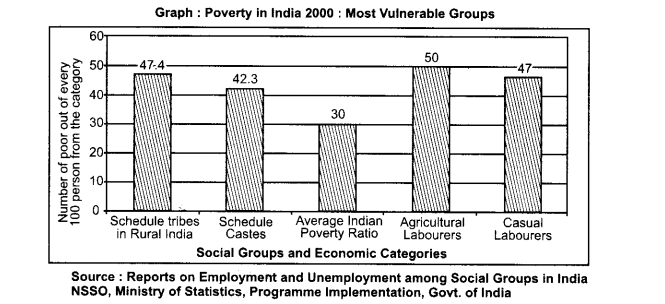
  • Social Groups: The social groups which are most vulnerable to poverty are scheduled caste and scheduled tribe households. Although the average for people below poverty line for all groups in India is 30, 48 out of 100 people belonging to scheduled tribes in rural areas are not able to meet their basic needs.
  • Economic groups: Similarly among the economic groups, the most vulnerable groups are the rural agricultural labour households and the urban casual labour households.
  • Inequality with in family: Apart from these social groups, there is also inequality of incomes within a family. In poor families all suffer, but some suffer more than others. Women, elderly people and female infants are systematically denied equal access to resources available to the family.

Therefore women, children (especially the girl child) and old people are poorest of the poor.

Question 4.
Explain some measures which have been taken by the government to remove poverty. [CBSE 2015]
Or
Describe the current government strategy to remove poverty in India.
Answer:
To remove poverty government has adopted two approaches:

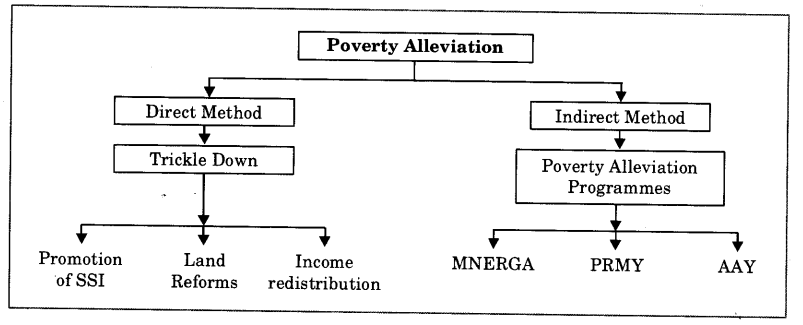
  • Indirect approach: This covers achieving high economic growth rate, promotion of small scale industry, promotion of agriculture. This approach is also referred as trickle down effect. It was assumed that the development of industry and agriculture would create employment opportunities and income, which would lead to rapid economic development.
  • Direct approach: Under direct approach government has launched various poverty alleviation programmes and food schemes to target the poor directly.

The government has launched various poverty alleviation schemes to control poverty.

(i) National Rural Employ-ment Guarantee Act (NREGA) 2005: It was passed in September 2005. The Act provides 100 days assured employment every year to every rural household in 200 districts. Later, the scheme will be extended to 600 districts. One-third of the proposed jobs would be reserved for women. The central government will also establish National Employment Guarantee Funds. Similarly, state governments will establish State Employment Guarantee Funds for the implementation of the scheme. Under the programme, if an applicant is not provided employment within fifteen days, he/she will be entitled to a daily unemployment allowance.

(ii) National Food for Work Programme (NFWP): It was launched in 2004 in 150 most backward districts of the country. The programme is open to all rural poor, who are in need of wage employment, and desire to do manual unskilled work. It is implemented as a 100 per cent centrally sponsored scheme, and food grains are provided free of cost to the states. Once the NREGA is in force, the NFWP will be subsumed within this programme.

(iii) The Prime Minister Rozgar Yojana (PMRY): It was started in 1993. The aim of the programme is to create self-employment opportunities for the educated unemployed youth in rural areas and small towns. They are helped in setting up small business and industries.

(iv) Rural Employment Generation Programme (REGP): It was launched in 1995. The aim of the programme is to create self-employment opportunities in rural areas and small towns. A target for creating 25 lakh new jobs has been set for the programme under the Tenth Five Year Plan.

(v) Swamajayanti Gram Swarozgar Yojana (SGSY): It was launched in 1999. The programme aims at bringing the assisted poor families
above the poverty line by organising them into self-help groups through a j mix of bank credit and government subsidy.

(vi) Pradhan Mantri Gramodaya Yojana (PMGY): It was launched in 2000, additional central assistance is given to states for basic services such as primary health, primary education, rural shelter, rural drinking water and rural electrification.
Poverty as a Challenge Class 9 Important Questions Economics Chapter 3 1

Question 5.
Explain any three major reasons for a widespread poverty in India.
Or
Discuss the major reasons for poverty in India. [CBSE 2015]
Answer:

  • British Rule: Britishers ruled India more than 100 years. Prior to the British rule, traditional industries, for instance, textiles, flourished in India. During the British rule, the government adopted policies to discourage such industries. This left millions of weavers poor. Even after fifty years of independent India, we can find a major section of the people engaged handicraft industries as , downtrodden.
  • Lack of industrialisation: India is very backward from the industrial point of view. Hardly 3 per cent of the total working population is engaged in the large- scale industry.
  • Over dependence on agriculture Even after more than 60 years of independence more than 60 per cent of our total population still depends on agriculture for its livelihood. Due to shortage of inputs, our agriculture is backward.
  • Inflationary pressure: Upward trend in prices adversely affects the poor sections of the society.
  •  Unemployment: Due to lack of job opportunities, more than 90 lakhs of our total working force is unemployed.

Poverty as a Challenge Class 9 Important Questions Higher Order Thinking Skills (Hots) Questions

Question 1.
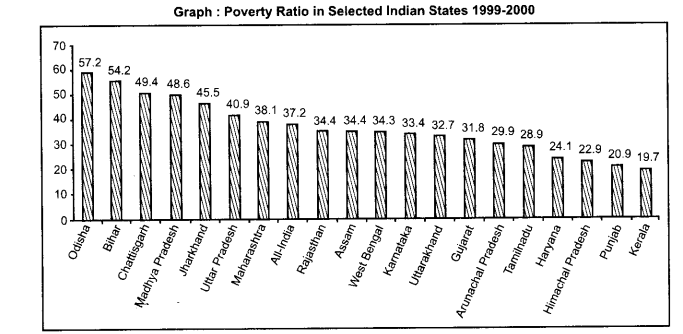
Study the given bar graph carefully, and answer the following questions:
Poverty as a Challenge Class 9 Important Questions Economics Chapter 3 2
Source: Economic Survey 2001-02, Ministry of Finance, Government of India.
(i) Identify the three states where the poverty ratio is the highest.
(ii) Identify the three states where poverty ratio is the lowest.
(iii) Why the states named by you in part (i) have a high poverty ratio?
(iv) Why the states named by you in part (ii) have a low poverty ratio? Mention one reason.
Answer:
(i) Odisha, Bihar and Chattisgarh.
(ii) Himachal Pradesh, Punjab and Kerala.
(iii) Due to lack of job opportunities and high density of population.
(iv) Due to availability of work.
Poverty as a Challenge Class 9 Important Questions Economics Chapter 3 3

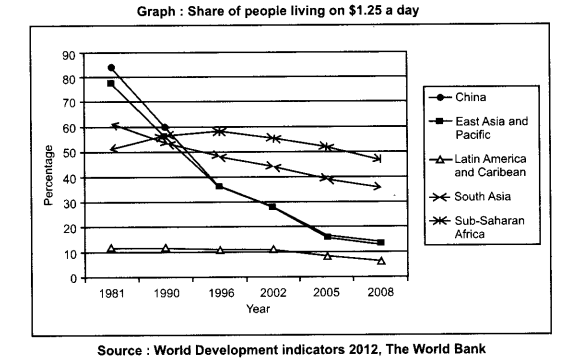
Question 2.
Study the given figure carefully, and answer the following questions:
(i) Which area/country of the world had the largest concentration of poor in 1981?
(ii) Name the regions/countries where poverty has decreased (any two).
(iii) Whether the poverty in South Asia is increasing or decreasing. Give reason.
Answer:
(i) China.
(ii) China, East Asia and the Pacific.
(iii) Poverty in South Asia is decreasing. In 1981 more than 50 per cent of the population
was living below the poverty line, but in 2001, it was approximately 30 per cent.

Question 3.
Study the given bar graph carefully, and answer the following questions:
(i) Name any two social groups are highly vulnerable to poverty.
(ii) What is an average Indian poverty ratio?
(iii) Name any two economic groups which are highly vulnerable to poverty.
Answer:
(i) Scheduled tribes arid Scheduled castes.
(ii) 30 per cent.
(iii) Rural agricultural labourer households and the urban casual labour households.
Poverty as a Challenge Class 9 Important Questions Economics Chapter 3 4

Poverty as a Challenge Class 9 Important Questions Value Based Questions

Question 1.
Suggest any four ways to reduce poverty in India. [CBSE 2015]
Answer:

  • There is need to invest in agriculture and industrial sector. The investment in both these sectors will lead to higher economic growth. The higher economic growth rate is expected to provide to more economic opportunities.
  • Increasing stress on universal free elementary education will help in the formation of human capital.
  • There is need to check high birth rate. The high birth rate leads to a mismatch between resources and population.
  • There is need for to empower women and economically weaker sections of society.

Question 2.
What is the basic aim of following poverty alleviation programmes?
(i) Prime Minister Rozgar Yozana (PMRY).
(ii) Rural Employment Gener¬ation Programme (REGP).
Answer:
(i) The scheme which was started in 1993. The aim of the programme is to create self-employment opportunities for educated unemployed youth in rural areas and small towns. They are helped in setting up small business and industries.
(ii) Rural Employment Generation Programme (REGP) The aim of the programme is to create self employment opportunities in rural areas and small towns and to develop entrepreneurial skill and attitude among rural unemployed youth.

Question 3.
Mention any two causes of poverty in India.
Answer:

  • High growth rate of population.
  • Lack of job opportunities in the secondary sector.

Question 4.
How can poverty be reduced in future in India? Suggest any two points.
Answer:

  • Better Economic growth.
  • Increasing stress on universal free elementary education.

Question 5.
“Poverty is a curse upon humanity.” Explain by giving two examples.[CBSE 2015]
Answer:

  • Poverty is a curse because most of the poor people live with a sense of helplessnes.
  • Poor people are debarred from the basic necessity if life, i.e. good health, drinking water etc.

People as Resource Class 9 Important Questions Social Science Economics Chapter 2


People as Resource Class 9 Important Questions Social Science Economics Chapter 2

Important Questions for Class 9 Social Science Economics Chapter 2 People as Resource

People as Resource Class 9 Important Questions Very Short Answer Type Questions

Question 1.
What is human capital?
Answer:
Human capital is the stock of skilled and productive work force of a nation.

Question 2.
How can the population of a nation becomes human capital?
Answer:
Population of a nation becomes human capital through education, training and medical care.

Question 3.
Which type of investment is known as human capital investment?
Answer:
The investment made in the form of education, training and medical care is known as human capital investment.

Question 4.
How is human capital superior to other resources?
Or
Why is human resource considered to be the best resource? Explain.
Answer:
Human capital can make use of land and capital for further production, whereas land and capital cannot become useful on its own.

Question 5.
Name any four factors which can improve the quality of human resources.
Answer:

  • Education,
  • Health,
  • Training,
  • Technology.

Question 6.
Mention any four factors on which the quality of population depends.
Answer:

  • Literacy rate,
  • Health,
  • Life expectancy,
  • Skill.

Question 7.
‘Countries like Japan did not have any natural resources, still they are developed countries.’Give reasons.
Answer:

  • They have invested on people especially in the field of education and health.
  • The skilled and trained people have made efficient use of other resources like land and capital. Efficiency and technology evolved by people have made these countries rich/developed.

Question 8.
The various economic activities have been classified into three sectors? What are these sectors?
Answer:

  • Primary,
  • Secondary,
  • Tertiary.

Question 9.
Give two examples of primary sector.
Answer:

  • Agriculture,
  • Foresty.

Question 10.
Which sector (in the primary sector) is the most labour absorbing sector of the economy? ‘
Answer:
Agriculture.

Question 11.
Give two examples of secondary sector.
Answer:

  • Manufacturing of cloth.
  • Manufacturing of car.

Question 12.
A person is making envelopes with the help of papers. In which sector his activity be included?
Answer:
Secondary sector

Question 13.
Give two examples of tertiary sector.
Answer:

  • Trace,
  • Transportation.

Question 14.
What are market activities?
Answer:
The activities which involve remuneration to anyone who performs, i.e., activities performed for pay or profit. For example, growing of cotton by a farmer.

Question 15.
What are determinants of the earning of any individual in the1’ market? ‘
Answer:

  • Education,
  • Skill.

Question 16.
State an example of a non-market activity.
Or
Give an example of a non-economic activity.
Answer:
A mother cooking food for her family.

Question 17.
What is the term used for production for self-consumption?
Answer:
Non-market activity.

Question 18.
What are non-market activities?
Answer:
These are activities which are performed for self consumption. For example, growing of wheat by a farmer.

Question 19.
What is infant mortality rate?
Answer:
Infant mortality rate is the death of a child under one year of age.

Question 20.
What is birth rate?
Answer:
Birth rate is the number of babies bom there for every 1000 people during a particular period of time.

Question 21.
What is death rate?
Answer:
Death rate is the number of people per 1000 who die during a particular period of time.

Question 22.
What does increase in unemployment indicate?
Answer:
Depressed economy.

Question 23.
What is the most labour absorbing sector of economy?
Answer:
Agriculture.

Question 24.
In which sector is disguised unemployment mostly found?
Answer:
Agriculture sector.

Question 25.
What is meant by seasonal unemployment?
Answer:
Seasonal unemployment happens when people are not able to find jobs during some months of the year. For example, workers working in sugar mills get employment only for four or five months in a year.

Question 26.
State the two types of unemployment existing in rural India.
Answer:
Seasonal and disguised unemployment.

Question 27.
What name has been given to the unemployment when people do not find job dining some months of a year?
Answer:
Seasonal unemployment.

Question 28.
A work requires the services of five people but engages eight people. Which type of unemployment is this?
Answer:
Disguised unemployment.

Question 29.
What type of unemployment is found in agriculture? Mention any one feature of this type of unemployment. HOTS
Answer:
Disguised unemployment is found in agriculture.
Under this, people appear to be employed, but actually they are not.

Question 30.
How unemployment problem differs in rural areas?
Answer:
In case of rural areas there is seasonal and disguised unemployment whereas urban areas have educated unemployment

Question 31.
Which type of unemployment is common in urban areas?
Or
Which type of unemployment is found in urban areas?
Answer:
Educated unemployment.

Question 32.
Which Asian country invested the most part of resources on people, the especially in the field of education and health?
Answer:
Japan.

Question 33.
What do you call shifting of labourers from rural area to urban area in search of work?
Answer:
Migration.

Question 34.
‘Sarva Shiksha Abhiyan’ is a significant step towards providing elementary education to all children of which age group?
Answer:
6-14 years.

People as Resource Class 9 Important Questions Short Answer Type Questions

Question 1.
How has human capital formation helped India?
Answer:

  • It increases people’s level of productivity and efficiency as well as the productive power of the country.
  • It has added to skilled labour force of India.
  • Millions of skilled workers are working in other countries. They earn foreign exchange for us.

Question 2.
How is human resource different from other factors of production? Explain it in three points.
Answer:

  • It is living active factor of production.
  • It extracts work and activates other factors.
  • It works as labour, management and entrepreneur.

Question 3.
Which is the most labour absorbing sector of the Indian economy? What trend has been recently noticed in terms of dependence of population on this sector and what is the reason for that?
Answer:

  • Agriculture is the most labour absorbing sector of the Indian economy.
  • In recent years, there has been a decline in dependence of population on agriculture. This decline is mainly due to:
    • Disguised unemployment.
    • Surplus labour in agriculture has moved to either the Secondary or Tertiary Sector.

Question 4.
“Employment structure is characterised by self-employment in the primary sector.” Explain the statement.
Answer:

  • The whole family contributes in the field even though not everybody is really needed. So, there is disguised unemployment in the agriculture sector.
  • All the family also have a share in what has been produced.
  • The concept of sharing of work in the field and the produce raised reduces the hardship of unemployment in the rural areas. But, this does not reduce the poverty of the family.

Question 5.
Explain the ways of investment of Human Resources that can give high returns in future.
Answer:
Three ways of investment in development of Human Resource are:

  • Through Education.
  • Through Medical Care.
  • New technology.
  • Providing training to use new technology. ,
  • They can discover new methods of increasing production.
  • Acquired knowledge is well-invested in new fields like IT.

Question 6.
How are working conditions for women in unorganised sector different from those in the organised sector? Explain.
Answer:

  • The woman working in unorganised sector has lower wages than that in organised sector. This is because organised sector requires education and skill.
  • Jobs are low paid and often not regular. Workers can be removed at any time without assigning reason. This is not the case in the organised sector.
  • In unorganised sector, there is absence of basic facilities like maternity leaves, child care etc. while in the organise sector, these facilities are available.

Question 7.
Explain how investment in education creates the virtuous cycle of human development.
Or
What does a Virtuous cycle’ created by the educated parents mean? Explain. HOTS
Answer:

  • A child, too, with investments made on her/ his education and health can yield a high return in future and contribute more to society.
  • Educated parents invest more heavily on the education of their children.
  • This is because, they realize the importance of education.
  • They are also conscious of proper nutrition and hygiene.
  • A virtuous cycle is, thus, created.

Question 8.
Why do educated parents invest more heavily on their children’s education? Give three reasons.
Answer:

  • They realize the importance of education.
  • They are conscious of proper nutrition and hygiene.
  • Educated parents have more income as compared to illiterate parents.

Question 9.
Explain three problems of educated unemployment in urban areas.
Answer:
Problems:

  • Many youth with matriculation, graduation and post-graduation degrees are not able to find job.
  • Unemployment of graduate and post-graduate has increased faster than among matriculates.
  • A paradoxical manpower situation is witnessed as surplus of manpower in certain categories co-exist with shortage of manpower in others.
  • There is unemployment among technically qualified persons bn one hand while there is a dearth of technical skills.

Question 10.
What is seasonal unemployment? What are the factors responsible for seasonal unemployment?
Answer:
It is a type of unemployment in which a worker is employed during some months of the year (especially, during harvesting or the sowing season), anti remains without work during the rest of the year.
Factors:

  • Lack of small-scale and cottage industries in rural areas.
  • Lack of multiple cropping. .
  • Lack of commercialisation of agriculture.

Question 11.
Can you suggest some measures in the education system to mitigate the problem of the educated unemployed?
Answer:

  • Technical education should be provided.
  • Vocational education should be introduced.
  • Emphasis should be given to skill development.

Question 12.
Why will a firm not like to employ a worker having ill-health? How does it affect the working environment?
Answer:
(i) (a) The main objective of a firm is to maximise its profit. So, any firm would not like to employ a worker having ill-health because he/she may not work efficiently as a healthy worker due to ill-health,
(b) An unhealthy person becomes a liability for an organisation or the economy.
(ii) It affects the working environment adversely. An unhealthy person can infect healthy persons of the organisation also.

Question 13.
‘Improvement in the health status of the population has been the priority of a country.’ Give reasons.
Answer:

  • Healthy citizens are the basic factors of production.
  • The health of a person helps him to realise his potential, and the ability to fight illness.
  • An unhealthy worker or person becomes a liability for the country.
  • Good health increases the efficiency of the worker.

Question 14.
Explain any three consequences of unemployment.
Answer:

  • Poverty: The basic cause of poverty is unemployment. People do not have enough money to support their family. Inability of educated people, who are willing to work to find gainful employment implies a great social waste.
  • Increase in Dependent Population: Unemployment tends to increase the economic overload. The dependence of the unemployed on the working population increases.
  • Poor Quality of Life: The quality of life of an individual as well as of the society is adversely affected. When a family has to live on a bare subsistence level, there is a general decline in its health status and rising withdrawal from the school system.

Question 15.
What are the two types of unemployment which are prevailing in rural areas? Write any four factors responsible for this. HOTS
Answer:
(i) Disguised unemployment,
(ii) Seasonal unemployment.
Causes:

  • Large families due to overpopulation.
  • Underdevelopment of cottage and small-scale industries.
  • Lack of diversification of agriculture.
  • Lack of capital.

Question 16.
Suggest some methods to remove rural unemployment problem.
Answer:

  • By promoting small-scale and cottage industry.
  • By spreading technical education.
  • By promoting supplement works like animal rearing, horticulture etc.

Question 17.
What is disguised unemployment? Explain with the help of an example.
Answer:
It is a situation in which more workers are working in an activity than required. The people, who are actually engaged in such an activity appear to be employed, but are not fully employed. For example, if for the cultivation of one hectare land, 10 workers are required, but instead of 10 workers, 15 workers are working. In this case, 5 workers are disguised unemployed. In such cases, even if the surplus workers are removed the production does not suffer.

Question 18.
Distinguish between disguised unemployment and educated unemployment.
Answer:

S.No.Disguised UnemploymentEducated Unemployment
(i)Under this, people appear to be employed, but they are not.Under this, people are educated, but are unable to find a job.
(ii)It is mainly found in rural areas.It is mainly found in urban areas.

Question 19.
Distinguish between market and non-market activities.
Answer:

MarketNon-market
(i) These involve remuneration, i.e., they are performed for pay or profit.These activities are performed for self consumption.
(ii) Teacher teaching in a school, a worker working in a mine, a man working in a bank, etc. are some examples of market activities.Subsistence farming, processing of primary products etc. are non-market activities.

Question 20.
What are the objectives of the 10th Five Year Plan with reference to education?
Answer:

  • The 10th Five Year Plan endeavoured to increase the enrolment in higher education of the 18 to 23 year age group from the present 6 per cent to 9 per cent, by the end of the plan period,
  • The strategy focuses on increasing access quality, adoption of states-specific curriculum modification, vocationalisation and networking on the use of information technology.
  • The plan also focuses on distant education, convergence of formal, non-formal, distant and IT education institutions.

People as Resource Class 9 Important Questions Long Answer Type Questions

Question 1.
What do you understand by Human Capital Formation? Highlight two initiatives each of Indian government to enhance health and education facilities.
Answer:
When the existing human resource is further developed by becoming more educated and healthy, human capital formation takes place. It adds to the productive power of the country. Just like the physical capital formation.
Following are the two schemes introduced by the government to enhance health facilities in India:

  • Integrated child development services.
  • Central government health schemes.

Following are the two schemes introduced by the government to enhance education facilities in India:

  • Sarva Shiksha Abhiyan.
  • Mid-day meal scheme.

Question 2.
Why is human capital considered superior to other resources like land and physical capital? Name the factors that affect the quality of population. Explain, how these factors help in human capital formation?
Answer:
Factors affecting human capital formation are:

  • It is living active factor of production.
  • It extracts work and activates other factors.
  • It works as labour, management and entrepreneur.

Factors affecting the quality of population are:

  • Skill Formation: Skill formation increases the productivity of the workers.
  • Health: A healthy worker is an asset for the company as well as society.
  • Literacy Rate: Education widens the menial horizon of the citizens.

Question 3.
“People are the greatest resource that a country has.” Explain.
Or
Why is the human resource important for development? Explain.
Answer:

  • It is a way of referring to a country’s working people in terms of their existing productive skills and abilities. Land, capital and natural resources etc. form the important resources of a country because these help in further production, but all these are useless if a country does not have human resource. It is a human resource which converts all the other sources into useful form.
  • Countries like China, Japan etc. have achieved a high growth rate due to human capital.
  • A skilled and trained person generates more than uneducated and unskilled worker.

Question 4.
How are children of educated parents different from those of uneducated parents? Give three points of difference.
Answer:

Children of Educated ParentsChildren of Unedcated Parents
(i) These parents realise the importance of education. So, they are found to invest more heavily on the education of their children.Uneducated parents often fail to realise the importance of education. They are seen reluctant to spend heavily on the education of their children.
(ii) They are conscious of proper nutrition and hygiene. So, they properly look after their children’s health and nutritional needs.These parents are themselves uneducated and lacking in hygiene. So, they are not expected to properly look after their children’s health and hygiene needs.
(iii) Being better educated and healthy, these children are always expected to yield a high return in the future.Their children are also not expected to receive higher education and yield a high return in the future.
(iv) Their earnings are higher and they provide greater contribution to society.Their earnings are generally expected to be less and insufficient. So, their contribution to society is also likely to be lower.
(v) As educated parents better look after their children’s education and health, a virtuous cycle is created.As these parents are found deficient in looking after their children’s health, hygienic condition form a vicious cycle. Their children also remain in a similarly disadvantaged state.

Question 5.
Mention any five steps which have been taken by the government to promote education. taken by the government to promote education.
Or
Explain the initiative taken by the government to improve elementary education in India.
Or
Give three measures taken by Government to improve literacy condition in India.
Answer:

(i) Government has launched various schemes for providing universal access, retention and quality in elementary education, with a special emphasis on girls.

(ii) There is also an establishment of pace setting of schools like the Novodaya Vidyalaya in each district.

(iii) Vocational streams have been developed to equip large number of high school students with occupations related to knowledge and skills.

(iv) Sarva Shiksha Abhiyan is a significant step towards providing elementary education to all children in the age group of six to fourteen years by 2010. It is a time-bound initiative of the central government, in partnership with the states, the local government and the community for achieving the goal of universalisation of elementary education.

(v) The Right to Education act has been passed by the Indian Parliament to provide free and compulsory education of all children in the age group of 6 to 14 years.

Question 6.
How education and skill formation are the major determinants of the earning of any individual in the market? Explain.
Answer:

  • Education and training lead to higher productivity.
  • Earning capacity of an individual depends upon productivity.
  • Education also leads to mobility of human resource. Many a time people migrate to other regions or countries in search of better opportunities. Farm labours are ill paid because of their low productivity.
    Countries like Japan and USA have high per capita income because of skill formation.

Question 7.
Mention any one advantage of education. How can an educated woman improve her family’s condition?
Answer:
The key to education is learning. A solid education gives us a base level of understanding that allows us to actively participate in intellectual conversations, and makes us aware and open minded in any situation. An educated woman improves her family’s condition in the following manner:

  • An educated woman tends to desire a smaller family size and seek the health care necessary to do so.
  • An educated woman has high educational and career expectations of her children, both boys and girls. For females, education profoundly changes their lives, how they interact with society, and their economic status.
    Educated women create more equitable lives for women and their families and increase their ability to participate in community decision-making and work towards achieving local sustainability goals.

Question 8.
Female literacy rate in India is still far behind that of the men. What are the reasons of it? Explain.
Answer:
Negative Atitude for Girls: The negative attitude of illiterate parents towards the girl child and her education is one of the major reason of low female literacy.
Poverty: Poverty is another root cause of low literacy rate for the girl child.
Gender Inequality: Gender inequality is still existing in most of the remote areas of India.
Inadequate School Facilities: Most parts of rural India still lacks basic facilities related to education.
Lack of Funds: Low allotment of government funds to education sector is another cause of low literacy rate.

Question 9.
Mention any three peculiarities of literacy in India.
Answer:

  • The literacy rates have increased from about 18% in 1951 to around 73% in 2011.
  • A vast difference is noticed across different sections of the population. Literacy among males is nearly 50% higher than females, and it is about 50% higher in urban areas as compared to the rural areas.
  • Literacy rates vary from 96% in some districts of Kerala to below 30% in some parts of Madhya Pradesh and Bihar.
  • According to the census of 2001, a person aged 7 years and above, who can read and write with understanding in any language is treated as literate.

Question 10.
Describe five main features of Sarva Shiksha Abhiyan.
Or
Write a short note on ‘SARVA SHIKSHA ABHIYAN.’
Answer:

  • To strengthen the primary school system, the scheme of Sarva Shiksha Abhiyan (SSA) was started in 2001.
  • All 6-14 age children were expected to complete eight years of schooling by 2010.
  • It began as a time-bound initiative or programme of the Central Government in partnership with the state, the local government and the community to achieve the goal of universalisation of elementary education.
  • This programme has covered the entire country with special focus on the educational needs of girls, SCs/STs and other children.
  • Along with it, bridge courses and back-to-school camps were started to increase the enrolment in elementary education. The Mid-day Meal Scheme has been implemented to encourage attendance and retention of children as well as to improve their nutritional status.

Question 11.
What are the difference between the working conditions of educated and uneducated women? Mention any three of them.
Answer:

Uneducated WomenEducated Women
(i) Because of low skill formation, they are paid low wages as compared to men.They are paid at par with the men.
(ii) Most of them work in unorganised sector where there is no job security, absence of basic facilities like maternity leave, child care and other social systems etc.They work in the organised sector where they enjoy job security and other basic facilities like maternity leave, child care and other social security system etc.
(iii) Most of them work in the primary sector.Most of them work in the secondary or tertiary sector.

Question 12.
Which two states in India have poor health facilities in comparison with others? State the ways by which health facilities in these states can be improved.
Answer:
Bihar and Uttar Pradesh.
Ways:

  • Improving the accessibility of health care, family welfare.
  • Ensuring nutritional service with a special focus on the under-privileged segment of population.
  • Improving built up a vast health infrastructure and has developed man power required at primary, secondary and tertiary sector in Government as well as in the private sector.

Question 13.
Give an account of National Health Policy. Mention any five points.
Or
“Health should be treated as an important asset for human capital”. Analyse the statements with reference to our national health policy.
Answer:

  • Improvement in the health status of the population has been the priority of the country.
  • The National Health Policy 2002 aims at achieving an acceptable standard of health for the general population of the country.
  • To achieve the objective, a comprehensive approach was advocated, which included improvements in individual health care, public health, sanitation, clean drinking water, access to food and knowledge of hygiene and feeding practices.
  • The country has a well structured 3-tier public health infrastructure comprising Community Health Centres, Primary Health Centres and Sub-Centres spread across rural and semi-urban areas and tertiary medical care providing multi-speciality hospitals and medical colleges located almost exclusively in the urban areas.
  • Over the last five decades India has built up a vast health infrastructure and has developed manpower required at primary, secondary and tertiary sector in Government as well as in the private sector.

Question 14.
Describe the provisions made by Indian government for the development of education and health care sector for the growth of society.
Answer:
Education:

  • Education is one of the main factors of economic and social development.
  • Education helps in increasing the mental horizon of the people, and is a must to develop human personality.
  • Education helps in the development of science and technology.
  • Education encourages economic development through greater participation of the people in the affairs of the country.
  • Education increase the efficiency of the workers.
  • It enhances the national income, cultural richness and increases the efficiency of governance.

Health:

  • Health does not mean survival only. It involves not only the physical fitness of the individual but also his mental, economic and social well-being.
  • Good health increases the efficiency of a worker.
  • Good health increases the learning capacity of a worker.
  • A healthy worker is an assest for the firm as well as for the country.

Question 15.
What are the major factors responsible for unemployment in India?
Answer:

  • Rapid Growth of Population: Our population has been continuously rising. From a population of about 361 million in 1951, it has risen to around 1210.2 million in 2011, but due to slow economic growth employment opportunities have not risen at the same pace.
  • Overdependence on Agriculture: Even after more than 50 years of independence, more than 60% of our population still depends upon the primary sector for its livelihood.
  • Underdevelopment of Cottage and Small-scale Industry: Our
    rural sector is facing problems of disguised and seasonal unemployment. This is due to underdevelopment of the cottage and the small-scale industry.
  • Underdevelopment of Industries: Due to the shortage of capital and other essential inputs, the industrialisation process is very slow. So the industrial sector has failed to provide enough job opportunities to the unemployed workers.
  • Slow pace of Infrastructure Growth: Slow pace of infrastructure growth is one of the major factors responsible for the slow growth of Indian economy.

Question 16.
What is unemployment? What kind of unemployment found in India? Explain any two of them.
Answer:
It is a situation under which worker is ready to work at the prevailing wages but he/she is unable to find any useful work.

  • Disguised unemployment
  • Seasonal unemployment
  • Structural unemployment
  • Technical unemployment

Disguised Unemployment:

  • It is a type of unemployment under which people appear to be employed, but actually they are not.
  • It is mostly found in agriculture.
  • It is mainly found in rural areas.

Seasonal Unemployment:

  • It is a type of unemployment under which workers are employed only for a particular season.
  • It is mostly found in agro based industries.
  • It is found both in rural as well as urban areas.

Question 17.
What are the disadvantages of unemployment? Explain.
Or
“Unemployment leads to a depressed economy.” Justify the statement with five arguments.
Answer:

  • Wastage of Resource: Human capital is one of the most important resources. Unemployment leads to wastage of manpower resource. People who are an asset for the economy turn into a liability.
    There is a feeling of hopelessness and despair among the youth.
  • Poverty: The basic cause of poverty is unemployment. People do not have enough money to support their family. Inability of educated people, who are willing to work to find gainful employment implies a great social waste.
  • Increase in Dependent Population: Unemployment tends to increase the economic overload. The dependence of the unemployed on the working population increases.
  • Poor Quality of Life: The quality of life of an individual as well as of the society is adversely affected. When a family has to live on a bare subsistence level, there is a general decline in its health status and rising withdrawal from the school system.
  • Class Struggle: Unemployment divides the society into haves and have-nots. Accordingly, there is class conflict that compounds the problem of social turmoil.

Question 18.
Explain any five effects of unemployment on the overall growth of an economy.
Answer:
The unemployment has detrimental impacts on the overall growth of an economy.

  • It is wastage of man power resource.
  • It increases the economic overload.
  • It tends to increase the number of dependant population.
  • Increase in unemployment is an indicator of a depressed economy.
  • It can lead to emotional and mental stress.