Showing posts with label NS SS 6TH EM. Show all posts

NCERT Solutions for Class 6 Social Science

NCERT Solutions for Class 6th Social Science Civics Chapter 8 Rural Livelihoods


NCERT Solutions for Class 6th Social Science Civics Chapter 8 Rural Livelihoods

1. You have probably noticed that people in Kalpattu are engaged in a variety of non­farm work. List five of these.
Ans:

  1. Making baskets, utensils, pots, bricks bullock-carts, etc.
  2. Teaching
  3. Washing clothes
  4. Weaving
  5. Repairing cycle.

2. List the different types of people you read about in Kalpattu who depend on farming. Who is the poorest among them and why?
Ans: These people are Thulasi, Sekar and Ramalingam.
Thulasi is the poorest among them. It is because she has no land of her own. She works on Ramalingam’s field and earns Rs. 40 per day. Although she is not satisfied with her wages, yet she continues her work in Ramalingam’s field because of the fact that she can depend on him.

3. Imagine you are a member of a fishing family and you are discussing whether to take a loan from the bank for an engine. What would you say?
Ans: I would say that it is better to take a loan from bank for this purpose than to go to a moneylender. Money lenders usually charge high rate of interest which pushes the borrowers in great hardships.

4. Poor rural labourers like Thulasi often do not have access to good medical facilities, good schools, and other resources. You have read about inequality in the first unit of this text. The difference between her and Ramalingam is one of inequality. Do you think this is a fair situation? What do you think can be done? Discuss in class.
Ans: No, this is not a fair situation. There should be a ceiling of land. It will help everyone to have some land where one can earn one’s livelihood. Opportunity should be equal for all. Primary education should be made compulsory. Efforts should be made to promote education among the poor. It will help them know their rights and other awareness.

5. What do you think the government can do to help fanners like Sekar when they get into debt? Discuss.
Ans: Government can provide assistance to farmers like Sekar. Interest-free loan or loan at the lowest rate can help him. Seeds, fertilizers and pesticides can also be provided to him on subsidised rate.

6. Compare the situation of Sekar and Ramalingam by filling out the following table:

SekarRamalingam
Land cultivated
Labour required
Loans required
Selling of harvest
Other work done by them

Ans.

SekarRamalingam ,
Land cultivatedTwo acres.Twenty acres.
Labour requiredNo labour required.He hires labour.
Loans requiredHe requires loan for seeds, fertilizers, pesticides etc. He takes loan from the trader.He takes loans from govt, bank for establishing a rice mill.
Selling of harvestHe sells a few bags of paddy to pay back the loan.
Other work done by themHe has a hybrid cow, whose milk he sells in the local milk cooperatives.He owns a rice mill and a shop selling seeds, pesti­cides etc.

I.MULTIPLE CHOICE QUESTIONS

Choose the correct option to complete the statements given below:

(i) Ramalingam has …………
(a) Thirty acres of land
(b) Twenty  acres of land
(c) Ten acres of land
(c) Five  acres of land

(ii) Thulasi earns ………..
(a) Rs. 40 per day
(b) Rs. 60 per day
(c) Rs. 70 per day
(d) Rs. 100 per day

(iii) Thulasi sold her cow to ………
(a) Purchase jewellery
(b) Pay the instalment of the loan that she took from bank
(c) Pay the fees of her daughter
(d) Pay back the money she borrowed from Ramalingam.

(iv) The percentage of large farmers in India is …………..
(a) 80
(b) 20
(c) 10
(d) 5

(v) Which one is not a farming activity?
(a) Ploughing                                   (b)    Harvesting
(c) Basket making                            (d)   Weeding.

Answer:
(i) – (b), (ii) – (a), (iii) – (c), (iv) – (b), (v) – (c).

II.FILL IN THE BLANKS

Fill in the blanks with appropriate words to complete each sentence:

  1. The people of Chizami village do …………………………………………..  farming.
  2. Nearly …….  of all rural families are agricultural labourers in India.
  3. Sekar has a hybrid cow, whose milk he sells in the local ………………
  4. In some villages in central India, both farming and ………………..  from forest are important sources of livelihood.
  5. The people of Pudupet village earn their living by………………

Answer:

  1. terrace
  2. two fifth
  3. milk cooperative
  4. collection
  5. fishing

III.TRUE/FALSE

State whether these sentences are true (T) or false (F).

  1. Ramalingam is a big farmer having twenty acres of land.
  2. Sekar takes loan from Thulasi and buys seeds and fertilizers.
  3. In coastal areas we find fishing villages.
  4. In India 60 percent farmers are small Farmers.
  5. Sekar takes help of other small farmers at the time of harvesting.

Answer:

  1. True
  2. False
  3. True
  4. False
  5. True

IV.MATCHING SKILL

Match the items in column A correctly with those given in column B.
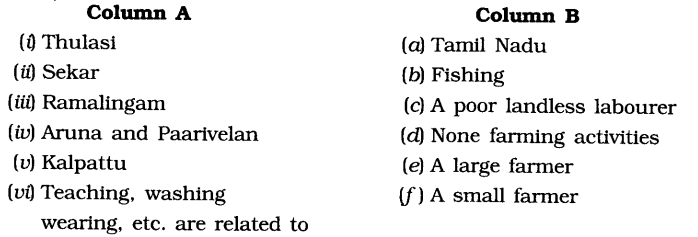
NCERT Solutions for Class 6th Social Science Civics Chapter 8 Rural Livelihoods Matching Skills

Ans: (i)—(c), (ii)—(f), (iii)—(e), (iv)—(b), (v)-(a),(vi)-d

V.VERY SHORT ANSWER TYPE QUESTIONS

1. What is the main crop of Kalpattu village?
Ans: The main crop of Kalpattu village is paddy.

2. How is Ramalingam different from others according to Thulasi?
Ans: Unlike others, Ramalingam does not go looking for cheaper labour from other villages. Whenever there is work, he calls Thulasi.

3. What does Thulasi’s husband do when he finds no work on the farm?
Ans: In such situation he finds work outside either loading sand from the river or stone from the quarry nearby.

4. Why did Thulasi borrow from Ramalingam?
Ans: She did so for her daughter’s treatment.

5. How did she pay back the loan to Ramalingam.
Ans: She paid back her loan to Ramalingam by selling her cow.

6 Name some other activities which poor families in rural areas often do for the household apart from farming.  [V. Imp.]
Ans: Collecting firewood, getting water and grazing cattle.

7. Why do people migrate? [V. Imp.]
Ans: People migrate from rural to urban areas to find job.                           .

8. How much land does Sekar own?
Ans: Sekar owns two acres of land.

9. How does he pay back the loan to trader?
Ans: He pays back the loan to trader by selling his paddy to him at a lower price.

10. Why does Sekar need to earn some extra money?
Ans: Whatever he produces last only eight months. So, he needs to earn some extra money.

11. What work does Sekar do at Ramalingam’s rice mill?
Ans: He helps Ramalingam collect paddy from other farmers in the neighbouring villager.

12. Why do farmers like Sekar need to borrow money?
Ans: They need to borrow money to purchase basic things like seeds, fertilizers and pesticides.

13. Why do fishermen go far into the sea?
Ans: They go far into the sea to get a better catch.

14. During which period do fish breed?
Ans: They breed during the monsoon.

15. How do fishermen manage during the monsoon period?
Ans: During the monsoon period fishermen survive by borrowing from the trader.

VI.SHORT ANSWER TYPE QUESTIONS

1. Describe different types of work that Sekar do for a living.                                 [Imp.]
Ans: Sekar is a small farmer having only two acres of land. He grows paddy in his field with the help of his family members. He also works in Ramalingam’s rice milk. He helps him collect paddy from other farmers is the neighbouring villages. He also has a hybrid cow, whose milk he sells in the local milk cooperative.

2. List the three situations in which crops can be ruined.                                    [V. Imp.]
Ans: The three situations in which crops can be ruined are :

  • If the seeds are not of good quality.
  • If pests attack the crop.
  • If the monsoon does not bring enough rain.

3. Write a brief note on the lifestyle of the people of Chizami.
Ans: Chizami is a village in Phek district in Nagaland. The people of this village do terrace farming. They have their own individual fields. But, they also work collectively in each other’s fields. They form groups of six or eight and take an entire mountain side to clean the needs on it. Each group eats together once their work for the day is over.

VII.LONG ANSWER TYPE QUESTIONS

1. Write a short note on the lives of fishing families. [V. Imp.]
Ans: Fishing families usually live close to the sea. Their lives revolve around the sea and fish. One can find rows of catamarans and nets lying around their houses. Their day usually starts from 7 O’clock in the morning. This is the time when there is a lot of activity on the beach. After catching fish the fishermen return with their catamarans. Women then gather to buy and sell fish. They do not go to the sea for at least four months during the monsoon because this is when the fish breed.

During these months they survive by borrowing from the trader. And thus, they are forced to sell the fish to that trader later on.The lives of fisherfolk are full of risks. Whenever there is a storm, they have to suffer a lot. In 2004, the tsunami hit them badly. They were the worst sufferers.

2. What different activities are done by the people of Kalpattu village?
Ans: Kalpattu is coastal village in Tamil Nadu. As the village is surrounded by low hills, paddy is the main crop here. Most of the families earn a living through agriculture. Besides agriculture, people do many non-farm activities such as making baskets, utensils, pots, bricks, bullock carts, etc. The village has no dearth of service providers like blacksmiths, nurses, teachers, washermen, weavers, barbers, cycle repair mechanics and so on.

One can find here shopkeepers and traders too. There is a bazaar where a variety of small shops such as tea shops, grocery shops, a tailor, seed shop etc. can be found. There are some coconut groves around the village. A group of people earn their living by working in mango orchards. In the village, there are small farmers as well as big farmers. There are landless labourers too who work in other’s field.

3. Under which circumstances poor farmers find themselves unable to pay back their loans? What happens after that?
Ans: Poor farmers are bound to take loans for agriculture purpose. Sometimes they successfully pay back the loans but there are also moments when they fail to do that in time because of crop failure. This is a very tough time for them. For the family to survive, they have to borrow more money. Soon the loan becomes so large that no matter what they earn, they are unable to repay. This is when we can say they are caught in debt. Whenever this situation occurs, farmers become helpless. Their helplessness to repay the loan sometimes compel them to commit suicide.


NCERT Solutions for Class 6 Social Science

NCERT Solutions for Class 6 Social Science Geography

NCERT Solutions for Class 6 Social Science Geography : The Earth: Our Habitat

NCERT Solutions for Class 6 Social Science History

NCERT Solutions for Class 6 Social Science History : Our Pasts – I

NCERT Solutions for Class 6 Social Science Civics

NCERT Solutions for Class 6 Social Science Civics : Social and Political Life – I


NCERT Solutions for Class 6th Social Science Civics Chapter 9 Urban Livelihoods


NCERT Solutions for Class 6th Social Science Civics Chapter 9 Urban Livelihoods

1. Read and discuss the following description of the living conditions of workers who come to the labour chowk.
Most workers that we find at the labour chowk cannot afford permanent accomodation and sleep on pavements near the chowk, or they pay Rs. 6 a night for a bed at a nearby night shelter run by the Municipal Corporation. To compensate for the lack of security, local tea and cigarette shops function as banks, moneylenders and safety lockers, all rolled into one. Most workers leave their tools at these shops for the night for safe keeping and pass on any extra money to them. The shopkeepers keep the money safety and also offer loans to labourers in need.
Source : Aman Sethi, Hindu on-line
Ans: Students are suggested to discuss on the above theme in the class in the presence of their teacher.

2. Complete the following table and discuss how their work is different:

NamePlace of workEarningsSecurity of workBenefits

received

Work on their own or employed
Bachchu

Manjhi

Rs 100 a day
Harpreet

Vandana

Work on their own
NirmalaNo security
SudhaCompanyRs. 30,000 p.m.

Ans:

NamePlace of workEarningsSecurity of workBenefits

received

Work on their own or employed
Bachchu

Manjhi

RoadRs 100 a dayNo securityNo benefitsWork on his own
Harpreet

Vandana

ShowroomFlexibleTheir job is securedThey are planning to buy a flat and car.Work on their own
NirmalaGarment

factory

Rs. 80 a dayNo securityShe can earn extra money by working late.Employed
SudhaCompany

office

She gets regular salary.Her job is securedHolidays,

medical

facilities

Employed


3.In what ways is a permanent and regular job different from a casual job? Discuss.
Ans: In a permanent and regular job an employee gets a regular salary every month. Besides, a regular salary he gets other benefits such as savings for old age, holidays, medical facilities for his family, etc. Thus, his job is secured. But casual workers avail no job security. If workers complain about their pay or working conditions, they are asked to leave. They are also expected to work very long hours. They don’t get other benefits like permanent employees.

Q.4.What benejits does Sudha get along with her salary?
Ans: Sudha is a permanent worker with a company. She gets several benefits along with her salary:

  • Savings for old age. A part of her salary is kept in a fund with the government. She will earn interests on these savings. When she retires from this job she will get this money in the form of pension.
  • Sudha gets off on Sundays and national holidays. She also gets some days as annual leave.
  • Medical facilities for her family. The company pays Sudha medical expenses up to a certain amount for her and her family members. She gets medical leave if she falls ill and her salary is not cut if she takes this leave.

5.Fill in the following table to show the services provided by people in markets which you msit frequently.

Name of the shop or officeNature of the service provided


Name of the shop or officeNature of the service provided
Garment showroomIt provides clothes as per the requirement of the customer.
Shop selling utensils, footwear, electronic goods, etc.They provide household things.
BanksThey provide security and growth to our money.
Note: Students are suggestecto add more.

I.MULTIPLE CHOICE QUESTIONS

Choose the correct option to complete the statements given below:

(i) Vandana is a ……………
(a)Doctor (b) Sales manager
(c) Dress designer                (d) Dentist.

(ii) The authority that issues a licence to the permanent shops is the
(a) Municipal corporation                    (b) Electricity department
(c) Home Ministry                              (d) None of the above.

(iii) Nirmala works in a ……………
(a) Showroom                                      (b) Garment factory
(c) Company                                       (d) Call centre.

(iv)Workers who are employed on casual basis usually get ……………………
(a) Handsome salary                           (b) Poor salary
(c) Medical leave                               (d) Both (a) and (b).

(v) Foreign companies usually set up call centres in India because
(a)They can get people who will work for lower wages
(b)They can get people who can speak English
(c)They can get cheap land to establish the centre
(d)Both (a) and (b).

Ans:(i)—(c), (ii)—(a), (iii)—(b), (iv)—(b), (v)—(d).

II.FILL IN THE BLANKS

Fill in the blanks with appropriate words to complete each sentence:

(i) There are almost ……… street vendors in the country working in …………………
(ii) Those who work in government departments get a ……………….. salary every month.
(iii) It is the……… that decides on which day of the week the market has to remain closed.
(iv) Call Centres in ………. cities provide a new form of employment to the people.
(v )Street vending is now recognised as a general benefit and as a………………… of people to earn their ……………  •

Ans. (i) one crore, urban (ii) regular                                   (iii) Municipal Corporation
(iv) big                               (y) right, livelihood.

III.TRUE/FALSE

State whether these sentences are true (T) or false (F).

(i)A large number of people in the city work on the streets.
(ii)Shops on streets are usually temporary structures.
(iii)Call Centres are usually seen in small towns.
(iv)Casual workers can complain about their pay or working conditions.
(v) Permanent workers get only medical facilities.

Ans. (i)—T, (ii)—T, (iii)—F, (ziv)—F, (v)—F.

IV.MATCHING SKILL

Match the items in column A correctly with those given in column B.

Column A                                                                   Column B

(i) Harpreet and Vandana                     (a) Works as a Marketing Manager
(ii) Bachchu Manjhi                                 (b) Works as a tailor
(iii) Sudha                                                    (c) Business persons
(iv) Nirmala                                                 (d) Work as helpers to masons
(v) Daily wage workers                             (e) Rickshaw puller
.
Ans. (i)—(c), (ii)—(e), (iii)—(a), (iv)—(b), (v)—(d).

V.VERY SHORT ANSWER TYPE QUESTIONS

1. Name some activities which are carried out on the streets.
Ans: Vending, hair-cutting, shoe-repairing, flower-selling etc.

2. What was found in a Survey of Ahmedabad city?                                               [V. Imp.]
Ans: In a survey of Ahmedabad city it was found that 12 percent of all the workers in the city were people working on the street.

3. What types of things do vendors usually sell?
Ans: Vendors usually sell things that are often prepared at home by their families who purchase, clean, sort and make them ready to sell.

4. How was street vending looked upon till recently?
Ans.Street vending was till recently looked upon only as an obstruction to traffic and to people walking.

5.How is it looked upon now?
Ans: It is now looked upon as a general benefit and as a right of people to earn their livelihood.

6. Mention two features of business persons.                                                               [Imp.]
Ans: (i)They own their own shops or business.
(ii)They employ a number of workers as supervisors and helpers.

7. What is essential for the permanent shops?                                                        [V. Imp.]
Ans: They must have a licence to do business.

8. Define ‘labour chowk’.
Ans: Labour chowk is a place where daily wage labourers wait with their tools for people to come and hire them for work.

9.What is the normal working day in a garment factory?
Ans: In a garment factory a normal working day begins at 9 a.m. and finishes only by 10 p.m.

10. What is a Call Centre? [V. Imp.]
Ans: A Qall Centre is a centralised office that deals with problems and questions that consumers / customers have regarding goods purchased and services like banking, ticket booking, etc.

11. Mention two features of permanent jobs.
Ans: • Men having permanent jobs get a regular salary with perks and other benefits eveiy month.

  • They can expect their job to continue for a long period of time.


VI.SHORT ANSWER TYPE QUESTIONS

1. How do hawkers manage their work? [V. Imp.]
Ans. Hawkers work on their own. They organise their own work. They know how much to purchase, as well as where and how to set up their shops. Their shops are usually temporary structures. Sometimes just some boards or papers spread over discarded boxes or may be canvas sheet hung up on a few poles. They may also use their own carts or simply a plastic sheet spread on the pavement. They can be asked to dismantle their shops at any time by the police.

2. Mention some drawbacks of casual jobs. [V. Imp.]
Ans. • In casual jobs, workers are not expected to complain about their pay or working
conditions. If they dare to do this, they are instantly asked to leave.

  • Casual jobs do not provide security protection if there is ill-treatment.
  • Casual workers are expected to do work for long hours.
  • Even if they don’t complain, they can be asked to leave when workload is less.

3. What works does Sudha do?
Ans. Sudha works as a Marketing Manager in a company which manufactures biscuits. The factoiy where the biscuits are made is outside the city. Sudha supervises the work of 50 salespersons who travel to different parts of the city. They get orders from shopkeepers and collect payments from them. She has divided the city into six regions and once a week she meets the salespersons of each region. She checks their progress report and discusses problems they face. She has to plan the sales in the entire city and often has to work late and travel to different places.

VII.LONG ANSWER TYPE QUESTIONS

1. What are various ways of earning livelihood in the urban areas? Discuss. [V. Imp.]
Ans. People in urban areas are engaged in a variety of activities in order to earn their living. Some are doing the work of a cobbler while some are barbers busy with their work. A number of people earn their livelihood by pulling rickshaw. Vendors are also seen here and there selling household articles. In urban areas showrooms of different items can be seen. These showrooms are run by businesspersons. These people employ a number of workers as supervisors and helpers for their showrooms. Several urban people are engaged in Factories where they work for long hours. They don’t have job security still they continue their work because they don’t have other option. But there are also people who do office work with full job security. They get regular salary and enjoy other benefits of job like savings for old age, holidays, medical facilities etc.

Working in Call Centres is a new form of employment in big cities. It has attracted a large number of young men and women. Thus, we see that with a growing population, job opportunities have also increased and people are availing these opportunities according to their talent and aptitude.

2. Write in brief on ‘Call Centres’.
Ans. Call Centres in big cities are providing new job opportunities to young and enthusiastic men and women. A Call Centre is a centralised office that deals with problems and questions that consumers/customers have regarding goods purchased and services like banking, ticket booking, etc. Call Centres are generally set up as large rooms with work stations that include a computer, a telephone set and supervisor’s stations.
India has become a major centre not only for Indian companies but also foreign companies. They set up Call Centres here as they can get people who can speak english and will work for lower wages.


NCERT Solutions for Class 6 Social Science

NCERT Solutions for Class 6 Social Science Geography

NCERT Solutions for Class 6 Social Science Geography : The Earth: Our Habitat

NCERT Solutions for Class 6 Social Science History

NCERT Solutions for Class 6 Social Science History : Our Pasts – I

NCERT Solutions for Class 6 Social Science Civics

NCERT Solutions for Class 6 Social Science Civics : Social and Political Life – I