Showing posts with label NS SCI 7TH EM. Show all posts

NCERT Solutions for Class 7 Science Chapter 18 Wastewater Story


NCERT Solutions for Class 7 Science Chapter 18 Wastewater Story

Topics and Sub Topics in Class 7 Science Chapter 18 Wastewater Story:

Section NameTopic Name
18Waste water Story
18.1Water, our lifeline
18.2What is sewage?
18.3Water freshens up — an eventful journey
18.4Wastewater treatment plant (wwtp)
18.5Better housekeeping practices
18.6Sanitation and disease
18.7Alternative arrangement for sewage disposal
18.8Sanitation at public places

Q.1. Fill in the blanks:
(a) Cleaning of water is process of removing __________
(b) Wastewater released by houses is called __________.
(c) Dried __________ is used as manure.
(d) Drains get blocked by __________ and __________.
Ans.(a) pollutants (b) sewage (c) sludge (d) (d) chemicals, kitchen waste

Q.2. What is sewage? Explain why it is harmful to discharge untreated sewage into rivers or seas.
Ans. Sewage is a liquid containing wastes which is disposed by households, industrial and agricultural activities in water. It is harmful to discharge untreated sewage into rivers or seas because it can pollute the whole sources of water. Sewage contains harmful substances and disease causing organisms. It is therefore dangerous to release untreated sewage in water.

Q.3. Why should oils and fats be not released in the drain? Explain.
Ans. Oils and fats should not be released in drains because they harden the soil in the pipes and block them. Fats get clogged in holes of the soil in the drain and block it. It does not allow the water to flow.

Q.4. Describe the steps involved in getting clarified water from wastewater.
Ans. Following steps are involved in the purification of water:
(i) Firstly all the physical impurities like stones, plastic bags, cans etc. are to be removed. It is done by passing the water through bar screens.
(ii) Then water is taken to grit and sand removal tank where impurities are removed by sedimentation.
(iii) Solid impurities and feaces etc. are collected from bottom of water. These impurities collected are called sludge.
(iv) Clarified water is cleaned of other impurities by aerator. All disease causing bacteria are removed by chlorination.

Q.5. What is sludge? Explain how it is treated.
Ans. Sludge is the collected solid waste from the wastewater during the treatment in water treatment plant. Sludge is decomposed in a separate tank by the anaerobic bacteria. Activated sludge is used as manure.

Q.6. Untreated human excreta is a health hazard. Explain.
Ans. Untreated human excreta can cause a lot of health related problems. It pollutes water, air and soil. The polluted water contain disease causing bacteria which can spread epidemics like cholera, meningitis etc.

Q.7. Name two chemicals used to disinfect water.
Ans. Chlorine and ozone

Q.8. Explain the Junction of bar screens in a wastewater treatment plant.
Ans. Bar screens clear the wastewater of all the physical impurities. Large size waste like napkins, plastics, cans etc. are removed from the wastewater through the bar screens.

Q.9. Explain the relationship between sanitation and disease.
Ans. Sanitation and disease are related to each other. Sanitation involves proper disposal of sewage and refuse from hou&e and public places. If sanitation is there, no disease will occur, but if sanitation is not there various types of disease will occur and spread. So sanitation should be kept to avoid disease.

Q.10. Outline your role as an active citizen in relation to sanitation.
Ans. As active citizen we should take care of our personal environmental sanitation. We should make people aware of the benefits of sanitation. We should help municipal corporations to cover all the open drains and remove disease causing substances thrown in open.

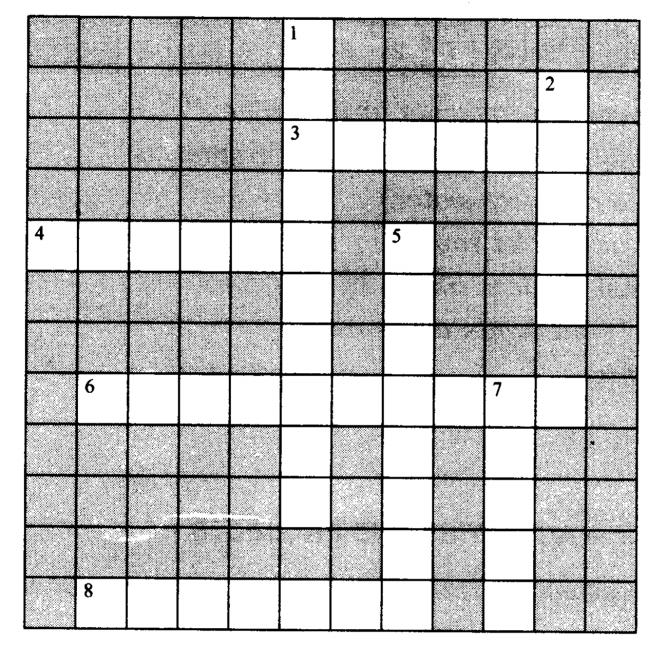
Q.11.Here is a crossword puzzle. Good luck!
NCERT Solutions for Class 7 Science Chapter 18 Wastewater Story Q11
Across:
3. Liquid waste products
4. Solid waste extracted in sewage treatment
6. A word related to hygiene
8. Waste matter discharged from human body
Down:
1. Used water
2. A pipe carrying sewage
5. Micro-organisms which cause cholera
7. A chemical to disinfect water

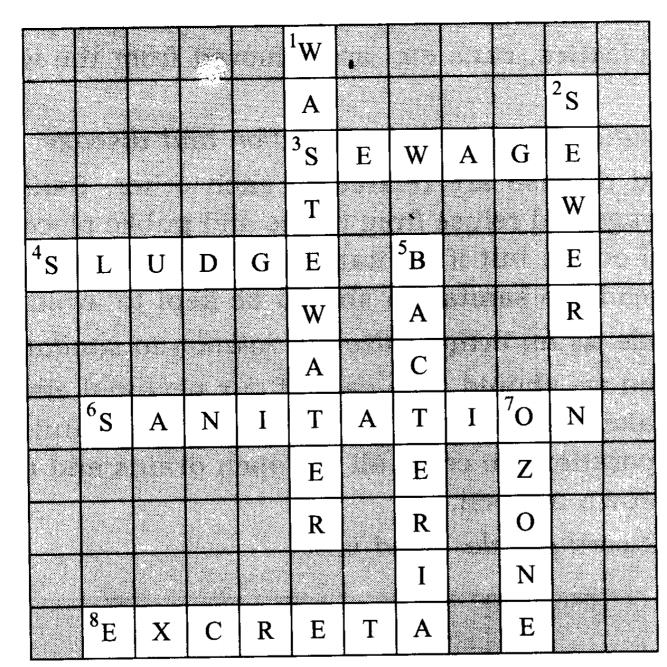
Ans
NCERT Solutions for Class 7 Science Chapter 18 Wastewater Story Q11.1

Q.12. Study the following statements about ozone:
(a) It is essential for breathing of living organisms.
(b) It is used to disinfect water.
(c) It absorbs ultraviolet rays.
(d) Its proportion in air is about 3%.
Which of these statements are correct?
(i) (a), (b) and (c) (ii) (b) and (c) (iii) (a) and (d) (iv) All four
Ans. (ii) (b) and (c)

NCERT Solutions for Class 7 Science Chapter 17 Forests Our Lifeline


NCERT Solutions for Class 7 Science Chapter 17 Forests Our Lifeline

Topics and Sub Topics in Class 7 Science Chapter 17 Forests Our Lifeline:

Section NameTopic Name
17Forests: Our Lifeline
17.1Visit to a Forest

Q.1. Explain how animals dwelling in the forest help it grow and regenerate.
Ans. Animals help in growing and regenerating forests in many ways. Animals work as the cleaning agents in the forest. Microorganisms work on dead bodies of plants and animals and degenerate them. An’imals also help in pollination which helps in growing a number of plants. Herbivores helps the carnivores to grow as they serve as food for them. Thus flora and fauna mutually grow in the forest.

Q.2. Explain how forests prevent floods.
Ans. Forests can absorb a lot of water. The roots of the trees absorb the water and prevent it from flowing away. Roots of trees also help in percolation of water into the soil. This helps in preventing floods.

Q.3. What are decomposers? Name any two of them. What do they do in the forest?
Ans. Decomposers are the organisms which feed on the dead bodies of plants and animals. They clean the forests decaying dead bodies and replenishing the nutrients back to the forest soil, e.g.„ beetles and grubs.

Q.4. Explain the role of forest in maintaining the balance between oxygen and carbon dioxide in the atmosphere.
Ans. Plants release oxygen in the atmosphere during the process of photosynthesis. This oxygen is inhaled by the animals for respiration. During respiration, they release carbon-dioxide which is absorbed by plants. In this way the oxygen and carbon dioxide cycle goes on. Since forests contain a large number of plants, they help much in this cycle and maintain balance in nature.

Q.5. Explain why there is no waste in a forest.
Ans. There is no waste in the forest because decomposers convert all the dead bodies of the plants and animals into the humus which gets added to the soil. Thus, no waste remains.

Q.6. List five products we get from forests.
Ans. (i) We get medicines from forests.
(ii) We get gum from forests.
(iii) We get wood which is used for many purposes like making furniture, paper etc.
(iv) We get food for animals from forests.
(v) We get sealing wax from forests.

Q.7.Fill in the blank:
(a) The insects, butterflies, honeybees and birds help flowering plants in .
(b) A forest is a purifier of and .
(c) Herbs form the layer in the forest.
(d) The decaying leaves and animal droppings in a forest enrich the .
Ans. (a) pollination (b) water, air (c) lowest (d) soil as humus.

Q.8. Why should we worry about the conditions and issues related to forests far from us?
Ans. We should be worried about deforestation as it would lead to floods, increase in earth’s temperature, decreasing animals habitats and soil erosion. Damage to forests directly or indirectly affects human habitat and environment so it must be a matter of concern among us.

Q.9. Explain why there is a need of variety of animals and plants in a forest.
Ans. All plants and animals sustain the forest life and also C02 – 02 cycle goes on due to animals and plants. Animals convert the dead and decaying matters into humus and increase the fertility of soil, thus enhancing plant growth. All food chains and food webs need variety of plants and animals.

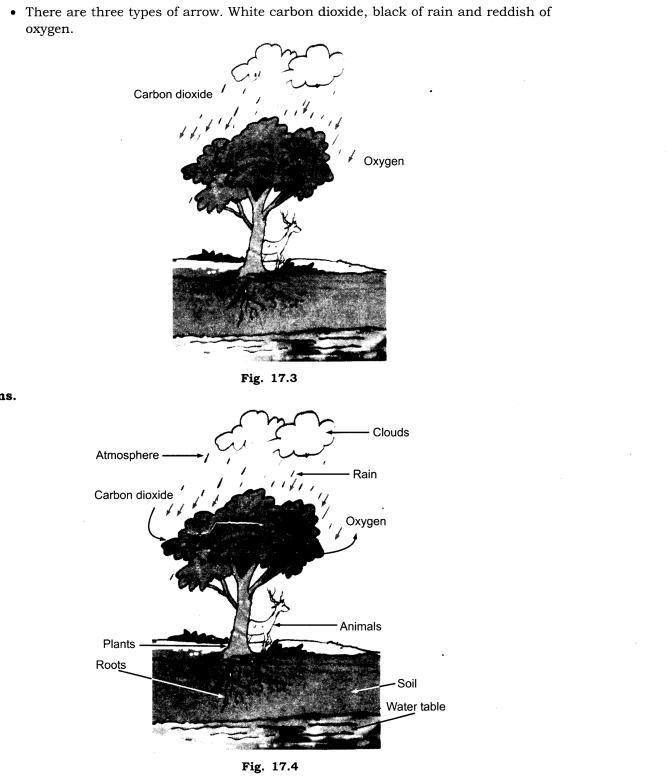
Q.10. In fig. 1 7.15 the artist has forgotten to put the labels and directions on the arrows. Mark the directions on the arrows and label the diagram using the following labels: clouds, rain, atmosphere, cabon dioxide, oxygen, plants, animals, soil, roots, water table.
NCERT Solutions for Class 7 Science Chapter 17 Forests Our Lifeline Q10

Q.11.Which of the following is not a forest product?
(i) Gum (ii) Plywood (iii) Sealing wax (iv) Kerosene
Ans.(iv) Kerosene

Q.12.Which of the following statements is not correct?
(i) Forests protect the soil from erosion.
(ii) Plants and animals in a forest are not dependent on one another.
(iii) Forests influence the climate and water cycle.
(iu) Soil helps forests to grow and regenerate.
Ans.(ii) Plants and animals in a forest are not dependent on one another.

Q.13.Micro-organisms act upon the dead plants to produce
(i) sand (ii) mushrooms (iii) humus (iu) wood
Ans. (i) Humus


NCERT Solutions for Class 7 Science Chapter 16 Water A Precious Resource


NCERT Solutions for Class 7 Science Chapter 16 Water A Precious Resource

Topics and Sub Topics in Class 7 Science Chapter 16 Water A Precious Resource:

Section NameTopic Name
16Water: a precious resource
16.1How much water is available
16.2Forms of water
16.3Groundwater as an important source of water
16.4Depletion of water table
16.5Distribution of water
16.6Water management
16.7What role you an play
16.8Effect of water scarcity on plants

Q.1. Mark ‘T’ if the statement is true and ‘F’ if it is false:
(a) The freshwater stored in the ground is much more than that present in the rivers and lakes of the world. (T/F)
(b) Water shortage is a problem faced only by people living in rural areas. (T/F)
(c) Water from rivers is the only source for irrigation in the fields. (T/F)
(d) Rain is the ultimate source of water. (T/F)

Ans. (a) T (b) F (c) F (d) T

Q.2. Explain how groundwater is recharged.
Ans. The groundwater gets recharged through the process of infiltration. Infiltration means seeping of water from rivers and lakes into the empty spaces and cracks deep below the ground.

Q.3.There are ten tubewells in a lane of fifty houses. What could be the long-term impact on the water table?
Ans.The effect on the water table depends on the replenishment of underground water. Only five families will share a tubewell, the water used for daily domestic purposes will not effect the water table. But if there is shortage of rains, the water used by the family will not replenished and water table will fall down.

Q.4.You have been asked to maintain a garden. How will you minimise the use of water? „
Ans.To minimise the wastage of water we will use the drip irrigation which throws the water at the base of plants. We will check the leakages in the water pipes and arrange small pits for rainwater harvesting. The collected rainwater will be used later.

Q.5.Explain the factors responsible for the depletion of water table.
Ans.Various factors responsible for the depletion of water table are:
(i) Increased population: Demand of water has been increased by the increased population. As the number of humans increase, the consumption of water also increases.
(ii) Increasing industries: All industries need water. As the number of human population increase, the number of industries are also increased which definitely increases the consumption of water.
(iii) Lack of water conservation techniques: Main source of water on earth and for the underground water is rain. The water of the rain, if conserved can increase the ground water level. But this is not done due to lack of water conservative techniques.
(iv) Agricultural activities: India is a country which depends on agriculture. The land used for cultivation has increased. So, the consumption of water for agriculture has increased. Irregular rainfall has increased the consumption of groundwater. This has increased the depletion of groundwater.

Q.6.Fill in the blanks with the appropriate answers: .
(a) People obtain groundwater through and .
(b) Three forms of water are solid, and .
(c) The water bearing layer of the earth is .
(d) The process of water seepage into the ground is called .
Ans.(a) wells, hand pumps
(b) liquid, gas
(c) aquifer
(d) infiltration

Q.7.Which one of the following is not responsible for water shortage?
(i) Rapid growth of industries
(ii) Increasing population
(iii) Heavy rainfall
(iv) Mismanagement of water resources
Ans.(iii) heavy rainfall

Q.8.Choose the correct option. The total water
(i) in the lakes and rivers of the world remains constant.
(ii) under the ground remains constant.
(iii) in the seas’and oceans of the world remains constant.
(iv) of the world remains constant.
Ans.(iv) of the world remains constant.

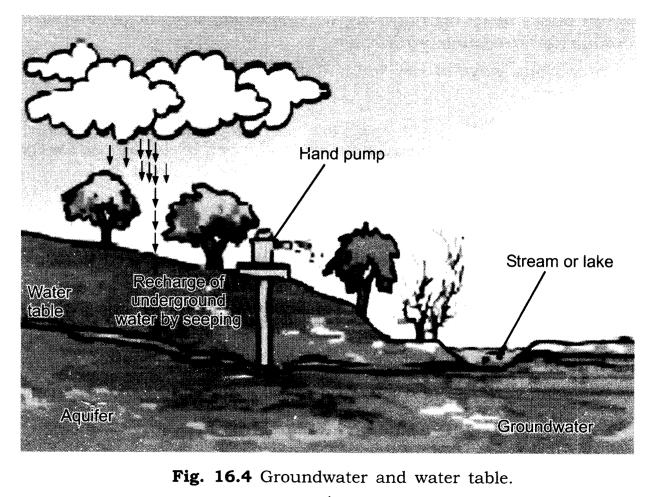
Q.9.Make a sketch shoyving groundwater and water table. Label it.
Ans
NCERT Solutions for Class 7 Science Chapter 16 Water A Precious Resource Q9

NCERT Solutions Class 7 Science Chapter 15 Light


NCERT Solutions Class 7 Science Chapter 15 Light

Topics and Sub Topics in Class 7 Science Chapter 15 Light:

Section NameTopic Name
15Light
15.1Light travels along a straight line
15.2Reflection of light
15.3Right or left!
15.4Playing with spherical mirrors
15.5Images formed by lenses
15.6Sunlight — white or coloured?

Q.1.Fill in the blanks:
(a) An image that cannot be obtained on a screen is called ___________ .
(b) Image formed by a convex is __________ always virtual and smaller in size.
(c) An image formed by a __________ mirror is always of the same size as that of the object.
(d) An image which can be obtained on a screen is called a __________ image.
(e) An image formed by a concave __________ cannot be obtained on a screen.
Ans.(a) virtual image (b) mirror (c) plane (d) real (e) lens

Q.2.Mark ‘T’ if the statement is true and ‘F’ if it is false:
(a) We can obtain an enlarged and erect image by a convex mirror. (T/F)
(b) A concave lens always form a virtual image. (T/F)
(c) We can obtain a real, enlarged and inverted image by a concave mirror. (T/F)
(d) A real image cannot be obtained on a screen. (T/F)
(e) A concave mirror always form a real image. (T/F)
Ans. a) F (b) T (c) T (d) F (e) F

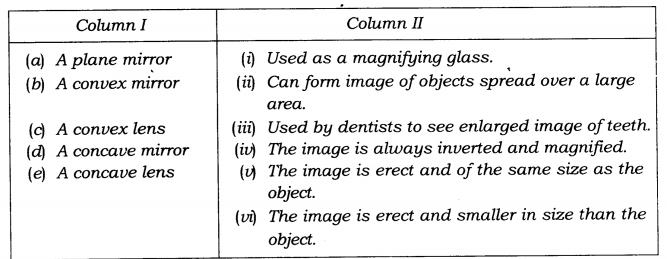
Q.3. Match the items given in Column I with one or more items of Column II
NCERT Solutions Class 7 Science Chapter 15 Light Q3
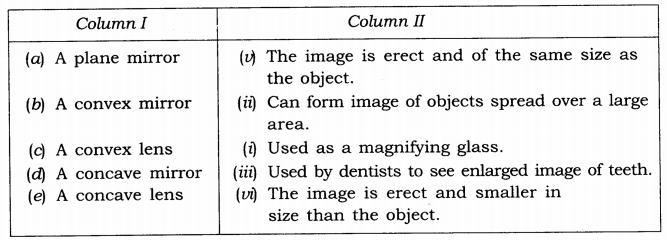
Ans.
NCERT Solutions Class 7 Science Chapter 15 Light Q3.1

Q.4.State the characteristics of the image formed by a plane mirror.
Ans.(i) Plane mirror forms an erect image.
(ii) It forms a virtual image.
(iii) Size of the image is same as that of the object.
(iv)Image is formed at the same distance behind the mirror as the object stands in front of it.
(v) Image formed is a laterally inverted image i.e., right hand side of the object seems to be the left hand side and vice-versa.

Q.5.Find out the letters of English alphabet or any other language known to you in which the image formed in a plane mirror appears exactly like the letter itself. Discuss your findings.
Ans.Letters like A, H, I, M, O, T, U ,V, W etc. appear same when seen through a plane mirror

Q.6.What is a virtual image? Give one situation where a virtual image is formed.
Ans.The image which cannot be taken on a screen is called virtual image. When some object is placed very close to the concave mirror we don’t get any image on the white screen placed behind the mirror. Such image is called virtual image.

Q.7. State two differences between a convex and a concave lens.
NCERT Solutions Class 7 Science Chapter 15 Light Q7

Q.8. Give one use each of a concave and a convex mirror.
Ans. Use of concave mirror:
Concave mirror is used by dentists to examine the teeth.
Use of convex mirror:
Convex mirror is used as side view mirror in vehicles

Q.9. Which type of mirror can form a real image?
Ans. Concave mirror can form a real image.

Q.10. Which type of lens forms always a virtual image?
Ans. Concave lens always forms a virtual image.

Choose the correct option in Questions 11-13:

Q.11. A virtual image larger than the object can be produced by a
(i) concave lens (ii) concave mirror (iii) convex mirror (iv) plane mirror

Ans. (ii) concave mirror

Q.12. David is observing his image in a plane mirror. Die distance between the mirror and his image is 4 m. If he moves 1 m towards the mirror, then the distance between David and his image will be
(i) 3 m (ii) 5 m (iii) 6 m (iv) 8 m

Ans. (iii) 6 m

Q.13. The rear view mirror of a car is a plane mirror. A driver is reversing his car at a speed of 2 m/s. The driver sees in his rear mew mirror the image of a truck parked behind his car. The speed at which the image of the truck appears to approach the driver will be
(i) 1 m/s (ii) 2 m/s (iii) 4 m/s {iv) 8 m/s

Ans. (ii) 4 m/s

NCERT Solutions Class 7 Science Chapter 14 Electric Current and its Effects


NCERT Solutions Class 7 Science Chapter 14 Electric Current and its Effects

Topics and Sub Topics in Class 7 Science Chapter 14 Electric Current and its Effects:

Section NameTopic Name
14Electric Current and its Effects
14.1Symbols of Electric Components
14.2Heating effect of electric current
14.3Magnetic effect of electric current
14.4Electromagnet
14.5Electric bell

Q.1.Draw in your notebook the symbols to represent the following components of electrical circuits: connecting wires, switch in the ‘OFF’ position, bulb, cell, switch in the ‘ON’ position and battery.
Ans.
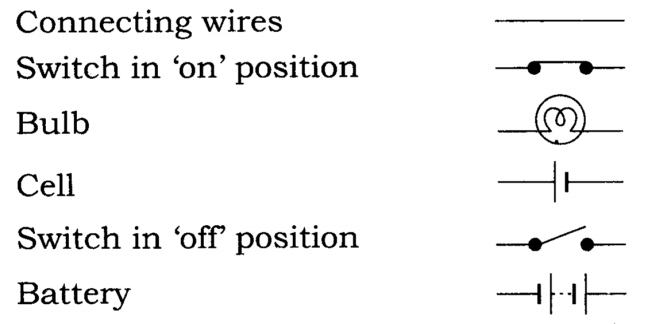
NCERT Solutions Class 7 Science Chapter 14 Electric Current and its Effects Q1

Q.2.Draw the circuit diagram to represent the circuit shown in fig. 14.9.
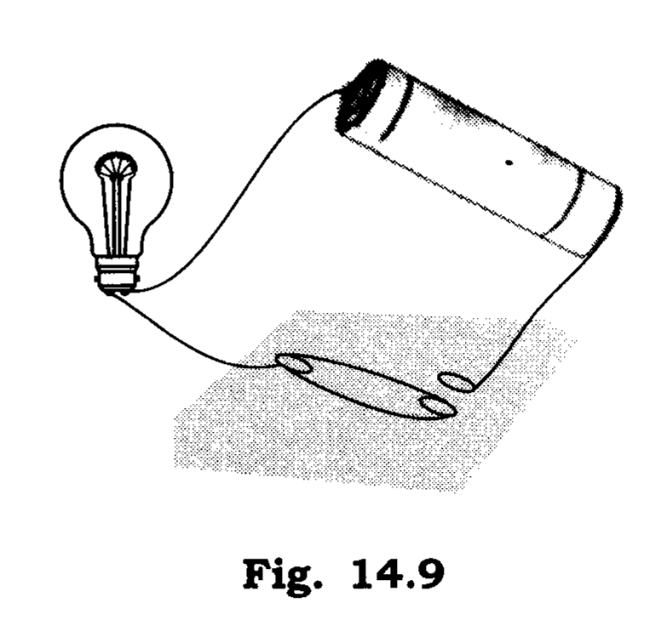
NCERT Solutions Class 7 Science Chapter 14 Electric Current and its Effects Q2
Ans.
NCERT Solutions Class 7 Science Chapter 14 Electric Current and its Effects Q2.1

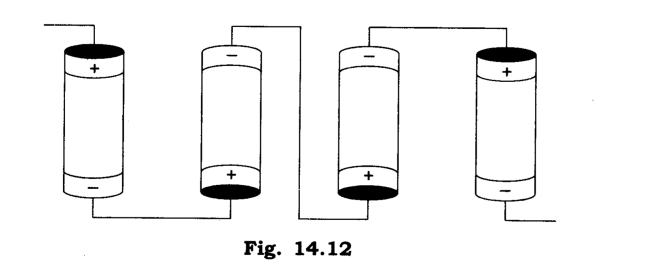
Q.3.Fig. 14.11 shows four cells fixed on a board. Draw lines to indicate how you will connect their terminals with wires to make a battery of four cells.
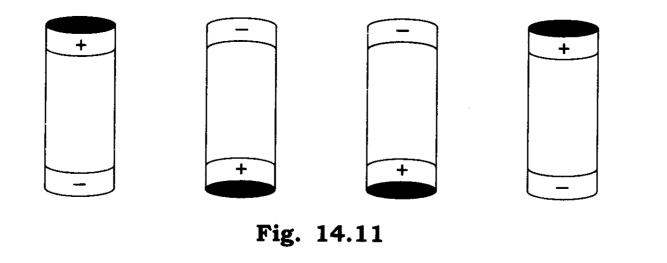
NCERT Solutions Class 7 Science Chapter 14 Electric Current and its Effects Q3
Ans.
NCERT Solutions Class 7 Science Chapter 14 Electric Current and its Effects Q3.1

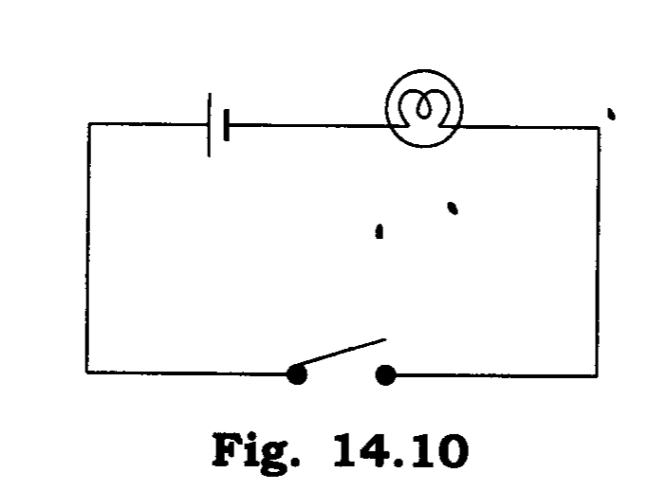
Q.4.The bulb in the circuit shown in fig. 14.13 does not glow. Can you identify the problem? Make necessary changes in the circuit to make the bulb glow.
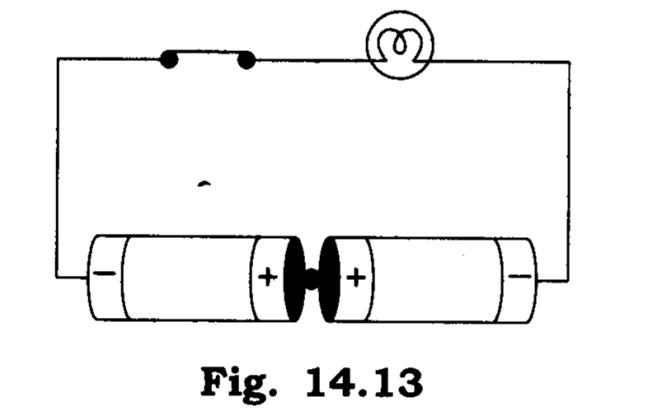
NCERT Solutions Class 7 Science Chapter 14 Electric Current and its Effects Q4
Ans.Problem in this circuit is the combination of two cells. In the circuit positive terminal of one cell should be connected with negative terminal of other to make the bulb glow
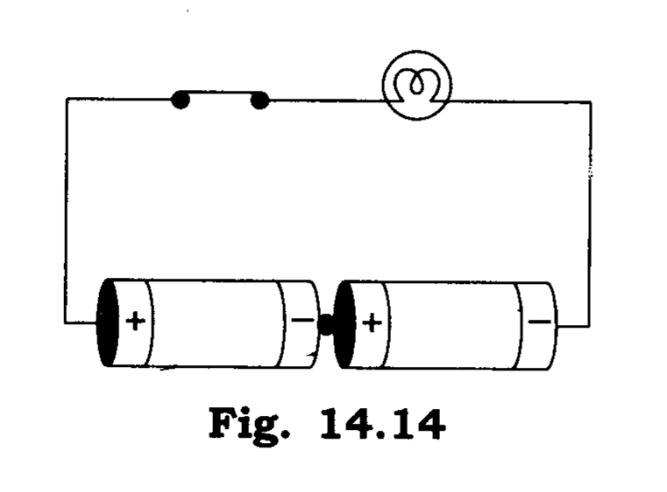
NCERT Solutions Class 7 Science Chapter 14 Electric Current and its Effects Q4.1

Q.5. Name any two effects of electric current.
Ans. Electric current has the following effect :
(i) Electric current can give rise to heating and lighting.
(ii) Electric current can convert a straight conductor into a temporary magnet.

Q.6.When the current is switched on through a wire, a compass needle kept nearby gets deflected from its north-south position. Explain.
Ans. When current is passed through the wire, it deflects the compass near it from its north-south position like a magnet. This is called magnetic effect of the current. As we know that needle of the compass is made up of a thin magnet. When this needle comes in contact with another magnet then the like poles of the magnet repel each other and opposite poles attract each other. So the deflection is seen in the needle. In this case the wire behaves like a magnet and causes deflection in needle of the compass.

Q.7.Will the compass needle show deflection when the switch in the circuit shown by fig. 14.15 is closed?
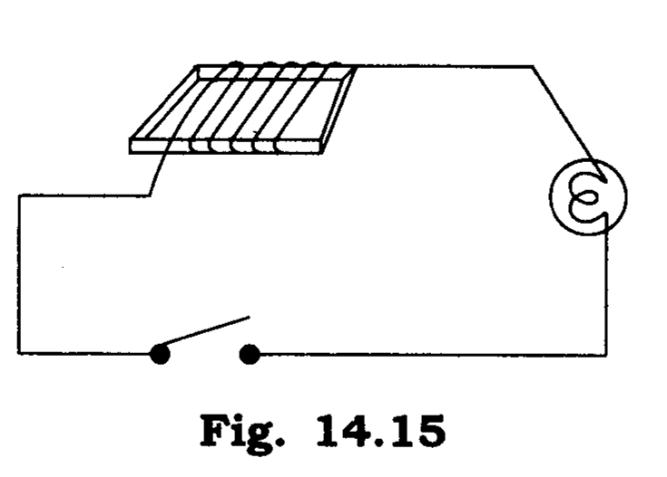
NCERT Solutions Class 7 Science Chapter 14 Electric Current and its Effects Q7
Ans. No, because there is no source of electric current in this circuit, i.e., there is no battery.

Q.8.Fill in the blanks:
(a) Longer line in the symbol for a cell represents its ___________terminal
(b) The combination of two or more cells is called a ____________.
(c) When current is switched ‘on’ in a room heater, it ___________.
(d) The safety device based on the heating effect of electric current is called a _____________.

Ans.(a) positive (b) battery (c) becomes red hot and emits heat (d) fuse.

Q.9.Mark ‘T’ if the statement is true and ‘F’ it is a false:
(a) To make a battery of two cells, the negative terminal of one cell is connected to the negative terminal of the other cell. [T/F]
(b) When the electric current through the fuse exceeds a certain limit , the fuse wire melts and breaks. [T/F]
(c) An electromagnet does not aatract a piece of iron. [T/F]
(d) An electric bell has an electromagnet. [T/F]
Ans. (a) F (b) T (c) F (d) T

Q.10. Do you think an electromagnet can be used for separating plastic bags from a garbage heap? Explain.
Ans. No, the plastic bags do not get attracted by the magnet, so they cannot be separated by an electromagnet. Plastic bags are not magnetic materials, only magnetic materials like iron can be attracted by the magnet.

Q.ll. An electrician is carrying out some repairs in your house. He wants to replace a fuse by a piece of wire. Would you agree? Give reasons for your response.
Ans. No, we would not agree to allow to replace the fuse by a wire. Wires in the fuses are of specific melting points. So wd should always use ISI marked fuses in our houses to prevent short circuits.

Q.12.Zubeda made an electric circuit using a cell holder shown in fig. 14.16, a switch and a bulb. When she put the switch in the ‘ON’ position, the bulb did not glow. Help Zubeda in identifying the possible defects in the circuit
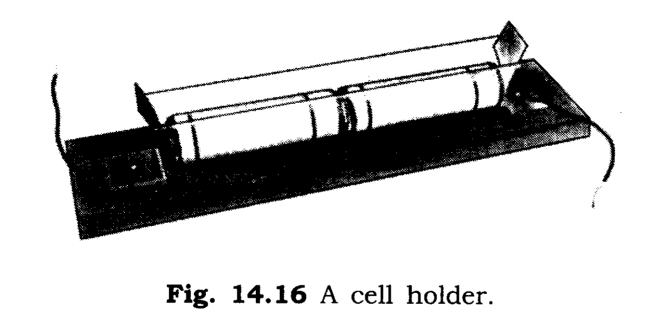
NCERT Solutions Class 7 Science Chapter 14 Electric Current and its Effects Q12
Ans. It is important to put the cells in right series. The positive terminal of the first cell should be connected with negative terminal of the second cell. The switch should be closed properly and bulb should not be fused. If Zubeda will check these then the bulb will certainly glow.

Q.13. In the circuit shown in fig. 14.17.
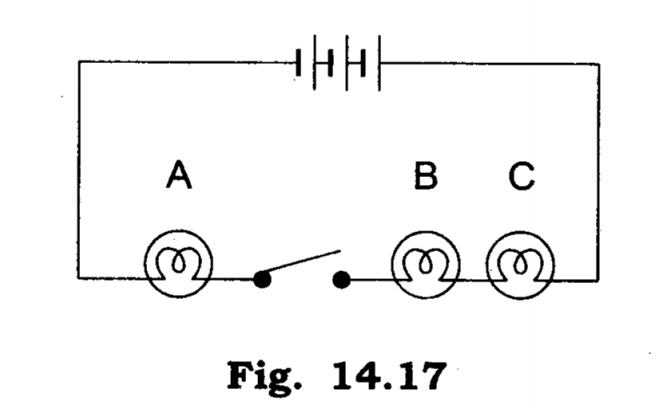
NCERT Solutions Class 7 Science Chapter 14 Electric Current and its Effects Q13
Would any of the bulb glow when the switch is in the ‘OFF’ position?
What will be the order in which the bulbs A, B and C will glow when the switch is moved to the ‘ON’ position?

Ans. No bulb will glow.
All bulbs will glow simultaneously.

NCERT Solutions Class 7 Science Chapter 13 Motion and Time


NCERT Solutions Class 7 Science Chapter 13 Motion and Time

Topics and Sub Topics in Class 7 Science Chapter 13 Motion and Time:

Section NameTopic Name
13Motion and Time
13.1Slow or Fast
13.2Speed
13.3Measurement of Time
13.4Measuring speed
13.5Distance -time graph

Q.1.Classify the following as motion along a straight line, circular or oscillatory motion :
(i) Motion of your hands while running.
(ii) Motion of a horse pulling a cart on a straight road.
(iii) Motion of a child in a merry-go-round. •
(iv) Motion of a child on a see-saw.
(v) Motion of the hammer of an electric bell.
(vi) Motion of a train on a straight bridge.
Ans.(i) Oscillatory motion
(ii) Linear motion
(iii) Circular motion
(iv) Oscillatory motion
(v) Oscillatory motion
(vi) Linear motion

Q.2.Which of the following are not correct?
(i) The basic unit of time is second.
(ii) Every object moves with a constant speed.
(iii) Distances between two cities are measured in kilometers.
(iv) The time period of a given pendulum is not constant.
(v) The speed of a train is expressed in m/h
Ans. (ii), (iv), (v)

Q.3.A simple pendulum takes 32s to complete 20 oscillations, what is the time period of the pendulum?
Ans. Time taken to complete 20 oscillations = 32 s
Time taken to complete 1 oscillation = 32/20 s = 1.6 s
Time period of a pendulum is time taken by it to complete 1 oscillation.
Time period of pendulum is 1.6 seconds.

Q.4.The distance between two stations is 240 km. A train takes 4 hours to cover this distance. Calculate the speed of the train.
Ans.Distance = 240 km
Time taken = 4 hours
Speed =Distance covered/time taken = 240km/4 hammer
=60 km/h
Speed of train =60 km/h

Q.5.The odometer of a car reads 57321.0 km when the clock shows the time 08:30 AM. What is the distance moved by the car, if at 08:50 AM, the odometer reading has changed to 57336.0 km? Calculate the speed of the car in km/min during this time. Express the speed in km/h also.
Ans.Distance = 57336.0 km – 57321 km =15 km
Speed in km/min =15km/20 min = 3/4 km/min

Speed in km/hr =15 km/1/3 hr
=(15 x 3) km/hr
=45 km/hr.

Q.6.Salma takes 15 minutes from her house to reach her school on a bicycle. If the bicycle has a speed of 2 m/min, calculate the distance between her house and the school.
Ans.Time taken =15 min
Speed = 2 m/min .
Distance = speed x time = 2 x 15 = 30 m
Distance between Salma’s school and her house is 30 m.

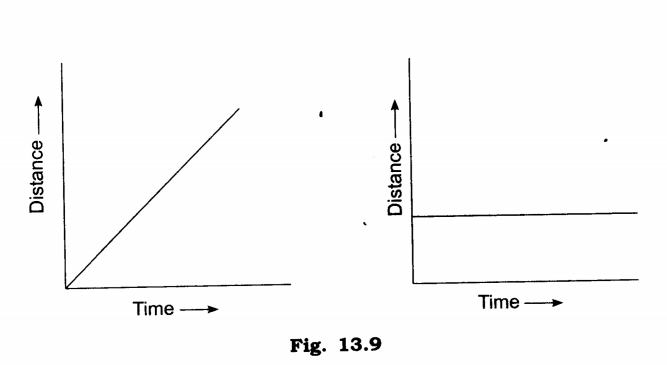
Q.7.Show the shape of the distance-time graph for the motion in the following cases :
(i) A car moving with a constant speed.
(ii) A car parked on a side road
Ans.
NCERT Solutions Class 7 Science Chapter 13 Motion and Time Q7

Q.8. Which of the following relations is correct?
(i) Speed = Distance Time
(ii) Speed = Distance/Time
(iii)Speed – Time/Distance
(iv)Speed = 1/Distance Time
Ans. (ii) Speed = Distance/Time is correct

Q.9.The basic unit of speed is:
(i) km/min (ii) m/min (iii) km/h (iv) m/s
Ans. (iv) m/s

Q.10.A car moves with a speed of 40 km/h for 15 minutes and then with a speed of 60 km/h for the next 15 minutes. The total distance covered by the car is:
(i) 100 km (ii) 25 km (iii) 15 km (iv) 10 km
Ans.(ii) 25 km
Q.11.Suppose the two photographs, shown in fig. 13.1 and fig. 13.2 of NCERT had been taken at an interval of 10 seconds. If a distance of 100 metres is shown by 1 cm in these photographs, calculate the speed of the blue car.
Ans.0.1 cm/s or 10 m/s

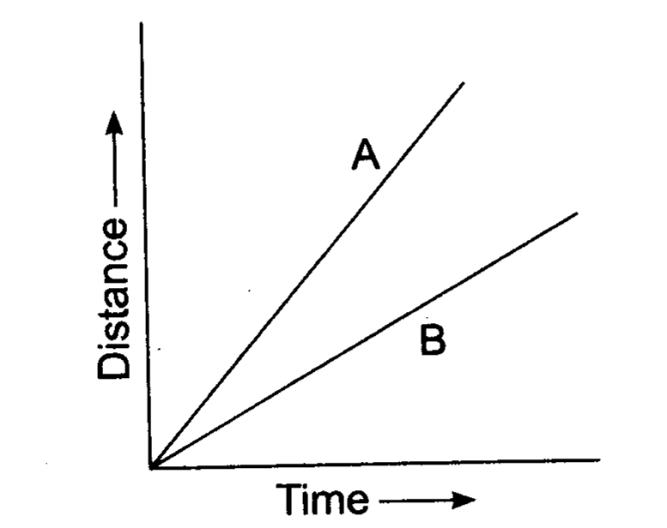
Q.12.Fig 13.10 shows the distance-time graph for the motion of two vehicles A and B. Which one of them is moving faster?
NCERT Solutions Class 7 Science Chapter 13 Motion and Time Q12

Ans. ‘A’ is moving faster.

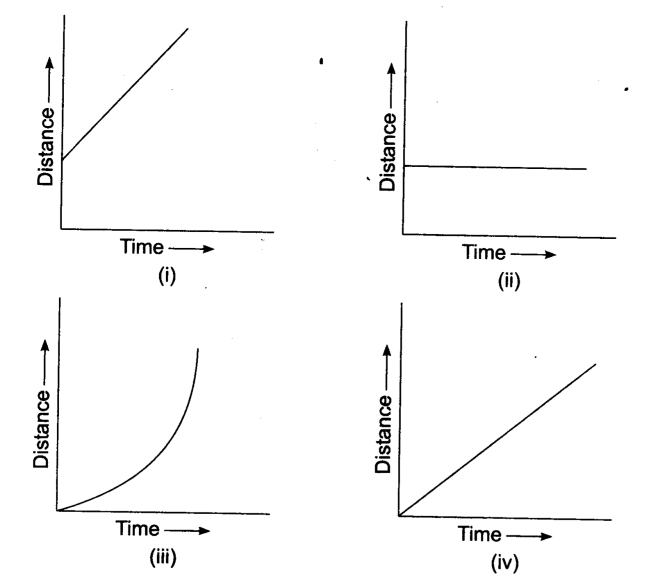
Q.13.Which of the following distance-time graphs shows a truck moving with speed which is not constant?
NCERT Solutions Class 7 Science Chapter 13 Motion and Time Q13

Ans. (iii)

NCERT Solutions Class 7 Science Chapter 12 Reproduction in Plants


NCERT Solutions Class 7 Science Chapter 12 Reproduction in Plants

Topics and Sub Topics in Class 7 Science Chapter 12 Reproduction in Plants:

Section NameTopic Name
12Reproduction in Plants
12.1Modes of reproduction
12.2Sexual reproduction
12.3Fruits and Seed Formation
12.4Seed dispersal

Q.1.Fill in the blanks:
(a) Production of new individuals from the vegetative part of parent is called ___________. 
(b) A flower may have either male or female reproductive parts. Such a flower is called _______.
(c) The transfer of pollen grains from the anther to the stigma of the same or of
another flower of the same kind is known as __________.
(d) The fusion of male and female gametes is termed as ____________ .
(e) Seed dispersal takes place by means of ________ and __________.
Ans. (a) vegetative reproduction (b) unisexual flower (c) pollination (d) fertilization (e) wind, water

Q.2. Describe the different methods of asexual reproduction. Give examples.
Ans. Different methods of asexual reproduction are:
(a) Binary Fission: This process takes place in unicellular organisms. Parent cell elongates and gets divided into two identical daughter cells. Each daughter cell grows into an independent adult.
(b) Endospore Formation: In this method the spore wall is formed around a bacterial cell to form an endospore. This endospore germinates to form an active bacterium under favourable conditions.
(c) Fragmentation: In this process, body of the organism breaks up into two parts. Then each part grows into a new filament thus forming two organisms from a single one.
(d) Spore Formation: The spores are tiny spherical unicellular structures protected by thick wall. The spores are stored in a hard outer covering and this is called sporangium. Under favourable conditions the hard cover breaks and spores spread for germination.
(e) Budding: In yeast, new organisms are produced by the bud formation from the parent organism. After growing to full size, the bud gets detached and forms a new independent individual.
(f) Vegetative propagation: When vegetative parts of a plant like stems, leaves and root etc., give rise to new ones, it is.called vegetative propagation.

Q.3. Explain what you understand by sexual reproduction.
Ans.Sexual reproduction means involvement of two parents in the process of reproduction. It is found mainly in higher plants where male gamete and female gamete fuse to form a zygote. These zygotes develop into individuals which are not identical. Offsprings inherit the characteristics of both the parents. In sexual reproduction both parents survive after the process of reproduction.

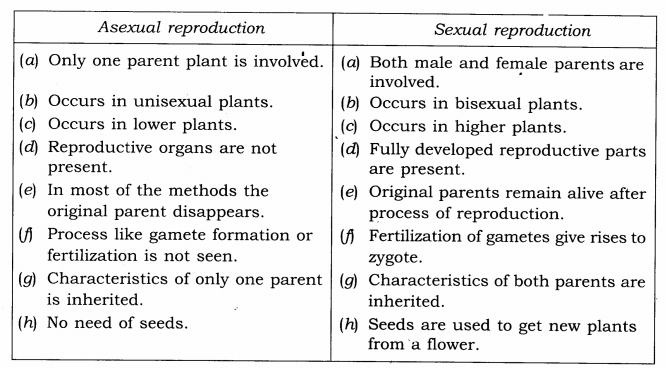
Q.4. State the main difference between asexual and sexual reproduction.
Ans.
NCERT Solutions Class 7 Science Chapter 12 Reproduction in Plants Q4

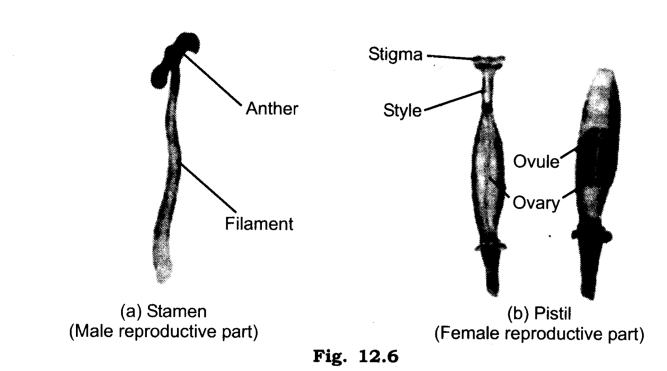
Q.5.Sketch the reproductive parts of a flower.
Ans.
NCERT Solutions Class 7 Science Chapter 12 Reproduction in Plants Q5

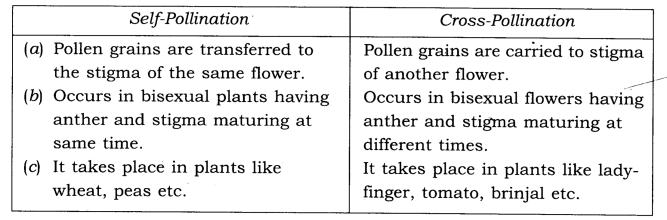
Q.6.Explain the difference between self-pollination and cross-pollination
Ans.
NCERT Solutions Class 7 Science Chapter 12 Reproduction in Plants Q6

Q.7.How does the process of fertilization take place in flowers?
Ans.When the pollen grain reaches the stigma of a same species flower, it starts
growing out into the pollen tube of the stigma. This tube continues to grow inside the style till it reaches the ovule. Male cells are released into the ovule for the fertilization with the female egg cell and thus the zygote is formed. After this process of fertilization, the ovary develops into fruit and ovule into seeds.

Q.8.Describe the various ways by which seeds are dispersed.
Ans. Following are the ways in which the seeds are dispersed:
(i) Some light seeds like that of madar, which are hairy, dry and small are carried away by the wind to different places.
(ii) Spiny seeds and fruits like that of xanthium and urena, stick to the clothes of passers by and animals. These seeds are carried away by these agents to different places.
(iii) In some plants having heavy seeds like that of coconut, water acts as the dispersing agents.
(iv) Some seeds are dispersed with the fruit burst like in case of balsam and castor.

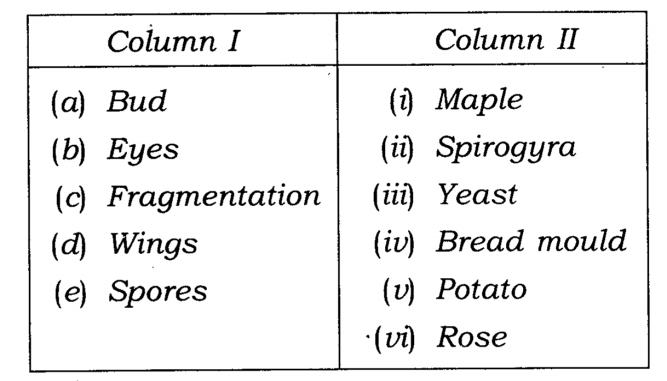
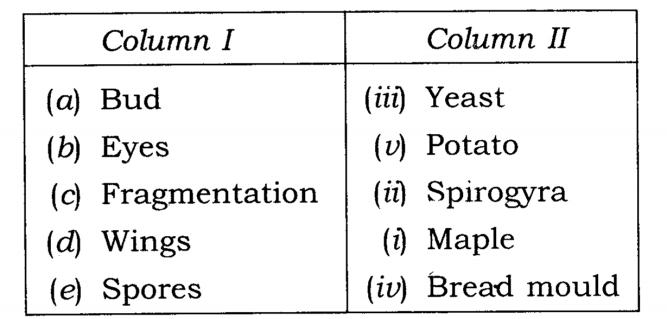
Q.9.Match items in Column I with those in Column II
NCERT Solutions Class 7 Science Chapter 12 Reproduction in Plants Q9
Ans
NCERT Solutions Class 7 Science Chapter 12 Reproduction in Plants Q9.1

Q.10. Tick (%/) the correct answer:
(a) The reproductive part of a plant is the
(i) leaf (ii) stem (iii) root (iv) flower
(b) The process of fusion of the male and the female gametes is called
(i) fertilisation (ii) pollination (iii) reproduction (iv) seed formation
c) Mature ovary forms the
(i) seed (ii) stamen (iii) pistil (iv) fruit
(d) A spore producing plant is
(i) rose (ii) bread mould (iii) potato (iv) ginger
(e) Bryophyllum can be reproduced by its
(i) stem (ii) leaves (iii) roots (iv) flower

Ans.(a) (iv) flower (b) (i) fertilisation (c) (iv) fruit (d) (ii) bread mould (e) (ii) leaves