Showing posts with label NS MATHS 7TH EM. Show all posts

NCERT Solutions for Class 7 Maths


NCERT Solutions for Class 7 Maths

Chapter wise detailed NCERT Solutions for Class 7 Maths are given below.


    NCERT Solutions for Class 7 Maths Chapter 1 Integers

    NCERT Solutions for Class 7 Maths Chapter 2 Fractions and Decimals

    NCERT Solutions for Class 7 Maths Chapter 3 Data Handling
    NCERT Solutions for Class 7 Maths Chapter 4 Simple Equations

    NCERT Solutions for Class 7 Maths Chapter 5 Lines and Angles

    NCERT Solutions for Class 7 Maths Chapter 6 The Triangles and its Properties

    NCERT Solutions for Class 7 Maths Chapter 7 Congruence of Triangles

    NCERT Solutions for Class 7 Maths Chapter 8 Comparing Quantities

    NCERT Solutions for Class 7 Maths Chapter 9 Rational Numbers

    NCERT Solutions for Class 7 Maths Chapter 10 Practical Geometry

    NCERT Solutions for Class 7 Maths Chapter 11 Perimeter and Area

    NCERT Solutions for Class 7 Maths Chapter 12 Algebraic Expressions

                          NCERT Solutions for Class 7 Maths Chapter 15 Visualising Solid Shapes


                          NCERT Solutions for Class 7 Maths Chapter 15 Visualising Solid Shapes Ex 15.1

                          NCERT Solutions for Class 7 Maths Chapter 15 Visualising Solid Shapes Exercise 15.1

                          Ex 15.1 Class 7 Maths Question 1.
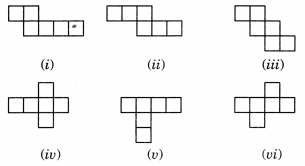
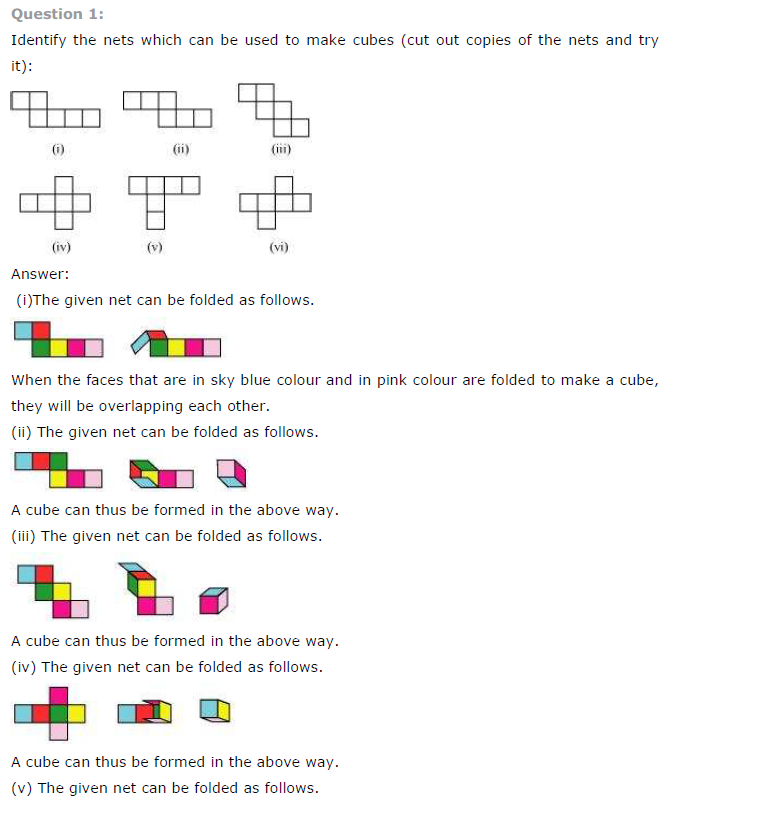
                          Identify the nets which can be used to make cubes (Cut out copies of the nets and try it):
                          NCERT Solutions for Class 7 Maths Chapter 15 Visualising Solid Shapes 1
                          Solution:
                          Fig. (ii), (iii), (iv) and (vi) can be used to make cubes.

                          Ex 15.1 Class 7 Maths Question 2.
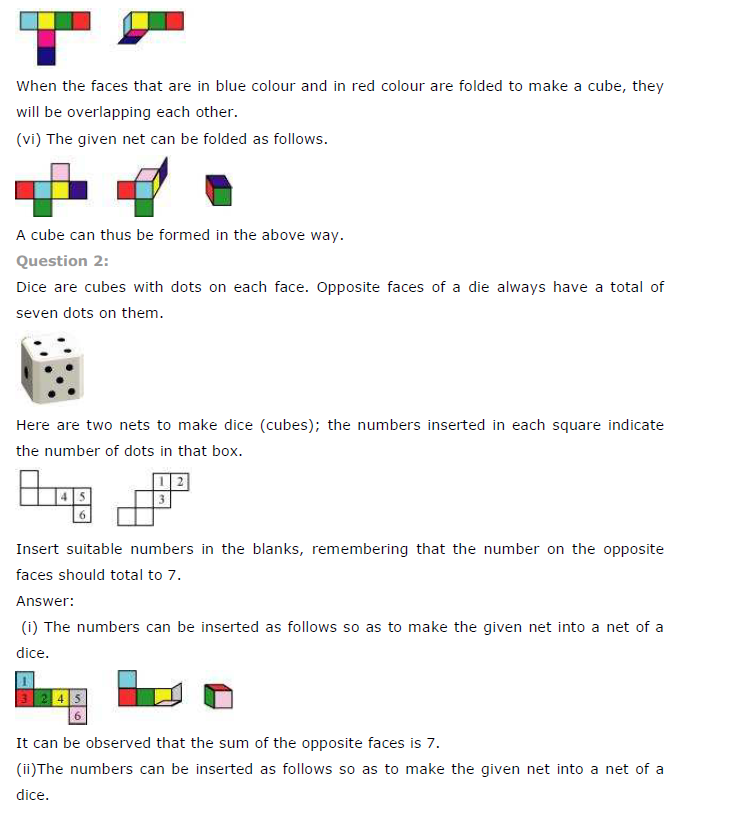
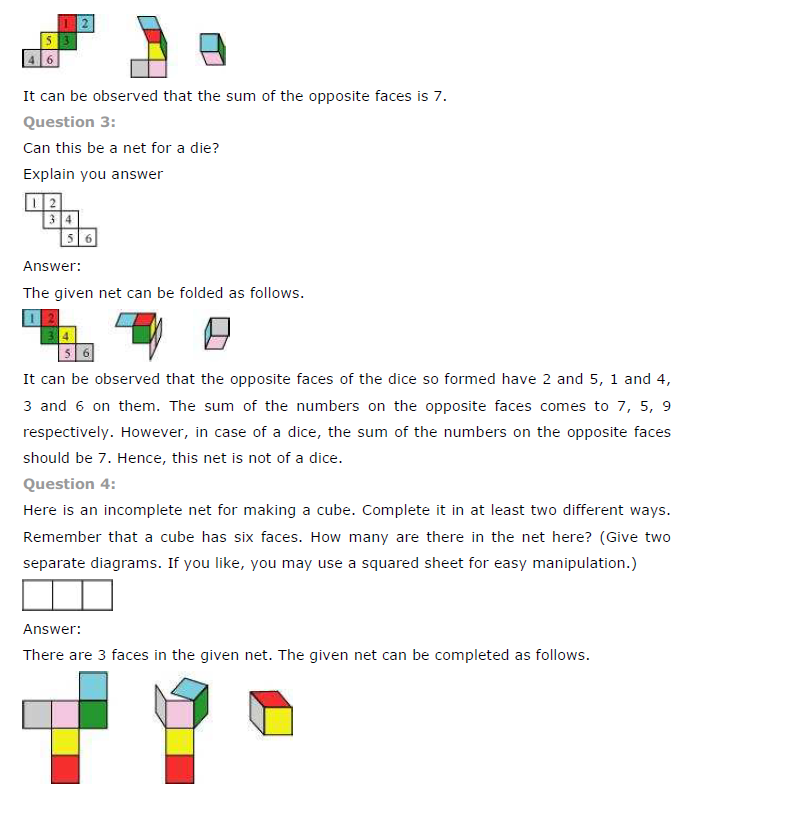
                          Dice are cubes with dots on each face. Opposite faces of a die always have a total of seven dots on them.
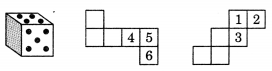
                          Here are two nets to make dice (cubes); the number inserted in each square indicate the number of dots in that box.
                          NCERT Solutions for Class 7 Maths Chapter 15 Visualising Solid Shapes 2
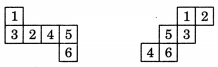
                          Insert suitable number in the blanks, remembering that the number on the opposite faces should total to 7.
                          Solution:

                          NCERT Solutions for Class 7 Maths Chapter 15 Visualising Solid Shapes 3

                          Ex 15.1 Class 7 Maths Question 3.
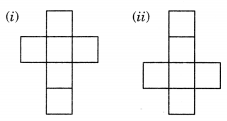
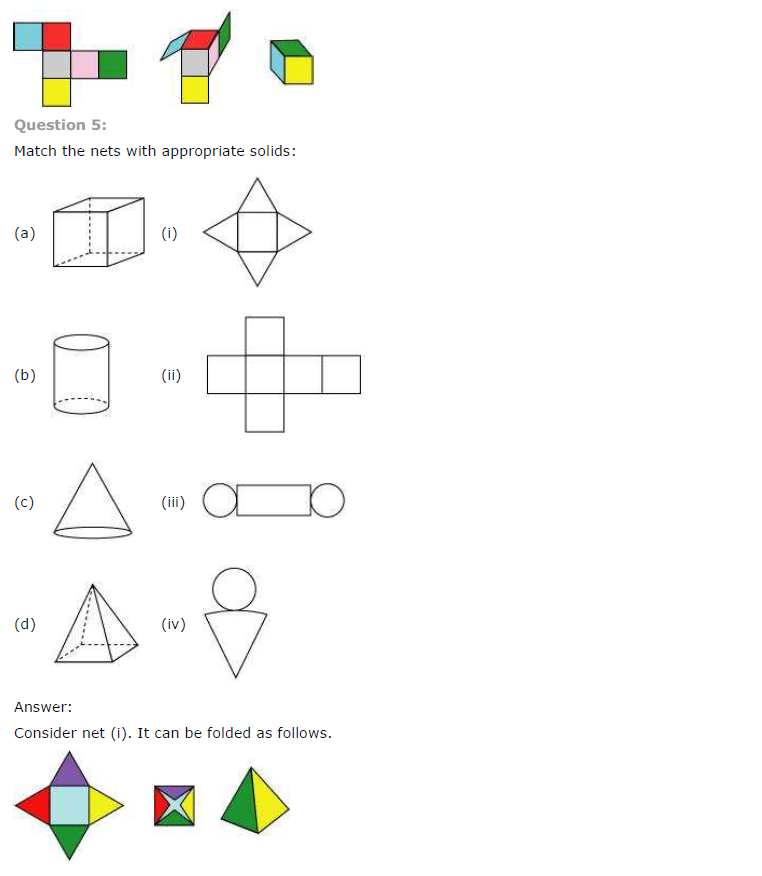
                          Can this be a net for a die? Explain your answer.
                          NCERT Solutions for Class 7 Maths Chapter 15 Visualising Solid Shapes 4
                          Solution:
                          If one pair of opposite faces will have 1 and 4 on them, then their total does not come 7.
                          If we take 3 and 6 on the opposite faces of the die, then the total does not come 7.
                          Hence, this cannot be for a die.

                          Ex 15.1 Class 7 Maths Question 4.
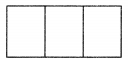
                          Here is an incomplete net for making a cube. Complete it in atleast two different ways. Remember that a cube has six faces. How many are there in the net here? (Give two separate diagrams. If you like, you may use a squared sheet for easy manipulation).
                          NCERT Solutions for Class 7 Maths Chapter 15 Visualising Solid Shapes 5
                          Solution:
                          There are three faces in the given net.
                          NCERT Solutions for Class 7 Maths Chapter 15 Visualising Solid Shapes 6

                          Ex 15.1 Class 7 Maths Question 5.
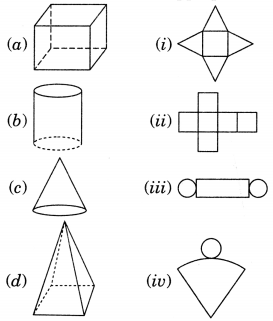
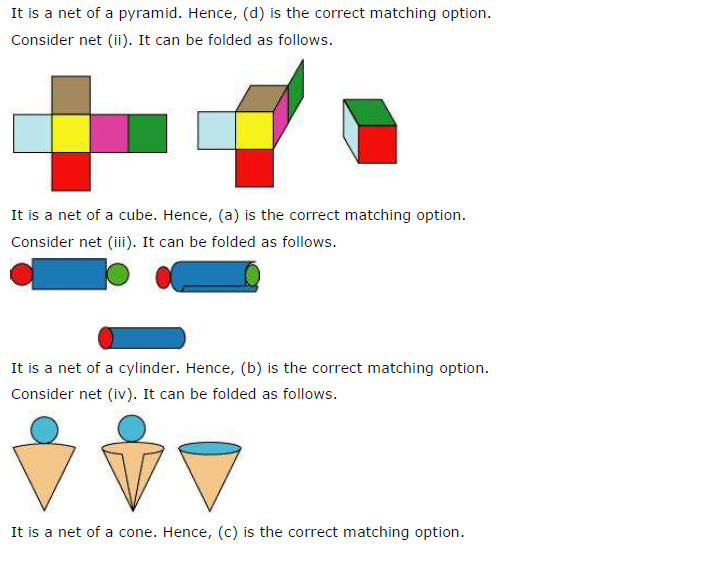
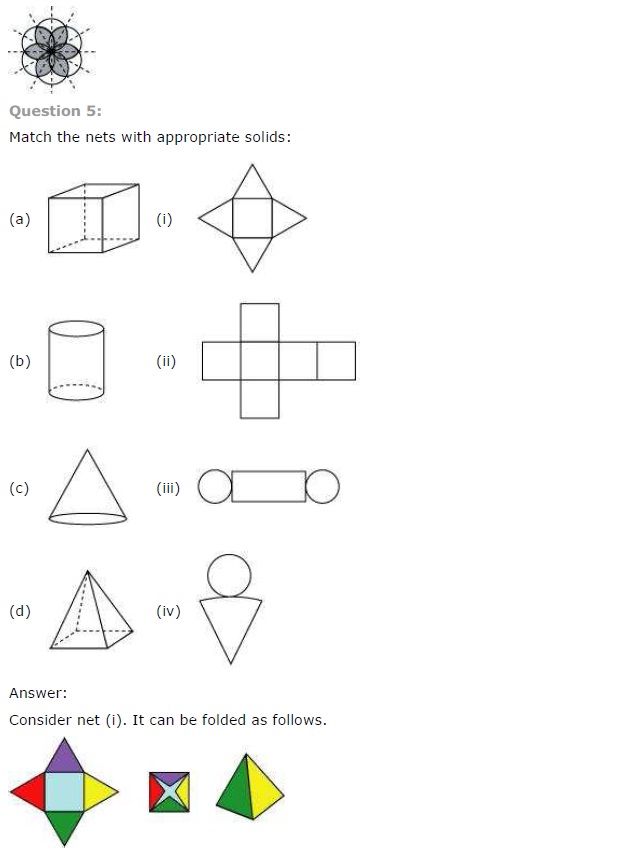
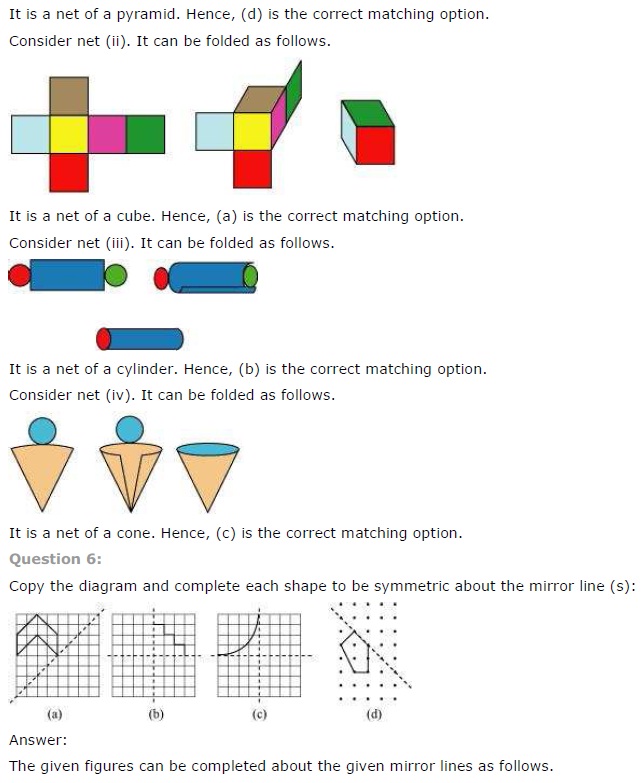
                          Match the nets with appropriate solids:
                          NCERT Solutions for Class 7 Maths Chapter 15 Visualising Solid Shapes 7
                          Solution:
                          (a) (ii)
                          (b) (iii)
                          (c) (iv)
                          (d) (i)

                          NCERT Solutions for Class 7 Maths Chapter 15 Visualising Solid Shapes Ex 15.1 Q1

                          NCERT Solutions for Class 7 Maths Chapter 15 Visualising Solid Shapes Ex 15.1 Q2

                          NCERT Solutions for Class 7 Maths Chapter 15 Visualising Solid Shapes Ex 15.1 Q3

                          NCERT Solutions for Class 7 Maths Chapter 15 Visualising Solid Shapes Ex 15.1 Q4

                          NCERT Solutions for Class 7 Maths Chapter 15 Visualising Solid Shapes Ex 15.1 Q5

                          NCERT Solutions for Class 7 Maths Chapter 14 Symmetry


                          NCERT Solutions for Class 7 Maths Chapter 14 Symmetry Ex 14.1

                          NCERT Solutions for Class 7 Maths Chapter 14 Symmetry Exercise 14.1
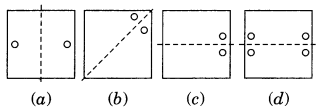
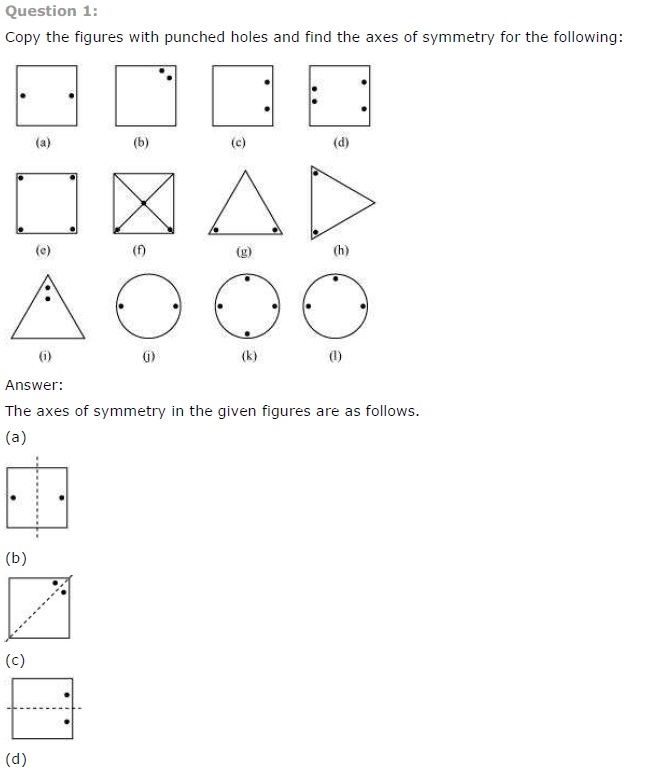
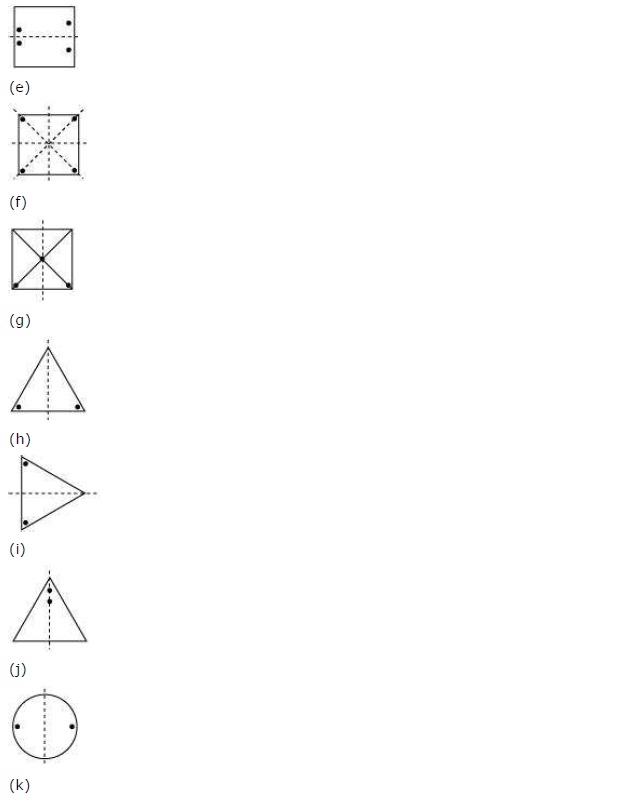
                          Ex 14.1 Class 7 Maths Question 1.
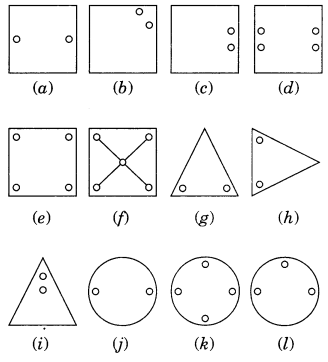
                          Copy the figures with punched holes and find the axis of symmetry for the following:
                          NCERT Solutions for Class 7 Maths Chapter 14 Symmetry 1
                          Solution:
                          The axis of symmetry is shown by following line.
                          NCERT Solutions for Class 7 Maths Chapter 14 Symmetry 2
                          NCERT Solutions for Class 7 Maths Chapter 14 Symmetry 3

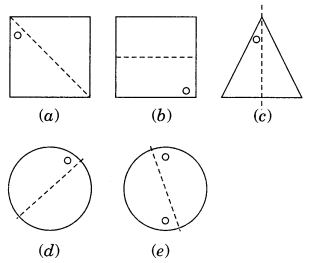
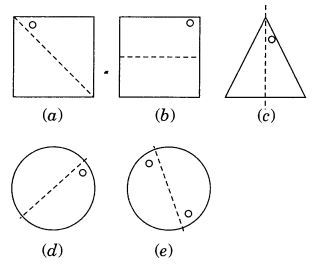
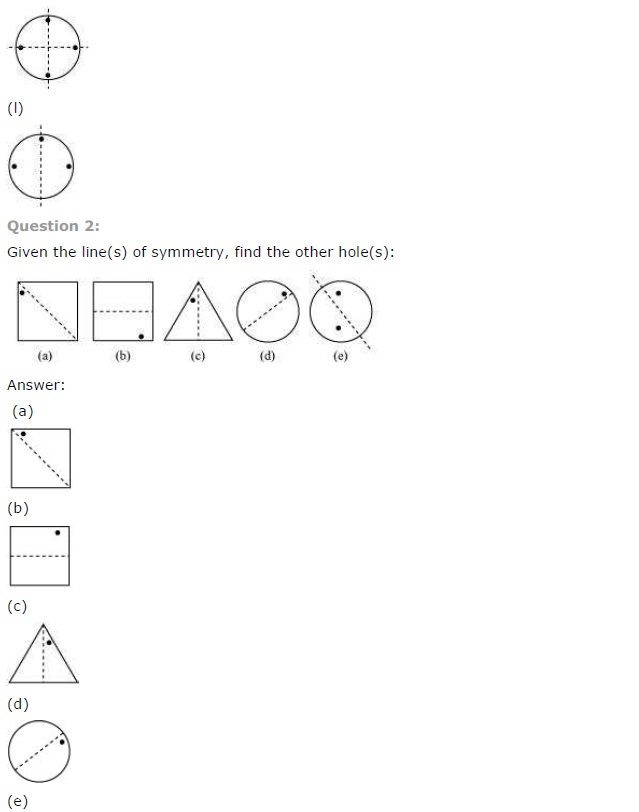
                          Ex 14.1 Class 7 Maths Question 2.
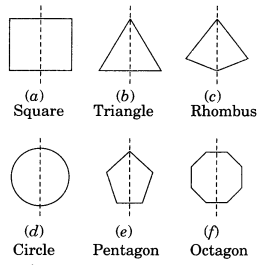
                          Give the line(s) of symmetry, find the other hole(s):
                          NCERT Solutions for Class 7 Maths Chapter 14 Symmetry 4
                          Solution:
                          NCERT Solutions for Class 7 Maths Chapter 14 Symmetry 5

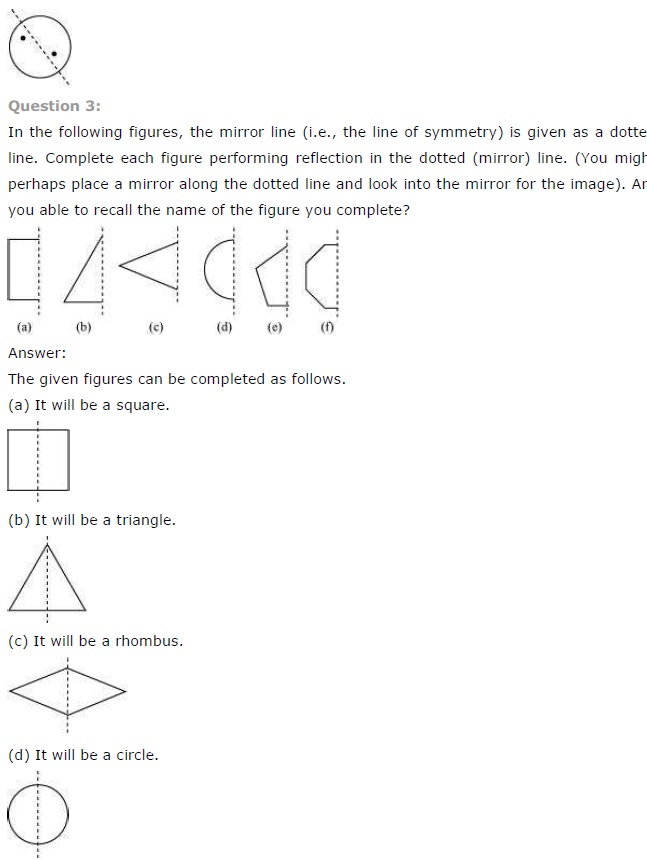
                          Ex 14.1 Class 7 Maths Question 3.
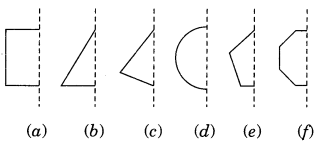
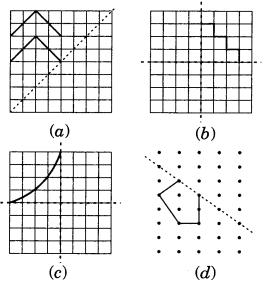
                          In the following figures, the mirror line (i.e., the line of symmetry) is given as dotted line. Complete each figure performing reflection in the dotted (mirror) line. (You might perhaps place a mirror along the dotted line and look into the mirror for the image). Are you able to recall the name of the figure you complete?
                          NCERT Solutions for Class 7 Maths Chapter 14 Symmetry 6
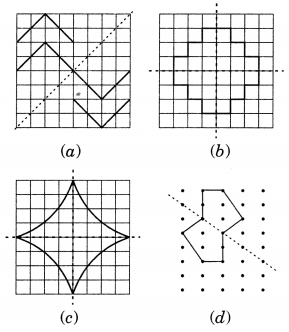
                          Solution:
                          Following are the complete figures.
                          NCERT Solutions for Class 7 Maths Chapter 14 Symmetry 7

                          Ex 14.1 Class 7 Maths Question 4.
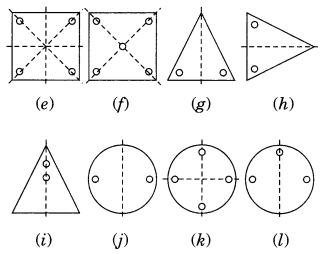
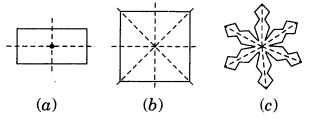
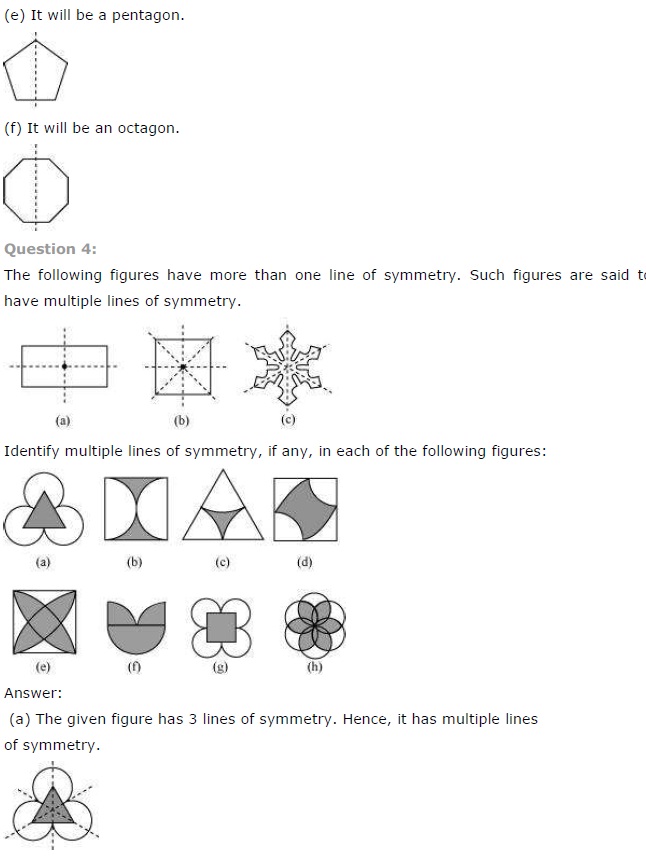
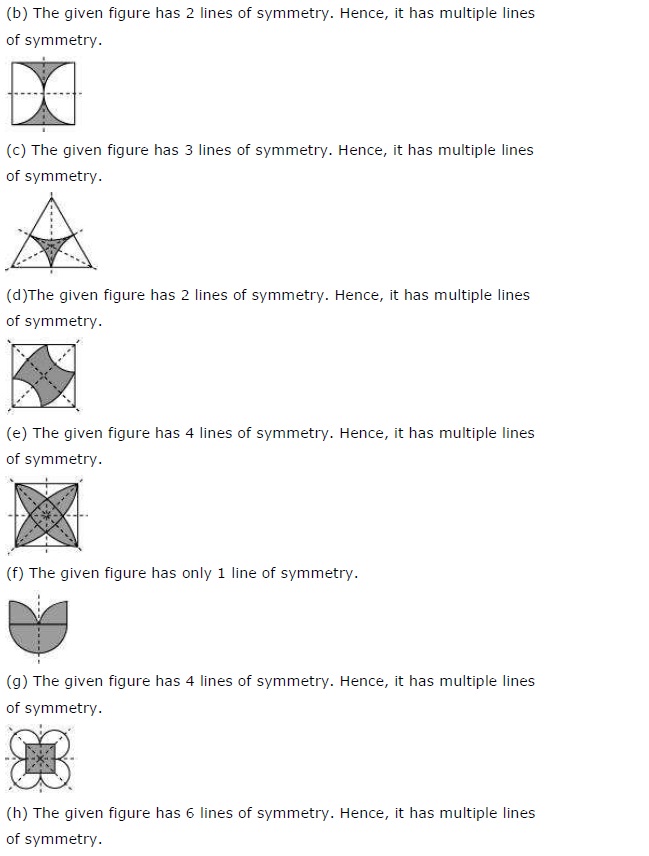
                          The following figures have more than one line of symmetry. Such figures are said to have multiple lines of symmetry.
                          NCERT Solutions for Class 7 Maths Chapter 14 Symmetry 8
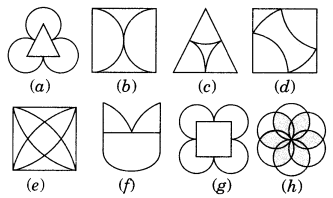
                          Identify multiple lines of symmetry, if any, in each of the following figures:
                          NCERT Solutions for Class 7 Maths Chapter 14 Symmetry 9
                          Solution:
                          Here, figure (6), (d), (e), (g) and (h) are the multiple lines of symmetry.

                          Ex 14.1 Class 7 Maths Question 5.
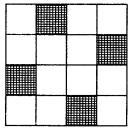
                          Copy the figure given here.
                          Take any one diagonal as a line of symmetry and shade a few more squares to make the figure symmetric about a diagonal. Is there more than one way to do that? Will the figure be symmetric about both the diagonals?
                          NCERT Solutions for Class 7 Maths Chapter 14 Symmetry 10
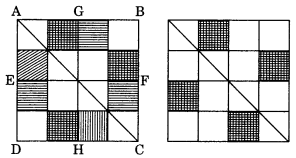
                          Solution:
                          (i) Let us take a diagonal as the axis of symmetry and shade the square as shown in the figure.
                          NCERT Solutions for Class 7 Maths Chapter 14 Symmetry 11
                          (ii) Yes, there are more than the line of symmetry i.e. BD, EF and GH.
                          (iii) Yes, the figure is symmetric about both the diagonals.

                          Ex 14.1 Class 7 Maths Question 6.
                          Copy the diagram and complete each shape to be symmetric about the mirror line(s).
                          NCERT Solutions for Class 7 Maths Chapter 14 Symmetry 12
                          Solution:
                          NCERT Solutions for Class 7 Maths Chapter 14 Symmetry 13

                          Ex 14.1 Class 7 Maths Question 7.
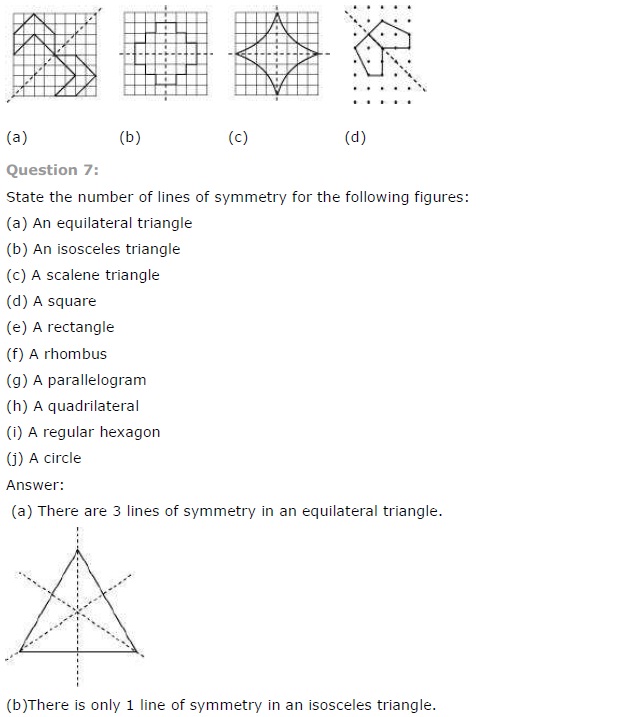
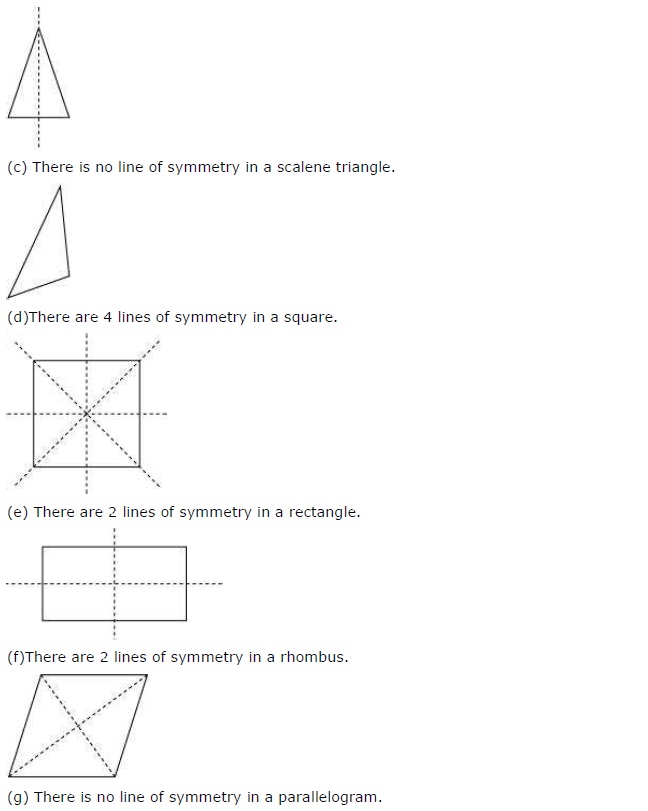
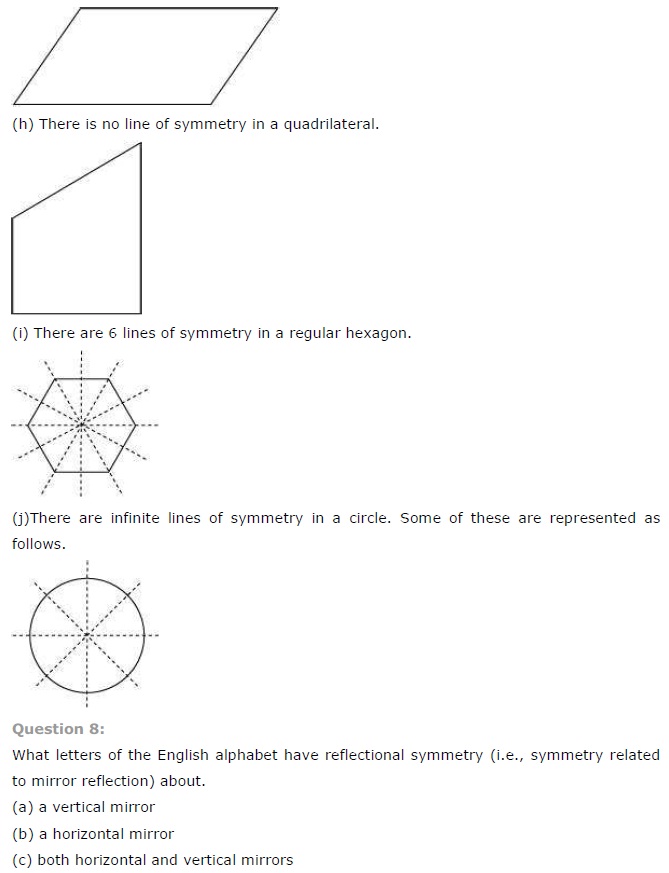
                          State the number of lines of symmetry for the following figures:
                          (а) An equilateral triangle
                          (b) An isosceles triangle
                          (c) A scalene triangle
                          (d) A square
                          (e) A rectangle
                          (f) A rhombus
                          (g) A parallelogram
                          (h) A quadrilateral
                          (i) A regular hexagon
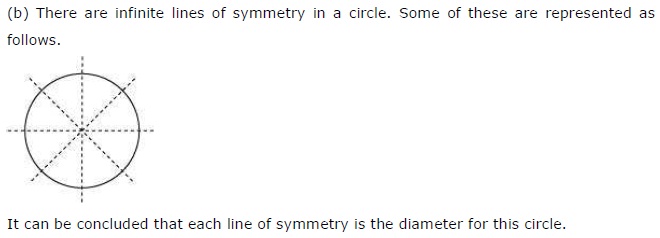
                          (j) A circle
                          Solution:

                          FigureNumber of lines of symmetry
                          (a) An equilateral triangle3
                          (6) An isosceles triangle1
                          (c) A scalene triangle0
                          (d) A square4
                          (e) A rectangle2
                          (f) A rhombus2
                          (g) A parallelogram0
                          (h) A quadrilateral0
                          (i) A regular hexagon6
                          (j) A circleInfinite

                          Ex 14.1 Class 7 Maths Question 8.
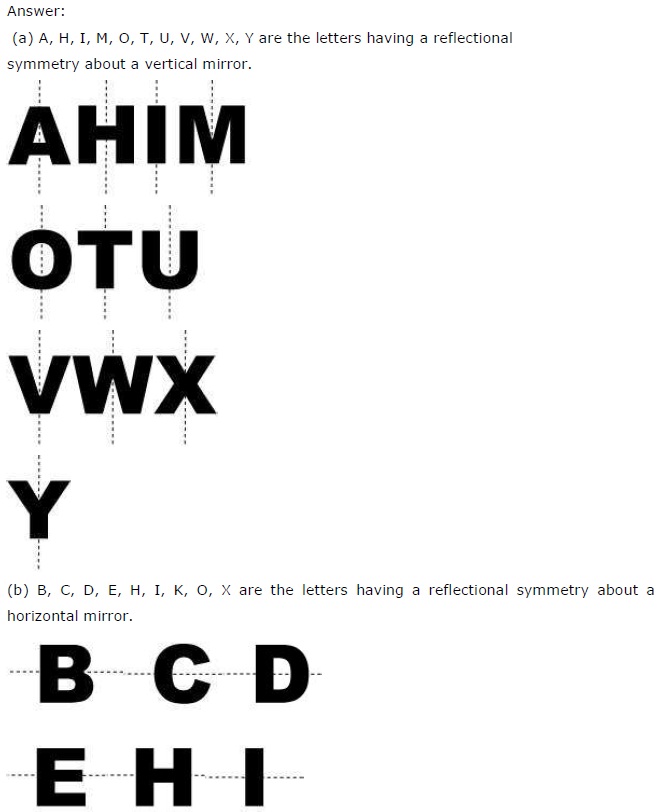
                          What letters of the English alphabet have reflectional symmetry (i.e. symmetry related to mirror reflection) about
                          (а) a vertical mirror
                          (b) a horizontal mirror
                          (c) both horizontal and vertical mirrors.
                          Solution:
                          (a) Alphabet of vertical mirror reflection symmetry are
                          A, H, I, M, O, T, U, V, W, X, Y
                          (b) Alphabet of horizontal mirror reflection symmetry are:
                          B, C, D, E, H, I, K, O, X
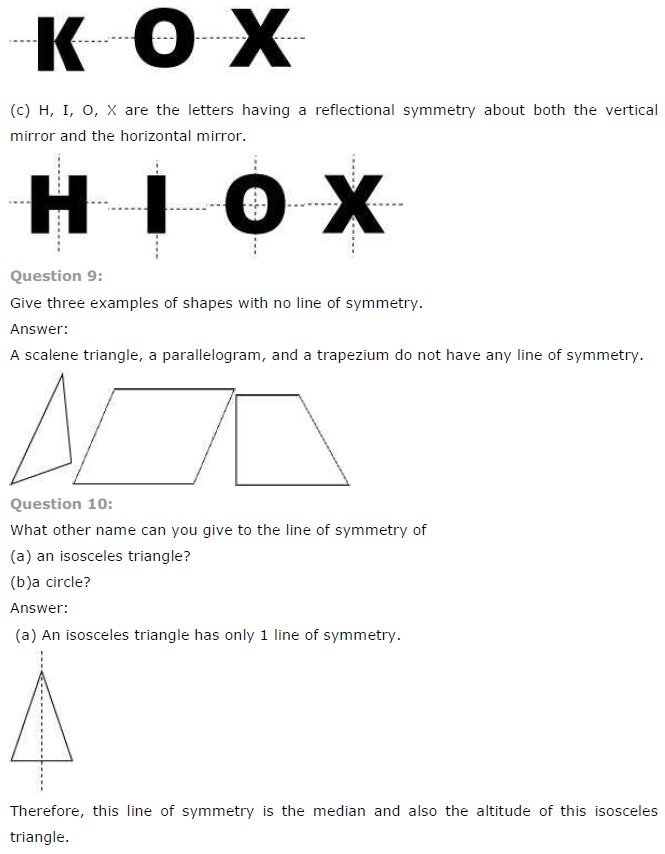
                          (c) Alphabet of both horizontal and vertical mirror reflection symmetry are:
                          H, I, O, X.

                          Ex 14.1 Class 7 Maths Question 9.
                          Give three examples of shapes with no line of symmetry.
                          Solution:
                          Example 1: Scalene triangle has no line of symmetry.
                          Example 2: Quadrilateral has no line of symmetry.
                          Example 3: Alphabet R has no line of symmetry.

                          Ex 14.1 Class 7 Maths Question 10.
                          What other name can you give of the line of symmetry of
                          (a) an isosceles triangle?
                          (b) a circle?
                          Solution:
                          (a) Median of an isosceles triangle is its line of symmetry.
                          (b) Diameter of a circle is its line of symmetry.

                          NCERT Solutions for Class 7 Maths Chapter 14 Symmetry Ex 14.1 Q1

                          NCERT Solutions for Class 7 Maths Chapter 14 Symmetry Ex 14.1 Q1.1

                          NCERT Solutions for Class 7 Maths Chapter 14 Symmetry Ex 14.1 Q2

                          NCERT Solutions for Class 7 Maths Chapter 14 Symmetry Ex 14.1 Q3

                          NCERT Solutions for Class 7 Maths Chapter 14 Symmetry Ex 14.1 Q4

                          NCERT Solutions for Class 7 Maths Chapter 14 Symmetry Ex 14.1 Q4.1

                          NCERT Solutions for Class 7 Maths Chapter 14 Symmetry Ex 14.1 Q5

                          NCERT Solutions for Class 7 Maths Chapter 14 Symmetry Ex 14.1 Q6

                          NCERT Solutions for Class 7 Maths Chapter 14 Symmetry Ex 14.1 Q7

                          NCERT Solutions for Class 7 Maths Chapter 14 Symmetry Ex 14.1 Q7.1

                          NCERT Solutions for Class 7 Maths Chapter 14 Symmetry Ex 14.1 Q8

                          NCERT Solutions for Class 7 Maths Chapter 14 Symmetry Ex 14.1 Q8.1

                          NCERT Solutions for Class 7 Maths Chapter 14 Symmetry Ex 14.1 Q9

                          NCERT Solutions for Class 7 Maths Chapter 14 Symmetry Ex 14.1 Q9.1

                          NCERT Solutions for Class 7 Maths Chapter 13 Exponents and Powers


                          NCERT Solutions for Class 7 Maths Chapter 13 Exponents and Powers Ex 13.1

                          NCERT Solutions for Class 7 Maths Chapter 13 Exponents and Powers Exercise 13.1
                          Ex 13.1 Class 7 Maths Question 1.
                          Find the value of
                          (i) 26
                          (ii) 93
                          (iii) 112
                          (iv) 54
                          Solution:
                          (i) 26 = 2 × 2 × 2 × 2 × 2 × 2 = 64
                          (ii) 93 = 9 × 9 × 9 = 729
                          (iii) 112 = 11 × 11 = 121
                          (iv) 54 = 5 × 5 × 5 × 5 = 625

                          Ex 13.1 Class 7 Maths Question 2.
                          Exress the following in exponential form:
                          (i) 6 × 6 × 6 × 6
                          (ii) t × t
                          (iii) b × b × b × b
                          (iv) 5 × 5 × 7 × 7 × 7
                          (v) 2 × 2 × a × a
                          (vi) a × a × a × c × c × c× c × d
                          Solution:
                          (i) 6 × 6 × 6 × 6 = 63
                          (ii) t × t = t2
                          (iii) b × b × b × b = b4
                          (iv) 5 × 5× 7 × 7 × 7 = 52 × 73 = 52 · 73
                          (v) 2 × 2 × a × a = 22 × a2 = 22 · a2
                          (vi) a × a ×a × c × c × c × c × d = a3 × c4 × d = a3 · c4 · d

                          Ex 13.1 Class 7 Maths Question 3.
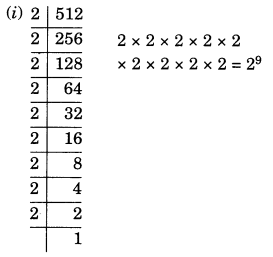
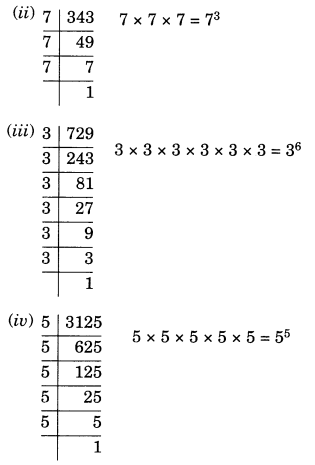
                          Express each of the following numbers using exponential notation:
                          (i) 512
                          (ii) 343
                          (iii) 729
                          (iv) 3125
                          Solution:
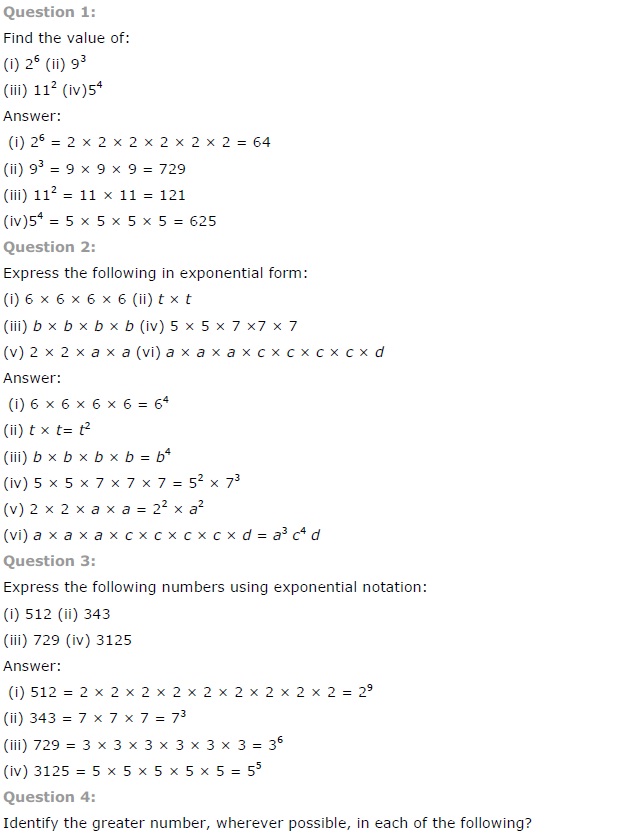
                          NCERT Solutions for Class 7 Maths Chapter 13 Exponents and Powers 1
                          NCERT Solutions for Class 7 Maths Chapter 13 Exponents and Powers 2

                          Ex 13.1 Class 7 Maths Question 4.
                          Identify the greater number, wherever possible, in each of the following?
                          (i) 43 or 34
                          (ii) 53 or 35
                          (iii) 28 or 82
                          (iv) 1002 or 2100
                          (v) 210 or 102
                          Solution:
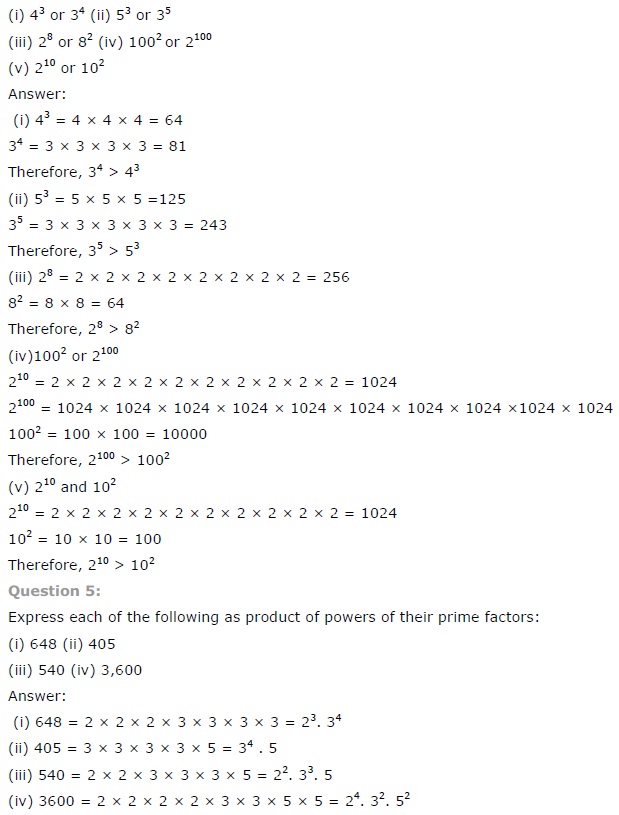
                          (i) 43 or 34
                          43 = 4 × 4 × 4 = 64,
                          34 = 3 × 3 × 3 × 3 = 81
                          Since 81 > 64
                          ∴ 34 is greater than 43.

                          (ii) 53 or 35
                          53 = 5 × 5 × 5 = 125
                          35 = 3 × 3 × 3 × 3 × 3 = 243
                          Since 243 > 125
                          ∴ 35 is greater than 53.

                          (iii) 28 or 82
                          28 =2 × 2 × 2 × 2 × 2 × 2 × 2 × 2 = 256
                          82 = 8 × 8 = 64
                          Since 256 > 64
                          ∴ 28 is greater than 28.

                          (iv) 1002 or 2100
                          1002 = 100 × 100 = 10000
                          2100 = 2 × 2 × 2 × … 100 times
                          Here 2 × 2 × 2 ×2 × 2 × 2 × 2 ×2 × 2 × 2 × 2 × 2 × 2 × 2 = 214 = 16384
                          Since 16384 > 10,000
                          ∴ 2100 is greater than 1002.

                          (v) 210 or 102
                          210 = 2 × 2 × 2 × 2 × 2 × 2 × 2 × 2 × 2 × 2 = 1024
                          102 = 10 × 10 = 100
                          Since 1024 > 100
                          ∴ 210 is greater than 102.

                          Ex 13.1 Class 7 Maths Question 5.
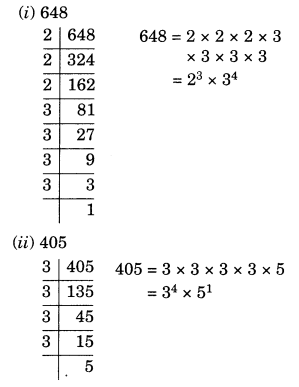
                          Express each of the following as the product of powers of their prime
                          (i) 648
                          (ii) 405
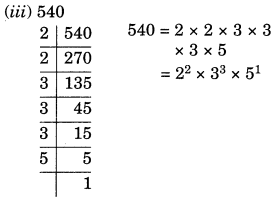
                          (iii) 540
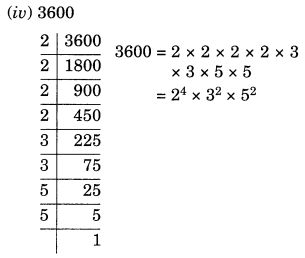
                          (iv) 3600
                          Solution:
                          NCERT Solutions for Class 7 Maths Chapter 13 Exponents and Powers 3
                          NCERT Solutions for Class 7 Maths Chapter 13 Exponents and Powers 4

                          NCERT Solutions for Class 7 Maths Chapter 13 Exponents and Powers 5

                          Ex 13.1 Class 7 Maths Question 6.
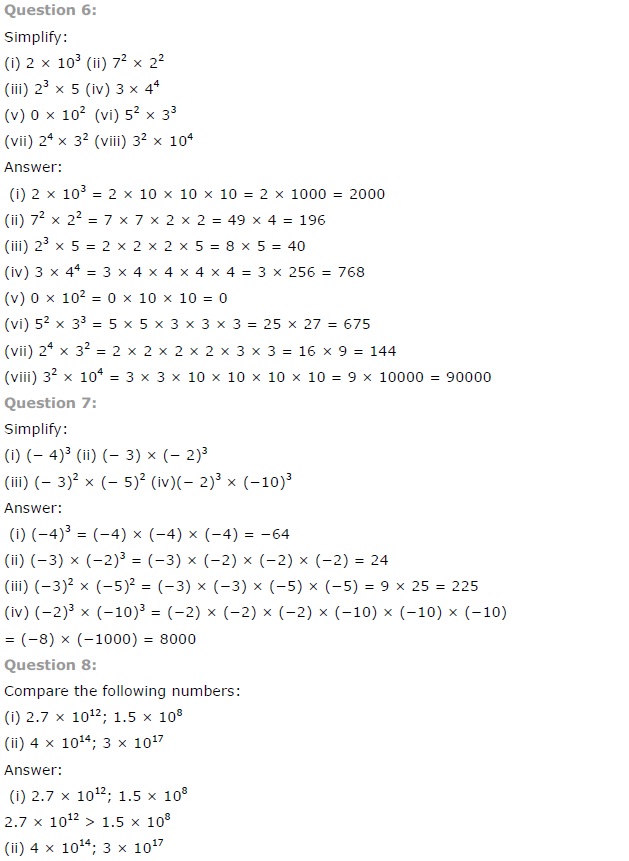
                          Simplify:
                          (i) 2 × 10³
                          (ii) 72 × 22
                          (iii) 23 × 5
                          (iv) 3 × 44
                          (v) 0 × 102
                          (vi) 52 × 33
                          (vii) 24 × 32
                          (viii) 32 × 104
                          Solution:
                          (i) 2 × 103 = 2 × 10 × 10 × 10 = = 2000
                          (ii) 72 × 22 = = 7 × 7 × 2 × 2 = 196
                          (iii) 23 × 5 = 2 × 2 × 2 × 5 = 40
                          (iv) 3 × 44 = 3 × 4 × 4 × 4 × 4 = 768
                          (v) 0 × 102 = 0 × 10 × 10 = = 0
                          (vi) 52 × 33 = 5 × 5 × 3 × 3 × 3 = 675
                          (vii) 24 × 32 = 2 × 2 × 2 × 2 × 3 × 3 = 144
                          (viii) 32 × 104 = 3 × 3 × 10 × 10 × 10 × 10 = 90000

                          Ex 13.1 Class 7 Maths Question 7.
                          Simplify:
                          (i) (-4)3
                          (ii) (-3) × (-2)3
                          (iii) (-3)2 × (-5)2
                          (iv) (-2)3 × (-10)3
                          Solution:
                          (i) (-4)2 = (-4) × (-4) × (-4) = -64 [∵ (-a)odd number = -aodd number]
                          (ii) (-3) × (-2)3 = (-3) × (-2) × (-2) × (-2)
                          = (-3) × (-8) = 24
                          (iii) (-3)2 × (-5)2 = [(-3) × (-5)]2
                          = 152 = 225 [∵ am × bm = (ab)m)
                          (iv) (-2)3 × (-10)3 = [(-2) × (-10)]3
                          = 202 = 8000 [∵ am × bm = (ab)m]

                          Ex 13.1 Class 7 Maths Question 8.
                          Compare the following:
                          (i) 2.7 × 10¹²; 1.5 × 10⁸
                          (ii) 4 × 10¹⁴; 3 × 10¹⁴
                          Solution:
                          (i) 2.7 × 10¹²; 1.5 × 10⁸
                          Here, 1012 > 108
                          ∴ 2.7 × 10¹²> 1.5 × 10⁸
                          (ii) 4 × 10¹⁴; 3 × 10¹⁷
                          Here, 1017 > 1014
                          ∴ 4 × 10¹⁴ < 3 × 10¹⁷

                          NCERT Solutions for Class 7 Maths Chapter 13 Exponents and Powers Ex 13.1 Q1

                          NCERT Solutions for Class 7 Maths Chapter 13 Exponents and Powers Ex 13.1 Q2

                          NCERT Solutions for Class 7 Maths Chapter 13 Exponents and Powers Ex 13.1 Q3

                          NCERT Solutions for Class 7 Maths Chapter 13 Exponents and Powers Ex 13.1 Q4