Showing posts with label NS MATHS 3RD EM. Show all posts

NCERT Solutions for Class 3 Mathematics Chapter-14 Rupees and Paise


NCERT Solutions for Class 3 Mathematics Chapter-14 Rupees and Paise

Shopping
You can visit this self-service store.
A.Without using a pencil or paper, find out the cost of:
•One ball and one toy car Rs 22
•One notebook and two pencils Rs 10
•Two bananas and a glass of milk Rs 6.50
•One doll and a ball Rs 15
•One glass of is lemon juice and a packet of biscuits Rs 7.50
B.Find the total cost of:
•One toy giraffe, one copy and a glass of lemon juice Rs 14.50
•One glass of milk, one packet of biscuits and a banana Rs 9.50
•One notebook, two pencils and two erasers Rs 12
•Two tops, three toffees and two bananas Rs 8.50
C. What can you buy, if you have a twenty rupee note?
•1 toy car, 1 lemon juice, 1 banana
•1 ball, 1 doll, 1 glass milk
•1 toy car, 1 packet of biscuits, 1 toffee
•1 toy car, 1 toy giraffe, 1 glass milk
D.You need to make a cash memo for the things you bought. Before adding, first
guess how much money will be needed. Then find the total and check your guess.
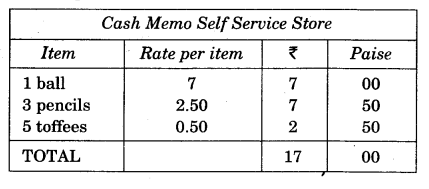
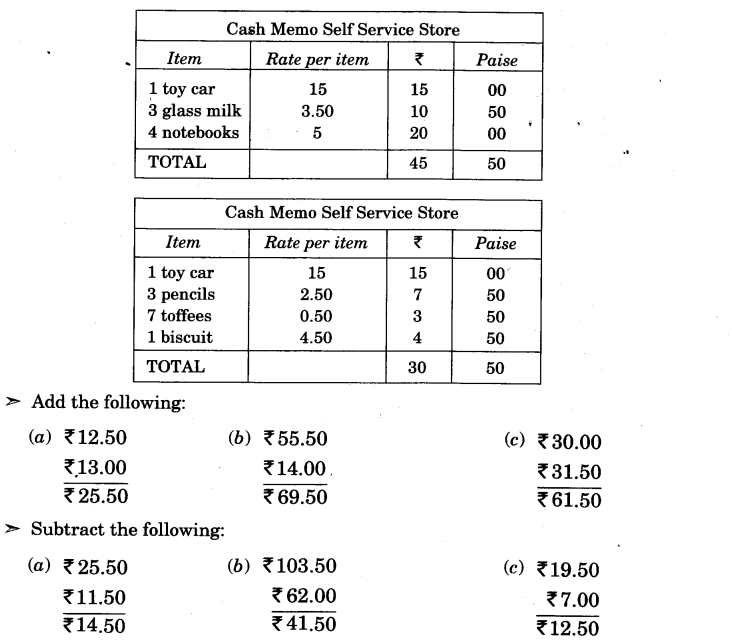
Monu prepared the following cash memos:
Check the cash memos and correct them if you find a mistake.
Ans. Correct memos are given as follows:
NCERT Solutions for Class 3 Mathematics Chapter-14 Rupees and Paise Shopping Q1

NCERT Solutions for Class 3 Mathematics Chapter-14 Rupees and Paise Shopping Q1.1
E.If you have 30 rupees with you. Find out how much money will be left after buying the following items:

1.One hall, one doll and one toy giraffe.
Ans.Price of one ball = Rs 7.00
Price of one doll = Rs 8.00
Price of one toy giraffe = Rs 6.50
So, total cost = Rs7.00 + Rs 8.00 + Rs 6.50 = Rs 21.50
Money left = Total money – money spent
= Rs 30.0021. 50 = Rs 8.50

2.Two bananas, one pack of biscuits and two glasses of lemon juice.
Ans. Price of 1 banana = Rs 1.50
So, price of 2 bananas = 1.50 x2=Rs 3.00
Price of one pack of biscuit = Rs 4.50
Price of one glass lemon juice = Rs 3.00
So, price of two glasses of lemon juice = 3.00 x2 = Rs 6.00
Total cost = Rs 3.00 + Rs 4.50 + Rs 6.00 = 13.50
Money left = Total money – Money spent = Rs 30.00 – Rs 13.50 = Rs 16.50

3.Three notebooks, two pencils and two erasers.
Ans. Price of 1 notebook =Rs 5.00
So, price of 3 notebooks =Rs 5.00 x 3 = Rs 15.00
Price of 1 pencil =Rs 2.50
So, price of 2 pencils = Rs 2.50 x 2 = Rs 5.00
Price of 1 eraser = Rs 1.00
So, price of 2 erasers = Rs 1.00 x 2 = Rs 2.00
Total cost= Rs 15.00 + Rs 5.00 + Rs 2.00 = Rs 22.00

Practice Time
A.Three friends wanted to buy a cricket bat and ball. Bina had Rs 48.50, Raman had Rs 55.50 and Venu had Rs 38.00. How much money did they have in all?
Ans. They had X 142.00 in all.

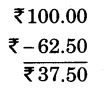
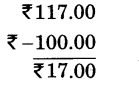
B. Hari booked a railway ticket for Rs 62.50. He gave a 100 rupee note. How much money will he get back with the ticket?
Ans.
NCERT Solutions for Class 3 Mathematics Chapter-14 Rupees and Paise Practice B

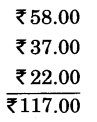
C. Gita and her friend went shopping. She bought things for Rs 58, Rs 37 and Rs 22. Gita had a hundred rupee note. How much money should she borrow from her friend to pay the bill?
Ans. Gita needs to pay the following amount:
NCERT Solutions for Class 3 Mathematics Chapter-14 Rupees and Paise Practice C
Now she needs to borrow the following amount:
NCERT Solutions for Class 3 Mathematics Chapter-14 Rupees and Paise Practice C.1

Train Journey
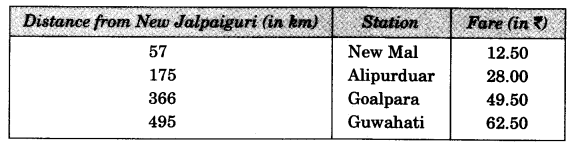
This train goes from New Jalpaiguri to Guwahati. On its way, it stops at New Mai, Alipurduar and Goalpara stations.
The cost of a rail ticket to different stations is given in the table.
NCERT Solutions for Class 3 Mathematics Chapter-14 Rupees and Paise Train Journey Q1
Find The Distance
(ะฐ)From New Mai to Guwahati 495 km – 57 km = 438 km
(b)Between New Mai and Goalpara 666 km – 57 km = 309 km
(c)From Alipurduar to Guwahati 495 km – 175 km = 320 km
(d)Between New Mai and Alipurduar 175 km – 57 km = 118 km
(e)From Goalpara to Guwahati 495 km – 366 km = 129 km

Find The Cost of Tickets
(a) Bhupen is going from New Jalpaiguri to Alipurduar. What is the cost of his ticket?
Ans.Rs 28.00
(b) Indra has to go from New Jalpaigurei to Goalpara. How much does she pay for the ticket?
Ans. Rs 49.50
(c) Debu, Shoma and Gobind are goind from New Jalpaiguri to New Mai. What amount will they pay for three tickets? They gjve aRs 50 note for the tickets. How much money will they get back?
Ans. Cost of 1 ticket from New Jalpaiguri to New Mall =Rs 12.50 So, cost of three tickets = Rs 12.50 x 3 = 37.50 Money given – Money spent = Money got back or, Rs 50 – Rs37,50 = Rs 12. 50 They will get back Rs 12.50.


NCERT Solutions for Class 3 Mathematics Chapter-13 Smart Charts!


NCERT Solutions for Class 3 Mathematics Chapter-13 Smart Charts!

Flowers of Different Colours

1.Have you ever been to a park?
Ans. Yes, I have been to a park.

2.What coloured flowers did you see?
Ans. I saw flowers of different colours like yellow, blue, red, orange and purple etc.

3.Were most of the flowers yellow in colour?
Ans. Yes.

What do We See on the Road?
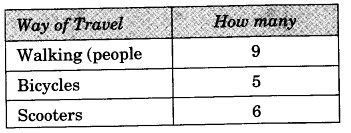
1.Look at the traffic scene in the picture and fill in the table.
Ans.
NCERT Solutions for class 3 Mathematics Chapter-13 Smart Charts What do We See on the Road Q1
Answer the following questions:
(ะฐ)In the picture which way of travel do you see the most?
Ans. Bus.
(b)Which way of travel (vehicle) do you see the least?
Ans. Bullock-cart.
(c)The number of people walking is more than the number of ———–
Ans. Scooters.
(d)The number of buses is less than the number of————
Ans. People walking.

How Many Times do You Get 6?
1.Have you played any games with dice?
Ans. Yes, I have played many games with dice?

2.How many dots are there on the different faces of a dice?
Ans. There are 1, 2, 3, 4, 5 and 6 dots on the different faces of a dice.
•Throw a die.
•Look at the number of dots you get on the face of your die.
•For each throw draw a mark / in front of that number in the table.
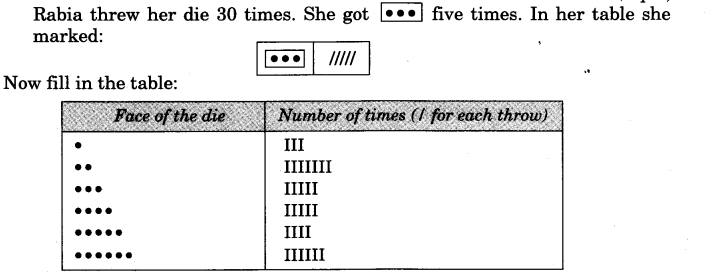
•Throw the die 30 times and mark in the table each time. For example,
NCERT Solutions for class 3 Mathematics Chapter-13 Smart Charts How Many Times do You Get 6 Q1
(a)Which face of the die did you get the most number of times?
Ans. 2

(b)
NCERT Solutions for class 3 Mathematics Chapter-13 Smart Charts How Many Times do You Get 6 Q1.1
Ans. Six .times.

(c)
NCERT Solutions for class 3 Mathematics Chapter-13 Smart Charts How Many Times do You Get 6 Q1.2
Ans. No.

Getting Smart with Charts
NCERT Solutions for class 3 Mathematics Chapter-13 Smart Charts Getting Smart with Charts Q1
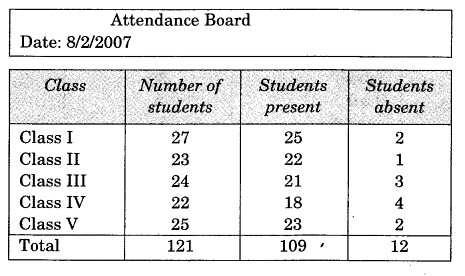
This board shows the number of students in each class. It also shows the number of students present and absent.
1.How many children in gill are there in the school?
Ans. 121.

2.How many children in all are absent on that day?
Ans. 12.
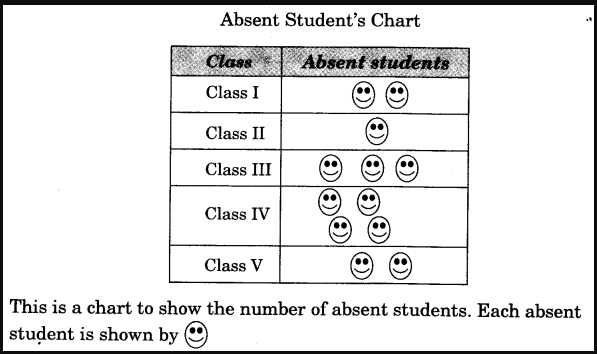
NCERT Solutions for class 3 Mathematics Chapter-13 Smart Charts Getting Smart with Charts Q2
In the chart show the absent students of class V.
Now look at the chart and fill in the blanks:
(ะฐ)The class with the highest number of absent students is IV.
(b)The class with the least number of absent students is II.
(c)The class with 3 students absent is III.
(d)The number of students absent in class IV and class V are 4 and 2.

Practice Time
Make your own smart charts about things around you.
1.Which bird has the most colours?
NCERT Solutions for class 3 Mathematics Chapter-13 Smart Charts Practice Q1
Ans. The table clearly shows that the peacock has the most colours

2.Which is the animal liked most as a pet?
NCERT Solutions for class 3 Mathematics Chapter-13 Smart Charts Practice Q2
Ans. This table clearly shows that dog is the animal which is liked most as a pet.

NCERT Solutions for Class 3 Mathematics Chapter-12 Can We Share?


NCERT Solutions for Class 3 Mathematics Chapter-12 Can We Share?

Share the Grains
1.Mummy bird brings 12 grains.
How to distribute equally?
Mummy bird starts by giving 1 grain to each baby. Then mummy bird gives one more grain to each baby. Each baby has got 2 grains now. How many grains are
Ans. There are 4 baby birds and each baby bird gets 2 grains.
So, number of grains with baby birds = 2×4 = 8
So, number of grains left = 12 – 8 = 4
She puts one more grain in each baby’s mouth. All the grains are finished.
12 grains have been divided among 4 baby birds. Each baby has got 3 grains. 12÷4 = 3

Try These Now
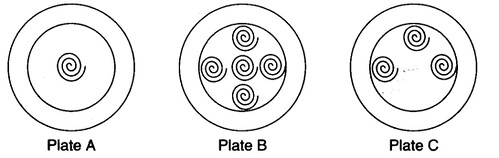
Gopu has 3 plates of jalebis.
Each plate has a different number of jalebis.
NCERT Solutions for Class 3 Mathematics Chapter-12 Can We Share Try These Now Q1
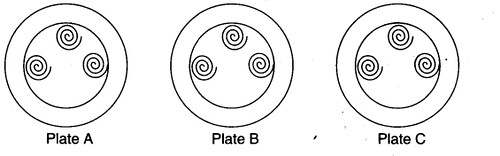
Now draw the jalebis on the plates below, so that each plate has the same number of jalebis.
NCERT Solutions for Class 3 Mathematics Chapter-12 Can We Share Try These Now Q1.1
1.How many jalebis are there altogether?
Ans. 1 + 5 + 3 = 9 jalebis.

2.How many jalebis are there in each plate?
Ans. 3 jalebis.

3.Discuss in the class how you found the answer.
Ans. Total number of jalebis = 1 + 5 + 3 = 9
Total number of jalebis is divided into 3 equal parts:
9÷3 = 3
So, each plate gets 3 jalebis.

Sharing Them Equally?
Here are six bananas.
Here are three monkeys.
If they share the bananas equally, each monkey will get 2 bananas.
6 bananas divided into 3 equal parts = 2 bananas each 6 + 3 = 2
If there are six bananas and two monkeys,
Each monkey will get three bananas.
Six bananas + 2 = 3 bananas each.
6 ÷2 = 3

1.If there are 60 bananas and two monkeys, how many will each monkey get?
Ans. 60 ÷ 2 = 30 bananas
So, each monkey will get 30 bananas.

2.What if there are 600 bananas and two monkeys?
Ans. 600 ÷ 2 = 300 bananas
So, each monkey will get 300 bananas.
NCERT Solutions for Class 3 Mathematics Chapter-12 Can We Share Sharing Them Equally Q2
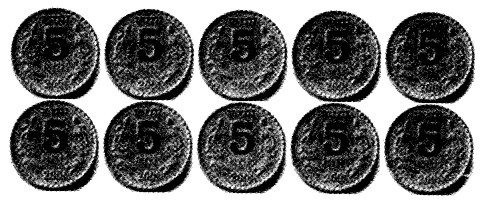
Five friends found 10 five-rupee coins on the ground. They shared them equally. Each friend got ten rupees.
50 ÷ 5 = 10
If there are 16 ten-rupee notes and four friends to share, then 16 ÷ 4 = 4 ten-rupee notes and 4 x 10 = 40. So, each friend gets 4 x 10 = 40
rupees.

1.Five friends found ? 100. If they share it equally, how much will each get?
Ans.100÷ 5 = 20.

2. Hari  Prasad has 30 metres of rope.
He distributes it equally among his three children. Each child gets———–metres of rope.
Ans. 30÷3 = 10 metres.

3.If there is 36 metres of rope, how much of rope will each child get?
Ans. 36 ÷ 3 = 12 metres.

4.If there is 60 metres of rope, how much will each child get?
Ans. 60 ÷ 3 = 20 metres.

How Many Shelves?
1.I have 20 books. I can keep 5 books in one shelf, so how many shelves do I need in my almirah?
Ans. 20÷5 = 4 shelves.

Practice Time
1. Minku puts her 15 laddoos equally into 5 boxes.
(i)How many laddoos will there be in each box?
Ans. 15 ÷ 5 = 3 laddoos in each box.
(ii)If she uses only 3 boxes, how many laddoos will there be in each box?
Ans. 15 ÷ 3 = 5 laddoos in each box.

2.Share 25 bananas among 5 monkeys. How many bananas for each monkey?
Ans. 25 ÷5 = 5 bananas for each monkey.

3.Share 12 balloons among 3 boys. How many balloons for each boy?
Ans. 12÷ 3 = 4 balloons for each boy.

4.There are 21 candles. Put them equally in 3 boxes. How many candles are there in each box?
Ans. 21 ÷ 3 = 7 candles in each box.

5.There are 18 socks. How many girls can wear these socks?
Ans. One girl wears 2 socks.
So, 18÷ 2 = 9 girls can wear these socks.
Raj has 36 minutes to make rotis. One roti takes 3 minutes.

6.How many rotis can he make in this time?
Ans. 36 ÷ 3 = 12
So, Raj can make 12 rotis in this time.

7.There are 24 foot marks of goats. So, how many goats are there?
Ans. 1 goat will make 4 foot marks , So, 24 -r 4 = 6 goats are there.

8.Some girls are playing a game with both their hands. The girls,“who are playing, ! have 60 fingers; altogether. How many girls are playing this game?
Ans. Each girl has 10 fingers.
So, 60 ÷10 = 6 girls are playing this game.

9.Lakshmi has 27 kg potatoes to sell. Three men came and bought equal amounts————— of potatoes. Each man bought kg of potatoes.
Ans. 27 ÷ 3 = 9 kg of potatoes.

Jumpy Animals
1.In how many jumps will the frog reach 30?
Ans. 30÷2 = 15.

2.In how many jumps will the squirrel reach 27?
Ans. 27÷ 3 = 9.

3.Which number will the kangaroo reach in two jumps?
Ans. 30 x 2 = 60

4.Who all will meet at number 15?
Ans. Squirrel, rabbit, horse.
Explanation: One jump of squirrel is 3 steps and 15 is divisible by 3 One jump of the rabbit is 5 steps and 15 is divisible by 5 One jump of horse is 15 steps.
So, all these three animals can meet at number 15.

5.Will the rabbit ever be at the number 18?
Ans. No.
Explanation: One jump of rabbit is 5 steps and 18 is not divisible by 5. So, the rabbit can never reach number 18.

6.How many jumps of the rabbit equal one jump of the horse?
Ans. One jump of horse = 15 steps One jump of rabbit = 5 steps
So, 15÷ 5 = 3 jumps of rabbit equal one jump of the horse.

7.How’ many jumps of the horse equal two jumps of the kangaroo?
Ans. One jump of kangaroo = 30 steps
So, two jumps of kangaroo = 30 x 2 = 60 steps One jump of horse = 15 steps
So, 60 ÷15 = 4 jumps of horse equal two jumps of kangaroo.

8.Which is the smallest number where the frog and the squirrel will meet?
Ans. One jump of frog = 2 steps
One jump of squirrel = 3 steps And, 2×3 = 6
So; the smallest number where the frog and the squirrel will meet is 6.

NCERT Solutions for Class 3 Mathematics Chapter-11 Jugs and Mugs


NCERT Solutions for Class 3 Mathematics Chapter-11 Jugs and Mugs

Water in Water Out?
1.About how many glasses of water do you drink in a day?
Ans. During summer I drink about 10 glasses of water in a day. During winter I drink about 5 glasses of water in a day.

2.Can you guess how much water goes out of you?
Ans. I guess about half of the water, taken by me, goes out of my body.

Whose Jug Holds More?
1.What are Naima and Jeetu doing?
Ans. Naima and Jeetu are pouring water in jugs.
NCERT Solutions for class 3 Mathematics Chapter-11 Jugs and Mugs Whose Jug Holds More Q1

2.What do you think?
Ans. I think Naima is right. She needs to pour around 3 glasses of water to fill the jug.
NCERT Solutions for class 3 Mathematics Chapter-11 Jugs and Mugs Whose Jug Holds More Q2

3.Whose jug holds more water?
Ans. Jeetu’s jug holds more water.

4.How many glasses of water do you think Jeetu should pour to fill his jug?
Ans. Four glasses of water.

Fill in the blank:
If Jeetu pours one more glass of water his jug will be around half full.

Filling Pots
1.Why did Naseem go more times than Abdul?
Ans. Naseem’s bottle is smaller in size and so she had to go more number of times.

2. Naseem’s bottle can hold———– (twice/half/three times) as much water as
Abdul’s bottle.
Ans. Nassem’s bottle can hold half as much water as Abdul’s bottle.

How Many Glasses?
1.Pot B holds 11 glasses of water. Pot A holds twice as much water as pot B. How many glasses of water are needed to fill pot A?
Ans. 11 x 2 = 22 glasses of water.

Filling Potholes
NCERT Solutions for class 3 Mathematics Chapter-11 Jugs and Mugs Filling Potholes Q1
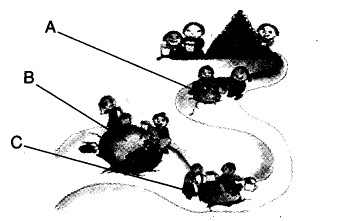
Mark A, B, C on the right hole in the picture.

1.Which is the biggest pothole?
Ans. ‘B’ is the biggest pothole.

2.If jugs are used, hole A gets filled with 5 jugs. How many jugs of pebbles are needed to fill hole B?
Ans. Pot B needs double the amount of pebbles than pot A
So, 5 x 2 = 10 jugs of pebbles are needed to fill hole B.

NCERT Solutions for Class 3 Mathematics Chapter-10 Play With Patterns


NCERT Solutions for Class 3 Mathematics Chapter-10 Play With Patterns

Around Us
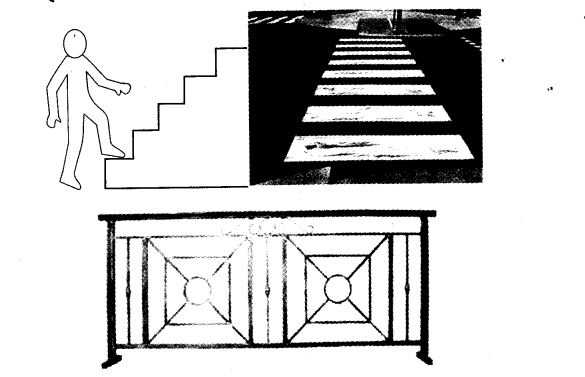
1.Look around you and list three things in which you find some patterns.
Ans. Staircase, Zebra crossing, Railing in a balcony.

2.Draw some patterns which you have found around yourself.
Ans.
NCERT Solutions for Class 3 Mathematics Chapter-10 Play With Patterns Around Us Q2

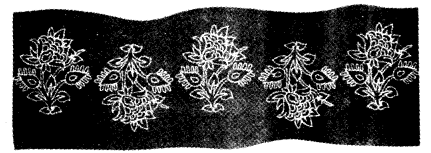
3.Can you see a pattern in the way each block is repeated?
NCERT Solutions for Class 3 Mathematics Chapter-10 Play With Patterns Around Us Q3
Ans. Yes, I can see that one block is placed upwards and the next is placed downwards.

Practice Time
Given below are some patterns.
1.Figure out the rule for each and continue the pattern.
Ans. (a) In this pattern; the colour of the pot changes from red to blue and then to red at each step.
(b) In this pattern A is written twice, followed by B written once.
AABAABAAB
(c)In this pattern; the number of petals increases from 1 to 3 and to 5. After that this sequence is repeated.
(d)In this pattern the blue colour is moving apticlockwise in steps of one.
(e) In this pattern; the figure is rotating clockwise in steps of one.
(f) In this pattern; the sequence of morning, afternoon, evening and night is repeated.
Morning, Afternoon, Evening, Night, Morning, Afternoon, Evening, Night

Growing Patterns
1.Can you see the rule and continue the pattern?
Ans. In this pattern; the number of marks in the oval is growing by one. After halfway mark the figure gets inverted.

Number Patterns
1.We have made some patterns with pictures. We can make patterns with numbers too. Like
21, 41, 61, 81, 101, 121
You know the next number, don’t you?
This series is growing by 20.
21, 41, 61, 81, 101,121, 141, 161, 181,
A.Look for the rules and continue these growing patterns:
(a)51, 56, 61, 66,————– ,———— ,————-
(b)7,————- ,21,28,35,————- ,————- ,————-
(c)2, 4, 8, 16, 32,————- ,————- , ————-
(d)12 A, 13 B, 14 C,————- ,————- ,————-
Ans. (a) 51, 56, 61, 66, 71, 76, 81, 86
(6) 7, 14, 21, 28,35, 42, 49, 56
(c) 2, 4, 8,16, 32, 64, 128, 256
(d) 12 A, 13 B, 14 C, 15 D, 16 E, 17 F.

B. Look at these growing patterns. Find out what to add to each number to get the next one.
(a)1, 3, 6, 10,———- ,————- ,————–
(b)0, 2, 6, 12,———- ,———–,————–
(c)1, 3, 7, 13,————–,———–, ————-
(d)2, 3, 6, 11,18,———— ,———–,————-
Ans. (a) Following sequence is observed in this pattern:
1 + 2 = 3 3 + 3 = 6 6 + 4=10
The number which is added in each step is growing by 1 Hence the pattern is as follows:
1, 3, 6,10, 15, 21, 28, 36, 45
(b)Following sequence is observed in this pattern:
0 + 2 = 2 2 + 4 = 6 6 + 6 = 12
The number which is added in each step is growing by 2.
Hence the pattern is as follows:
0, 2, 6, 12, 20, 30, 42, 56, 72
(c)Following sequence is observed in this pattern:
1 + 2 = 3
3+4=7
7 + 6 = 13
The number which is added in each step is growing by 2 Hence the pattern is as follows:
1, 3, 7, 13, 21, 31, 43, 57, 73 ’
(d) Following sequence is observed in this pattern:
2 + 1 = 3
3 + 3 = 6 6 + 5 = 11 11 + 7 = 18
The number which is added in each step is growing by 2 Hence the pattern is as follows:
2, 3, 6, 11, 18, 27, 38, 51, 66

Secret Messages
Amrita and Paritosh are writing secret messages:
3W3H3E3R3E 3A3R3E 3Y303U
3 I3 N 3T3H3E 3C3A3N3T3E3E3N
1.Can you tell what they are trying to say?
Ans. Following are the secret messages:Where are you?
In the canteen

3.There are two secret messages. Look at the patterns and find the hidden sentences.
1I2L204V5E6Y708U
Ans. The message is:I LOVE YOU

4.ATBHCIDSEBFOGOHKIIJSKFLUMN
Ans. The message is:
THIS BOOK IS FUN

5.Now you also make your own secret messages.
Ans.1 I 2 L 3 O 4 V 5 E 6 I 7 N8D9I10A I LOVE INDIA
AMBACNDMEOFHGAHNILJIKVLEMSNAOTPDQERLS
HTI
MANMOHAN LIVES AT DELHI

Even and Odd Number Patterns
NCERT Solutions for Class 3 Mathematics Chapter-10 Play With Patterns Even and Odd Number Q1
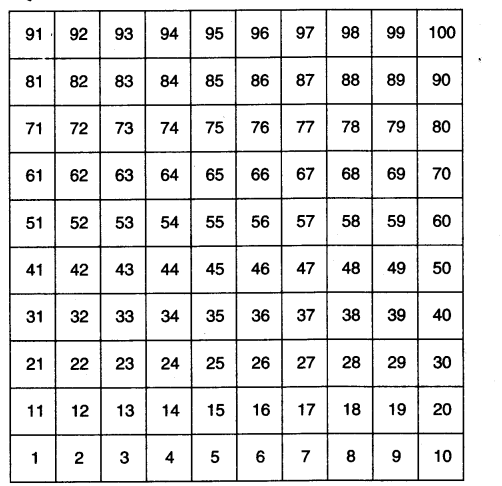
Half these numbers are in yellow. What patterns do you see in these numbers? Continue the same pattern and fill in the blanks:
96, 98,100,102,104,106, IQS, 110,112,114
1.How far can you continue this pattern?
Ans. This pattern can be continued endlessly.
These numbers have a special name. They are called even numbers.

2.Do any of these even numbers end with 3 or 5?
Ans. None of the even numbers end with 3 or 5.

3.What do even numbers end with?
Ans. Even numbers end with 2, 4, 6, 8 or 10.

4.Look at the pattern of numbers in blue. Continue the pattern and fill in the blanks.
Ans. 99,101,103,105,107,100, 111, 113,115

5.What do the numbers in blue end with?
Ans.The numbers in blue end with 1, 3, 5, 7 or 9.

6.Write all odd numbers between 400 and 410.
Ans. 401, 403, 405, 407, 409.

7.Write all even numbers between 155 and 165.
Ans. 156,158,160,162,164.

8.If we add 1 to any odd number we get an————(even/odd) number.
Ans. If we add 1 to any odd number we get an even number.

9.If we add’l to any even number we get an————(even/odd) number.
Ans. If we add 1 to any even number we get an odd number.

10.What do you get if you add an even number to an odd number?
Ans. Odd number.

Names in an Order
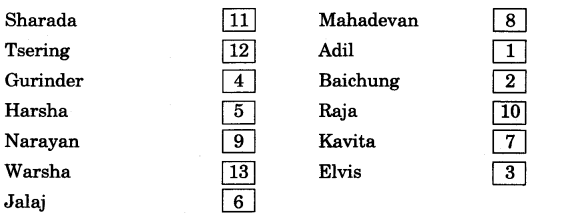
Adil has to arrange this list so that the names starting with A comes first and then come those with B, C, D and so on. Number these names in the order in which they will come.
NCERT Solutions for Class 3 Mathematics Chapter-10 Play With Patterns Names in an Order Q1
Jalaj is proud to have a special name. He says if you read it backwards it is still the same.
1.Which of the following names have the same pattern?
Harsh, Anna, Kanak, Munna, Ongbi
Ans. Anna and Kanak.