Showing posts with label NS EVS 5TH EM. Show all posts

NCERT Solutions for Class 5 EVS Chapter 22 On The Move Again


NCERT Solutions for Class 5 EVS Chapter 22 On The Move Again

QUESTIONS FROM TEXTBOOK SOLVED

Tell
1.Did all the farmers in Dhanu’s village have their own land?
Ans. No, only some of the farmers in Dhanu’s village have their own land. Some of the farmers work on the lands of big farmers.

2.During what time of the year did Dhanu’s family get work in the village? During what time did they not have work?
Ans. Dhanu’s family gets work from before the rainy season till Dussehra. During
the remaining six months, when there is no rain, they do not get work.

3.Do you know any families like Dhanu’s, who have to leave their villages for months in search of work?
Ans. Yes, I know of many families who have left their villages for months in search of work.

Think and Find Out
1.If people in Dhanu’s village did not leave the village in search of work, what difficulties would they face in their own village?
Ans. If people in Dhanu’s village did not leave the village in search of work, they would face many difficulties. They would not be able to earn enough money to meet even their basic needs like food and clothes. They will not be in a position to afford the cost of education for their children.

2.In Dhanu’s village, there can be no farming when there is no rain. Do you think farming can be done even without rain water? How?
Ans. Yes, farming can also be done without rain water. New methods of irrigation can be used to provide the required water to crops. Canals, tubewells or rahats can be used for irrigating the fields.

Think
1.Dhanu’s family and many others from the village go far away for work but some people stay back in the village. Why does this happen?
Ans. Some people need to stay in the village so that they can protect the houses and cattle. They are also needed to take care of elderly people who prefer to stay back in the village.

2.When Dhanu and other children leave the village for six months, what happens in the village school?
Ans. When Dhanu and other children leave the village for six months, the village school gets students from the families of big farmers only.

3.What arrangements are made at your home for old and unwell family members when everyone goes for work?
Ans. In my home, ladies do not go to work. They stay back and take care of elderly and unwell family members.

Think and Tell
1.Why does Mami wish that Dhanu should go to school for the whole year and study?
Ans. Mami wanted Dhanu to study well and get a good job so that he could work independently. Mami wished Dhanu to become a rich person and_ earn good reputation in the society. Mami did not want Dhanu to suffer like his family members. Hence, Mami wished Dhanu should go to school.

2.What happens when you are not able to go to school for a long time?
Ans. When I am not able to go to the school for a long time, I find it difficult to cope with he advance lessons.

Discuss and Write
1.Dhanu has to go with village people to other places. Can there be some arrangements during that time so that Dhanu continues his studies? What kind?
Ans. Yes, Dhanu can get enrolled in a school in the new town. He can also look for evening schools.

2.Do you know of any jobs/work for which people have to stay away from their families for many months? Look for examples from this book and write.
Ans. Some of the jobs which require people to stay away from their families for many months are as follows:
(a) Jobs in armed forces (b) Jobs in merchant navy
(c) Studying in a boarding school (d) Overseas assignments.

3.What are the similarities and differences in the lives of different kinds of farmers?
Ans. Similarities:
1. Most of the farmers are fully dependent on farming for their livelihood.
2. All the family members Eire engaged in farming.
3. They are dependent on rains for irrigation.
4. Most of them are illiterate.
5. They use primitive methods of farming.
Differences:
1. Some farmers have their own land.
2. Less number of family members is engaged in farming.
3. Some farmers are literate.
4. Some fariners use modern farm equipments.

What We Have Learnt
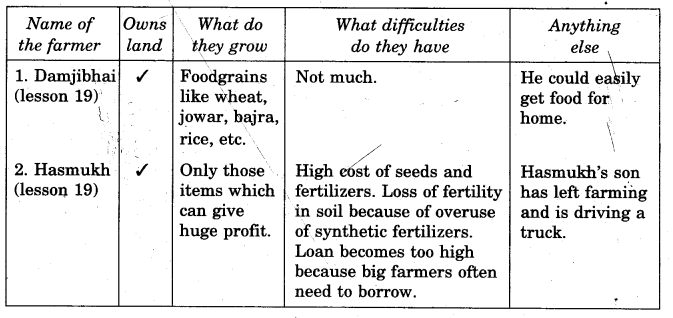
1.You have read about many kinds of farmers in different lessons in this book. Fill in the table.
Ans.
NCERT Solutions for Class 5 EVS Chapter 22 On The Move Again What We have Learnt Q1

NCERT Solutions for Class 5 EVS Chapter 21 Like Father, Like Daughter


NCERT Solutions for Class 5 EVS Chapter 21 Like Father, Like Daughter

QUESTIONS FROM TEXTBOOK SOLVED

1.Ashima sneezed just like her father. Do you have any such habit or trait which is similar to that of someone in your family? What is it? Whom is it similar to?
Ans. Yes, people say that I walk like my father.

Tell
1.Does your face or anything else look similar to that of someone else in your family? What is it?
Ans. Yes, some of my facial features resemble to someone else in my family. These are:
(a) My nose is like my mother’s nose.
(b) My eyes are of same colour as my father’s eyes.
(c) I have small ears; just like my grandfather’s.

2.Did someone tell you this or did you find it out yourself?
Ans. Many of my relatives told this to me.

3.How do you feel when people compare you with someone else in your family? Why do you feel so?
Ans. When someone compares me with someone else in my family; I feel good. The nice feeling comes because it makes me think I am the part of a great family.

4.Who laughs the loudest in your family? Laugh like that person.
Ans. My ‘tau’ laughs the loudest in my family.

5.Make a list of all the family members from Nilima’s nani to little Samir. How are they all related to Nilima? Write.
Ans. List of Nilima’s family members:
Nani: Nilima’s grandmother (Mother’s mother)
Eldest Nani: Nilima’s nani’s sister.
Elder son of Nani: Nilima’s mama (Mother’s brother)
Kiran: Nilima’s cousin (Mama’s daughter)
Samir: Nilima’s nephew (Son of her cousin)

Find Out
1.In your family are there any such examples of uncle-nephews or brother-sisters, where there is a big difference in the age? Find out from your elders.
Ans. Yes, some of my mamas (mother’s cousin brothers) are in my age group. My own mama is 20 years older than me.

Find Out and Write
1.Does Nilima have curly hair like her nani’s? Now you look for some special traits in your sister or brother (could also be cousins). Like colour of eyes, dimples in cheeks, height, broad or sharp nose, voice etc. See if this trait comes from the – father’s side or mother’s side. Make this table in your notebook and fill it. An example is given.
Ans. Yes, Nilima had curly hair, just like her nani’s.
NCERT Solutions for Class 5 EVS Chapter 21 Like Father, Like Daughter Findout and Write Q1
2.Have you seen a very young child in your (or any other) family? Whom does the child’s eyes, nose, hair or fingers look like in the family? Write their names.
Ans. Yes, I have seen the young child of my uncle. Some of his traits look like some of the family members and they are given below:
NCERT Solutions for Class 5 EVS Chapter 21 Like Father, Like Daughter Findout and Write Q2

3.Nilima’s hair is like her nani’s—thick and curly. Nilima’s mother has straight, brown and limp hair. What type of hair do you have—black or brown, oily or — dry?
Ans. My hair are black and oily.

4.What is the colour of your hair? Measure and write the length of your hair.
Ans. The colour of my hair is brown. My hair are 30 cm long.

5.Is your hair like that of anyone else in your family? If yes, then name the person.
Ans. Yes, my hair resembles with those of my father.

6.Measure the hair of other members of your family.
Ans. Do it yourself.

7.Who has the longest hair in your family?
Ans. My mausi has the longest hair in my family.

8.How many people do you know whose hair is longer than one metre? Does having long hair run in their family?
Ans. I know about one neighbour family where all the ladies have hair longer than a metre. It can be said that having long hair run in their family.

9.Do you know how to measure your height? Measure yourself from head to toe and write how tall you are.
Ans. Yes, I know how to measure my height. I can do it using a metre scale or a measuring tape. My height is about 120 cm.

10.How tall do you think you will be when you grow up? Is anyone else in your family of the same height?
Ans. i think I will be about 6 feet in height when I grow up because my father is exactly 6 feet tall.

11Measure the height of your family members and write it down.
Ans. Do it yourself.
One example is given here;
Father: 168 cm Mother: 150 cm Brother: 150 cm

Discuss
1.What is similar between Saroja and Suvasini? What is different?
Ans. Both Saroja and Suvasini look like mirror images because they are twin sisters. They look so similar that their mama gets confused.
Suvasini can speak both Marathi and Tamil, while Saroja can speak only Tamil. Suvasini is a good singer, while Saroja is a Karate exponent.

2.Do you know any twins? What is similar in them? How are they different?
Ans. Yes, there are two brothers in my class. They look similar in almost every trait. One of them has a mole on the left cheek.

3.Do you know of twins who do not look the same?
Ans. Yes, there Eire twin sister and brother in my neighbourhood. They look different from each other.

But Not this From Parents
1.Have you read or heard anything about polio? Where?
Ans. I have read about polio in newspaper emd on hoEirdings.

2.Have you read or heard any news about pulse polio? What?
Ans. Yes, I have heard about pulse polio. Pulse polio is a programme run by the government to eradicate polio from the country. Vaccination camps are organised every month where every child below five years of age is given the polio vaccine drops. The vaccine is given free of cost.

3.Do you know of anyone who has polio?
Ans. Yes, there is a boy in my neighbourhood who has polio. He is unable to walk properly.

4.Are there people in your house who talk loudly? It is their habit or they cannot also hear very well?
Ans. My Tau and my grandfather talk very loudly. My tau does it out of habit. My grandfather does it because he cannot hear properly.

5.Are there times when you do not talk loudly in front of some people? When? With whom? Why? When can you speak loudly?
Ans. Yes, there are times when I do not talk loudly. I talk softly in front of my father, mother and, tau because I respect them. I have to speak loudly with my grandfather because he cannot hear my soft voice.

6.Some people use a machine in their ear to help them hear better. Some use a stick or spectacles to help them in other ways. Do you know someone who does so?
Ans. Yes, my nana uses a hearing aid. My nani uses spectacles to see properly.

7.Talk to people who cannot hear very well. Find out if they had this problem from birth. When did they start to have a problem with hearing? What difficulties do they face?
Ans. My dada cannot hear, very well. The problem started around five years ago. Doctors say that it is because of old age. Due to hearing problems he is unable to enjoy talking over telephone. He finds it difficult to walk on the road because he cannot hear the sound of coming vehicles.

What We Have Learnt
1.What do you think—what all is a part of you that you got from your mother’s side?
Ans. I have got following features from my mother’s side:
(a) My brown eyes are like my mother’s.
(b) My hairs are like my mama’s.
(c) My nose is like my nana’s.

NCERT Solutions for Class 5 EVS Chapter 20 Whose Forests?


NCERT Solutions for Class 5 EVS Chapter 20 Whose Forests?

QUESTIONS FROM TEXTBOOK SOLVED

Discuss
1.What do you think is a forest?
Ans. Forest is a large area thickly covered with varieties of trees. It is home to different animals, insects and birds.

2.If someone grew lots of trees close to each other, would this become a forest?
Ans. No, this would not become a forest because a forest is more than thick green cover.

Find Out and Write
1.Other than trees what all is there in a forest?
Ans. Apart from trees; there are different types of animals, insects and birds in a forest.

2.Do all forests have similar types of trees? How many trees can you identify?
Ans. Different forests have different types of trees. I can identify some trees like peepal, banyan, neem, etc.

3.Suryamani says, “If the forests are not there, we too will not remain”. Why so?
Ans. Forests are essential for us. They help in maintain the balance in the environment. Green plants absorb harmful gases and release oxygen. Forests provide wood, herbs, many raw materials for us. Many tribal depend on forests for their livelihood. Hence, Suryamani is right in her statement.

Think and Write
1.Do you know anyone who loves the forest?
Ans. Yes, I and my friends love the forest.

2.The contractor did not allow Suryamani’s people to go into the forest. Why?
Ans. The contractor may have been in the forest for cutting the trees to sell somewhere. He may not want local people to use forest resources and hence did not allow Suryamani’s people to go into the forest.

3.Is there any place around your area which you feel should be open to everyone, but where people are not allowed to go?
Ans. Yes, there is a lake in my town. I have heard that for security reasons people are not allowed to go near that lake. I think it should be open to everyone.

Discuss
1.Who do you think the forest belongs to?
Ans. Forests belong to everyone.

2.Bhudhiyamai said—“Forest is our ‘collective bank’—not yours or mine alone”. Are there other things which are our collective wealth? So if someone uses more, everyone would suffer?
Ans. Yes, there are some other things which are our collective wealth. Some examples are as follows:
(a) Groundwater (b) Fish in the rivers and sea
(c) Minerals (d) Fossil fuels such as coal and petroleum.

3.Do you have a friend with whom you can share everything?
Ans. Yes, I have a friend with whom I share everything.

4.Some people have moved so far away from the forest that they cannot understand the lives of forest people. Some even call them ‘jungli’. Why is it not correct to say this?
Ans. The word ‘jungli’ is a derogatory remark and referred to someone who is seen as uncivilized. Forest dwellers have their own distinct culture which is altogether different than the mainstream culture. They are not uncivilized rather they are living in a way which is different than our way of living. Hence it is wrong to call them ‘jungli’.

5.What do you know about how adivasis live? Write and draw a picture.
Ans. Adivasis live a simple life. They wear simple clothes. During their traditional festivals, they wear costumes made of leaves and flower. They depend on forest produce for their livelihood. They collect firewood from forests and take their cattle into forest for grazing. They make useful articles from leaves, wood and bamboo. They have very good knowledge of medicinal herbs.

6.Do you have an adivasi friend? What have you learnt about the forest from her?
Ans. Yes, I have an adivasi friend. She reads in my class. I have learnt many things about forest from her. I can identify many trees which were unknown to me earlier. I have leant the method of preparing manure from fallen leaves. I also know about many useful items which can be made from bamboo and dry leaves.

Think
1.Do you know of any one who works to save forests?
Ans. Yes, there is a person in my neighbourhood who runs an NGO. His NGO works for protection of forests.

2.What is your dream? What will you do to make your dream come true?
Ans. I want to become an architect. I will work hard for making my dream come true.

3.Collect reports about forests from newspapers. Did you find any news about how cutting down of forests affects the weather? How?
Ans. Yes, I could find many news about how cutting down of forests affects the weather. I have read that cutting down of forests leads to less than normal rainfall in the area. This leads to a prolonged summer.

4.In ‘Torang’ Suryamani does a lot to keep the Kuduk music, dance and traditions alive. Would you like to do something like this for your community? What would you like to keep alive?
Ans. Yes, I also want to do some useful thing for my community. I want to keep the traditional painting style of my community alive.

Read and Tell
1.Is there any factory or some construction work going on in and around your area? What type of work?
Ans. Yes, lot of construction activity is going around near my area. A new flyover is under construction.

2.Due to the factory is there any effect on the trees and the land? Have the people in that area raised this issue?
Ans. Yes, there is a power plant in a particular area in my town. Lot of smoke and dust keep on coming from the factory. Most of the trees have become lifeless because of this. Now, people from that area have started raising their voices against the factory.

Look at the Map and Write
1.What all is shown in the map?
Ans. This is a map of India. The map shows areas with very thick forests and those with less thick forests.

2.You have read Sikhya’s letter. Look for Orissa in the map.
Ans. Orissa is in the eastern coastal part of India. It is towards the east of Chhattisgarh, south West Bengal, and north east of Andhra Pradesh.

3.Is there a sea close to Orissa? How did you find out?
Ans. Yes, the Bay of Bengal is close to Orissa. I could find it in the map.

4.Which are the states which have sea on one side?
Ans. Following states have sea on one side:
West Bengal, Orissa, Andhra Pradesh, Tamil Nadu, Kerala, Goa, Maharashtra and Gujarat.

5.Where is Suryamani’s state Jharkhand on the map?
Ans. Jharkhand is situated towards south of Bihar, north of Orissa and east of Madhya Pradesh.

6.Where are forests on the map? How will you find these?
Ans. Forests are in almost all states of India. Some states have more area of forest than some other states. Forest can be seen in the map by green colour.

7.How can you find out which states have very thick forests and which have less thick forests?
Ans. This can be done by looking for states with dark green colour and those with parrot green colour.

8.For someone in Madhya Pradesh, in which direction would the country’s thickest forests be? Name those states.
Ans. For someone in Madhya Pradesh, the country’s thickest forest would be in north and in east. The states with thickest forests are; Arunachal Pradesh, Uttarakhand, Jharkhand and Chhattisgarh.

Find Out
1.Which are the states around Mizoram?
Ans. The states around Mizoram are; Tripura, Assam and Manipur.

2.Chamui said they measure land using tin. Which are the other ways of measuring land?
Ans. Some of the other ways of measuring land Eire; in yards, in square metres,dn katha and bigha.

3.Returning from school, children drank water in a bamboo cup. Who do you think would have made this cup and kept it in the forest? Why?
Ans. The adivasis would have made the bamboo cup. They made those cups to help travellers passing through the forest.

4.Have you ever seen anything which people are free to use, with no one there looking after it?
Ans. Yes, I have seen some piau, baolis, etc. which people are free to use, with no one there looking after it. ”

5.Find out more about ‘cheraw’ dance. Do it in your class. But be careful and don’t hurt yourself.
Ans. Cheraw dance is a combination of rhythm and skill. Four people hold two pairs of long bamboos across one another on the ground. As the bamboo sticks are clapped together, the main dancers in traditional attires weave patterns through them in time to the rhythm. Cheraw is a major attraction during all festive occasions in Mizoram. Cheraw is believed to have a foreign origin. Similar dances are popular in the Far East and the Philippines. The Mizos may have brought the dance with them when they migrated to their land in India.

What We Have Learnt
1.What is similar and what is different between Jhoom farming and Bhaskarbhai’s way of farming?
Ans. Similarities:
In both the methods, organic manures are used.
Differences:
Bhaskarbhai uses plant waste to prepare manure. He makes manure by the process of composting. He also adds earthworms to hasten the process of composting. On the other hand, in case of Jhoom farming, weeds are burnt in the field and ashes are mixed with soil. The ash acts like manure.
Bhaskarbhai ploughs the land before sowing the seeds. In Jhoom farming, furrows are made with sickles before sowing the seeds.

2.Explain in your own words why forests are important for the people living in forests.
Ans. For people living in forests, forests are very important. Forest is an important resource. Forest provides firewood to be used as kitchen fuel. Forest provides different fruits and edible roots. Forest provides medicinal plants. Many forest produce are used to make useful articles which Eire sold in the market. The life of adivasis entirely depend on forests.

3.Did you find something interesting in Jhoom fanning? What is it?
Ans. Some of the interesting things in Jhoom farming are as follows:
(а) A new patch of land is cleared by slashing and burning the plants.
(b) Weeds are burnt and ashes are mixed with soil.
(c) Mixed cropping is practiced in Jhoom cultivation.

NCERT Solutions for Class 5 EVS Chapter 19 A Seed Tells A Farmers Story


NCERT Solutions for Class 5 EVS Chapter 19 A Seed Tells A Farmers Story

QUESTIONS FROM TEXTBOOK SOLVED

Tell
1.Are rotis made in your home? From which grains are they made?
Ans. Yes, rotis are made in my home. They are usually made from wheat and sometimes from maize.

2.Have you eaten roti made from bajra and jowar? Did you like these?
Ans. Yes, I have eaten roti made from bajra and jowar. They were tasty.

Find Out and Write
1.In your house what is done to protect grains and pulses from insects?
Ans. My mother keeps grains and pulses in air-tight containers. Sometimes, she dries them in the sun.

2.Which are the different festivals related to farming celebrated in different seasons? Find out more about any one such festival and write in your notebook— The name of the festival, in which season is it celebrated, in which states of India, what special foods are made, is it celebrated only at home with the family, or together with many people?
Ans. There are many festivals related to farming, e.g. Lohri, Holi, Baisakhi, etc. Let us take example of Lohri.
Lohri is celebrated in the winter season; on 13th January, in Punjab. It is celebrated by different names in different states. It is celebrated as Poiigal in Tamil Nadu. It is celebrated as Yella Bella in Karnataka. Different special dish
are made in different states. Sesame seeds and jaggery are’commonIn almost all states. In some states it is celebrated with many people; like in Punjab. In some states it is celebrated in family only. Kite flying is done in Gujarat on this day.

3.Talk to the elders in your family and find out if there were some special foods cooked earlier, that are not cooked any more.
Ans. My mother shared with me that earlier; laddoos of sesame seed and of beaten rice were made in home. Now, we just buy ‘gajak’ from the market.

4.Find out about the crops—cereals, vegetables, pulses—that are grown in your area. Of those, is there anything that is famous across the country?
Ans. Many crops like wheat, maize, rice, potatoes, mangoes, litchi, etc. are grown in my area. Of these litchi is famous across the country.

5.Can you recognise these grains?
Ans.
NCERT Solutions for Class 5 EVS Chapter 19 A Seed Tells A Farmers Story Findout and Write Q5

Discuss
1.The bajra seed saw differences in the way Damjibhai and Hasmukh did farming
(for example, in irrigation, ploughing, etc.). What were these differences?
Ans. Damjibhai did farming in a different way than how Hasmukh did.
Damjibhai followed the traditional methods of farming. He used bullocks to plough the field. He stored grains to be used as seeds. Hasmukh, on the other hand started using new methods of farming. He bpught a tractor to plough the field. He also bought a motorcycle. He stopped grdwing those crops which did not fetch good price in the market. He need not store grains to be used as seeds because he could buy seeds from the market. Expensive fertilizers were used for farming.

2.Hasmukh said, “With profits from our fields, we can progress”. What is your understanding of ‘progress’?
Ans. Progress means a better lifestyle. People get better houses to live in. They get more nutritious food to eat. Children get better schooling. Houses have all modern gadgets like TV, fridge, radio, etc. People may buy a vehicle for personal transport.

Write
1.What kind of progress would you like to see in your area?
Ans. I would like to see following progress in my area:
(a) Better roads
(b) All around cleanliness with no overflowing drain
(c) A good public transport system
(d) A big park and playground where children can play and others can do some recreation.

Discuss and Think
1.What can happen to Hasmukh’s farm after some years?
Ans. Hasmukh’s farm will lose fertility after some years because Hasmukh is using chemical fertilizers. Hasmukh is in danger of falling in debt trap as he has taken loans to buy tractor, seeds and fertilizers. In future he may not be able to properly work on his farm.

2.Damjibhai’s son Hasmukh chose to become a farmer like his father, Hasmukh’s son Paresh is not a farmer, but a truck driver. Why would he have done so?
Ans. Paresh could see that his father was running into losses. Farming had become a capital intensive activity with little profit. Hence, Paresh would have decided to switch to a new occupation.

3.The seeds were not sure that what Hasmukh was talking about was really progress? What do you feel?
Ans. I think the seeds were correct in their thinking. New method of agriculture tend to overexploit the soil and other resources. This leads to loss of fertility of soil which may result in the land becoming barren. Too much irrigation depletes the groundwater and thus leaves little water for future. A machine can do the work of many people which leaves many people jobless.
Apparently it looks like progress, but it is not the real progress.

4.Have there been any changes near your area, which may be difficult to call ‘progress’? What changes are these? What are the different opinions about them?
Ans. Yes, there are many changes which may not be called progress in the real sense. Let us take example of growing number of vehicles on the road. More vehicles have made travel easier but it is also leading to air pollution. Similarly, many factories are coming up near some cities and villages. These factories produce goods for people but they also create lot of air and water pollution. Some machines have been invented which can do the job of thousands of people and thus make thousands of people jobless. Many gadgets in our home have made us dependent on them. We are becoming more lethargic.

Project
1.What questions come to your mind about farmers and farming? Write some questions in your group and ask a farmer. For example, how many crops do they grow in a year? Which crop needs how much water?
Ans. An example of the questionnaire is given below:
Student: Since how long you have been farming?
Farmer: I have been farming for the last 20 years.
Student: Which are the main crops you grow in your field?
Farmer: I usually grow rice and wheat.
Student: Which are the other crops you grow in your field?
Farmer: I also grow maize, mustard and some vegetables.
Student: How do you irrigate your field?
Farmer: I use the water from the canal.

2.Visit a farm near your area. Observe and talk to the people there. Write a report.
Ans. One of my friends has a farm on the outskirts of the city. There is a big house at one edge of the farm. The house has a big courtyard. There is a tractor, a threshing machine and many small farm equipments kept outside the house. There are 5-6 people who live permanently at my friend’s farm. They have been working on this farm since last many years. At present the whole farm is full of mustard crops. It presents a beautiful landscape of yellow and green colours. There is a small orchard also in the farm. It has trees of many fruits like mango, guava, pomegranate, lemon, etc. I can also see many packets of synthetic fertilizers kept in the farmhouse. There are some jars of insecticides kept in a comer.

Journey of a Bajra Seed—From a Field to a Plate
1.What can you see in each picture? 
Ans. Picture 1: A lad is separating and taking out the cobs from the bajra crops.
Picture 2: The bajra cob is kept in a mortar. It will be punded by a pestle to separate grains from the cobs.
Picture 3: Bajra seeds are kept in a plate.
Picture 4: A lady is grinding bajra seeds to make flour. She is using chakki (grinding stone) for that.
Picture 5: Bajra flour is kept in a plate.
Picture 6: Dough has been made from bajra flour.
Picture 7: Chapatti is being made from dough.
Picture 8: Chapatti is being cooked on tawa.
Picture 9: Chapattis kept in a plate.

2.What technology could have been used to cut the stem in picture 1?
Ans. The stem, is usually cut by a sickle.

3.What do you think is being done in the grinder (chakki) in picture 4?
Ans. Flour is being made in the grinder

4.What ways (technologies) would have been used to do the work shown in picture 5 and 6? You can see that the dough is ready in picture 6. When do you think a sieve (Chhalni) would have been used? Discuss each step in detail, in any language you wish to use.
Ans. In most of the households, making dough does not involve using technologies. Ladies simply use the age old method of kneading the dough by bare hands. Flour is usually sieved before making the dough. After that, water needs to be
added to the flour. People usually estimate the required amount of water for making dough. After kneading for some time, the dough gets ready.

What We Have Learnt
1.There have been many changes over time, in our food. What can this mean? Use the seed story and what you know from your elders to explain.
Ans. There have been many changes in our food. Earlier, people used to eat chapatti of different kinds of grains but now wheat is the main ingredient of chapatti. My mother says that when she was a child, her father used to buy wheat grains. The wheat grains were washed and dried in the sun. Then it was taken to a chakki to make flour. Now, we buy packed atta (flour) and I have seen wheat grains in pictures only. Most of the children of my age would not recognise a particular grain. For example; I was surprised when I learnt how does the rice grain look with cover on it.
Many of us now use instant food, instead of traditional food. I think people will fipfget how to cook some of the traditional dishes.

2.What would happen if all the farmers were to use only one kind of seed and grow only one kind of crop?
Ans. It will be a scary situation. We cannot survive by eating just one kind of crop. We need dal and sabji, along with rice. We cannot eat a diet which contains only rice or only chapatti. We need many other food to satisfy our taste or also our nutritional needs.

NCERT Solutions for Class 5 EVS Chapter 18 No Place For Us?


NCERT Solutions for Class 5 EVS Chapter 18 No Place For Us?

QUESTIONS FROM TEXTBOOK SOLVED

Think and Tell
1.Jatrya felt alone, even in a crowd of people. Have you ever felt like this?
Ans. Yes, there are times when I feel alone even in a crowd of people. Once I was in market which was full of people. As I did not know anybody, so I felt alone.

2.Imagine how it feels to leave one’s own place and go far away to live in a new – place.
Ans. It must be very difficult to leave one’s own place and go far away to live in a new place. Everything will be new in the new place. The people, the market, the roads; everything will look like stranger in the new place.

3.Why do you think families like that of Jatrya’s are coming to big cities?
Ans. Smaller cities do not have much of opportunities. Poor people and people who want to earn more than what they are earning often migrate to big cities. Big cities have lot of opportunities. Variety ofworks is available in big cities. This is the reason families like that of Jatrya’s are coming to big cities.

4.Have you seen any children (in your school or neighbourhood) who also go to work?
Ans. Yes, I have seen some children from my neighbourhood who go to work. I regularly see many children, selling various items on traffic junctions.

5.What kind of work do they do? Why do they have to work?
Ans. These children do many types of work. Some examples are given below:
(a) Rag picking (b) Cleaning the car
(c) As domestic help (d) Selling sundry items near footpath
They need to work to support their family. Their parents do not earn enough and hence these children need to work.

Tell
1.In Khedi village what all did children learh?
Ans. Children in Khedi village learnt dancing, playing flute and dhol, making vessels and other things from bamboo and clay and recognising birds and imitating their sounds.

2.What do you learn from your elders?
Ans. We learn following from our elders:
(a) Respecting elders
(b) Sticking to a routine by sleeping and waking up on time and by studying and playing as per the routine.
(c) Maintaining love and affection with friends and relatives
(d) Helping in household chores

3.Jatrya learnt so many things in Khedi. How many of those would be useful for him in Mumbai?
Ans. Some of the skills which Jatrya learnt in Khedi can be useful for him in Mumbai. Some of them are; fish catching, selling goods in the market, playing dhol, etc. Jatrya can utilise these skills to earn some money in Mumbai.

4.Do you hear the sounds of birds everyday? Which ones?
Ans. Yes, I hear sounds of some birds. For example; guttar-guttar of pigeon, kav- kav of crow and chi-chi of sparrow.

5.Can you imitate the sound of any bird? Show how.
Ans. I can imitate the sound of a crow. (Demonstrate in your class)

6.What are some of the sounds that you hear everyday, but the people of Khedi may not be hearing?
Ans. Some of the sounds which people of Khedi may not be hearing are;
(a) Horns of vehicles,
(b) Sound of trains,
(c) Sound of police siren Yes, I can imitate these sounds.

7.Have you experienced silence? When and where?
Ans. Yes, I do experience silence. When I go to sleep at night then I experience silence.

Discuss and Tell
1.Many people in Jatrya’s village did not agree to move away from their land and forest. Why? They had to leave even though they did not want to. Why?
Ans. The land and forest were associated with fond memories of many generations of people. Their forefathers had been living on that land since a long period. They were forced to leave the place by government officials and the police. Moreover, they were also promised to be sent to a better place. They were promised that the new place would have better facilities in terms of electricity and water.

2.In Khedi, how many people were there in Jatrya’s family? When he thought about his family who all came to his mind?
Ans. There were three people in Jatrya’s family in Khedi; his father, mother and Jatrya . himself. But for Jatrya, the whole village was like a big family. When he thought about his family, he thought about his future wife and future children. Whenever he felt lonely, he used to think about his family.

3.Who all come to your mind when you think about your family?
Ans. When I think about my family, then my parents, my grandparents, cousins and their parents come to my mind.

4.Have you heard of people who don’t want to be moved from their old place? Talk about them.
Ans. Yes, my grandparents do not want to live their old place. When they come to live with us, they get bored in no time. They say that they don’t feel comfortable in cramped space in cities. They love to enjoy the fresh and open air of a village.

5.Do you know some people who have never been to school? Do you also know of any place where there is no school?
Ans. Yes, the maidservant who comes to our house has never been to school. She had said that there is no school in her village which is in the state of West Bengal.

Imagine
1.Think of the kinds of difficulties people have to face where a dam is being built.
Ans. People have to face many difficulties where a dam is being built. Some of them are discussed below:
(a) Houses and farms get destroyed.
(b) Thousands of people are forced to leave their homes where they have been living for many generations.
(c) They are relocated to a new area which does not provide as much facilities as was promised to them.
(d) Starting the life in a new set up presents many challenges.
(e) They have to struggle very hard to develop the support system; which
includes schools, markets, etc.

2.Draw a picture of Khedi village and a picture of Jatrya’s dream village. Discuss the differences between them. Also look at the pictures your friends have drawn.
Ans.
NCERT Solutions for Class 5 EVS Chapter 18 No Place For Us Imagine Q2

Write
1.Was Sinduri village like the village of Jatrya’s dreams?
Ans. Sinduri village was not like the village of Jatrya’s dreams.

2.What difference did he find between Sinduri and his dream village?
Ans. Nothing was ideal as Jatrya once dreamt about an ideal village. The houses in Sinduri were made of tin Sheets and were very weak. There was no electricity supply in Sinduri. Jatrya had to bum old tyre as fuel. It was difficult to tolerate the bad stench of burning tyre. There was no open space in Sinduri. There was neither school nor hospital in Sinduri.
Thus, Sinduri was radically different from Jatrya’s dream village.

3.Have you ever been to anyone’s house as an ‘unwanted guest’? How did you feel?
Ans. Yes, once I had been to one of my friend’s house. His family members did not welcome me and nobody talked to me. I felt like an ‘unwanted guest’.

4.What all does your family do, when you have guests at home for a few days?
Ans. When guests come to our home for a few days, we pay full attention and respect to them. We take care that they have a comfortable stay. My mother makes special food for them so that they can enjoy their stay. My father takes a day off to take them to some good places.

Think
1.What had Jatryabhai thought while moving to Mumbai? Did he find Mumbai as he had imagined?
Ans. The problems of Sinduri village made Jatrya think as if he was an ‘unwanted guest’ in the village. He wanted to leave Sinduri. As he could not go back to Khedi so he thought of moving to Mumbai.
He did not find Mumbai as he had imagined. It was difficult to live in Mumbai.

2.What kind of school do you think Jatrya’s children would be going to in Mumbai?
Ans. Jatrya’s children would be studying in government school in Mumbai.

Find Out and Write
1.Do you know of any family that has come to your town after having moved out of their place? Talk to them and find out:
Ans. Yes, the maidservant who comes to our house has come from a small village in Bengal.

2.From where have they come? Why did they have to come here?
Ans. She has come from a small village in Bengal. She came to Delhi as there was severe flood in her village.

3.What kind of place did they live in there? How do they find this new place compared to the old one?
Ans. They are living in a nearby slum. Houses are made of tin sheets and roofs are made of plastic sheets. There is a big drain near the slum which makes the area unhygienic.

4.Is their language and way of living any different from that of the people here? In what ways?
Ans. Her native language is Bengali and she is uncomfortable with Hindi. She can just manage to communicate with others, in her broken Hindi.

5.Learn some words from their language and write them in your notebook.
Ans. Some words which people from Bengal use in their lingo are as follows:
NCERT Solutions for Class 5 EVS Chapter 18 No Place For Us Findout and Write Q5

6.Do they know how to make some things that you cannot make? What?
Ans. Some of the dishes made in their home are new to me. For example; they ‘Bhappa Ilish’. A child makes beautiful toys from dry palm leaves.

7.Have you ever read or heard of a city slum being removed? How do you feel about this?
Ans. Yes, recently there was news of a slum being removed from an area near Yamuna. I felt very bad when I read the news. People who are very poor live in slums. For them finding a shelter is very difficult. The government should do some arrangements before razing the slum.

8.People also shift from one place to another when they get transferred in their jobs? How do they feel then?
Ans. Transfers are an integral part of many jobs. It is always difficult to leave a place and start life afresh in a new place. One has to do lot of packing and unpacking during transfers. One needs to leave close friends from a place and needs to make friends with new people. A child has to move to a new school in a new environment. This is difficult but I think it is challenging also.

Debate
1.Some people say that—“The city people do not create garbage. Cities are dirty because of the slums”. How do you feel about this? Discuss and debate between yourselves.
Ans. It is totally incorrect to put all the blame on slum dwellers. City people also produce lot of garbage. Many people in middle class colonies throw garbage on the roads. In order to keep their homes clean they throw all the waste on the roads. Slums also develop because of city people. Government constructs new dams, roads, factories, etc. to cater to the needs of city people. As a result displaced people from villages are forced to leave their place and move to cities. These poor people cannot afford good houses and hence they develop slums.

What We Have Learnt
1.Like Jatrya’s family, thousands of families come to stay in big cities for many different reasons. Do you think their life may be better in a big city from what it was before? Imagine how they feel in a big city.
Ans. Many people migrate to big cities for different reasons. Life in a big city is difficult and different than it was before.
It is true that a big city offers many opportunities but there are many more challenges. One has to compromise with limited space in big cities. Poor people are forced to live in unhygienic conditions. They may be earning more than what they earned in villages but they are unable to save money because of the higher cost of living in big cities.
They also face the problem of language if they are not comfortable with the mainstream language of the city. They are often subject to ridicule because of their distinct culture. They are unable to afford medical facilities and quality education.