The Earth in the Solar System Class 6 Extra Questions Social Science Geography Chapter 1
NCERT Extra Questions for Class 6 Social Science Geography Chapter 1 The Earth in the Solar System
The Earth in the Solar System Class 6 Extra Questions Very Short Answer Type
Question 1.
Define Stars.
Answer:
Celestial bodies which have their own heat and light arc called Stars.
Question 2.
Why is Venus considered as ‘Earth’s Twin’?
Answer:
Venus is considered as ‘Earth’s Twin’ because its size and shape are very much similar to that of the Earth.
Question 3.
Why do we always see only one side of the Moon?
Answer:
- The Moon revolves round the Earth in nearly 27 days.
- It also takes exactly 27 days to rotate on its axis.
- Thus, both its movements take the same time. That’s why we always see only one side of the Moon.
Question 4.
Why is the Earth called ‘Blue Planet’?
Answer:
- From the space, the Earth looks blue because of the presence of water on it.
- The Earth is, therefore, called a ‘Blue Planet’.
Question 5.
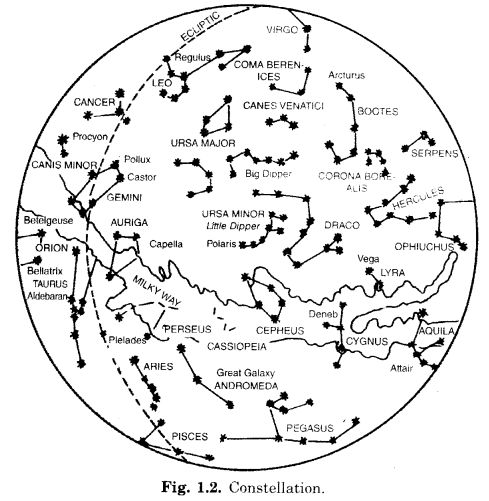
What is a constellation? What is the name of the constellation in Latin and English?
Answer:
Constellation. In the night sky the stars form various patterns and designs. A group of stars forming a particular pattern or design is called constellation. Saptrishi (design of Seven Stars) is one such constellation (Sapt-seven, rishi-sages). The constellation Saptrishi is called Ursa Major in Latin, and Big Bear in English.
Question 6.
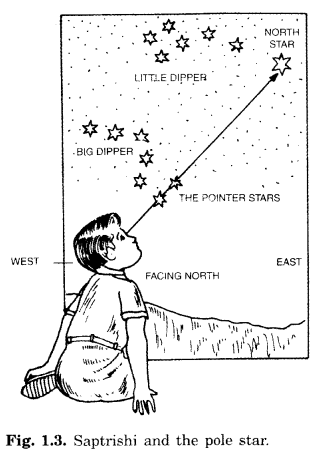
How can we locate the position of the Pole Star with the help of Saptrishi constellation?
Answer:
Please see the figure below. A line passing through pointer stars always points towards a pole star. Thus we can locate the position of the pole star by this line which passes through the pointer stars.
Question 7.
Which is the biggest member of the Solar System? Discuss it.
Answer:
The Sun is the biggest member of the Solar System. It is in the centre of the solar system. It is made of extremely hot gases and is the source of all heat and light (energy). It is a million times larger than our Earth. All kinds of life require radiation from the Sun for their existence. The Earth would grow cold and lifeless without the solar energy.
Question 8.
How does the Moon appear different each night?
Answer:
The Moon revolves round the Earth. Its position in relation to the Sun changes every day as it has no light of its own, it only reflects the light of the Sun. The Moon neither decreases nor increases in reality, it only appears changed its shape because of difference in light falling on it everyday.
Question 9.
What is an orbit?
Answer:
All the planets of the Solar Family revolve around the Sun in elliptical paths. It is known as orbit.
Question 10.
Why does the moon not have conditions favourable for life?
Answer:
The moon does not have conditions favourable for life because of the following reasons:
- During the day it is very hot.
- At night it is very cold.
Question 11.
Why do we see shadows on the moon?
Answer:
- The moon has mountains, plateaus, plains and depressions on its surface.
- In the reflected light on the Earth these features look like shadows. Hence, we see shadows on the surface of the Moon.
The Earth in the Solar System Class 6 Extra Questions Short Answer Type
Question 1.
Write the major features of the Moon.
Answer:
- The Moon has been separated from the Earth, the third planet of the solar system. Hence, it is called a satellite or moon of the earth. This is the only natural satellite of the Earth.
- Its diameter is only one-fourth of the Earth.
- It looks so big because it is not very far from the Earth.
- It is about 3,84,400 km. away from the Earth.
Question 2.
State some characteristics of stars.
Answer:
- Stars are very big and hot bodies.
- They are made up of various gases.
- They emit a large amount of heat and light.
- There are numerous stars.
- They are so far away from us that we cannot see them with our naked eyes.
Question 3.
What are the characteristics of some of the celestial bodies like the
Earth and the Moon?
Answer:
Some of the celestial bodies like the Earth and the Moon do not have their own heat and light. They only reflect the light of the Sun.
- The Earth is a planet of the Sun.
- Whereas the Moon is a satellite of the Earth.
Question 4.
What is a galaxy?
Answer:
A galaxy is a huge system of stars. The white glowing path of stars across the sky is called the Milky Way galaxy. We in India call it Akash Ganga. It has millions of stars very close to one another. All planets revolve round the Sim and our Solar System. (Solar family consisting of the Sun, the Planets, the Satellites, Asteroids and Meteoroids) move along our galaxy, the Milky Way (Akash Ganga).
Question 5.
How did people in the past determine directions?
Answer:
In the past people used to determine directions by watching the stars.
- The North Star or the Pole Star indicates the North because it shines directly above the North Pole.
- It remains in the same direction in the sky, throughout the year.
Question 6.
How is the universe formed?
Answer:
During the day we see the Sim shining brightly and during dark nights we see thousands of twinkling objects in the sky. The Sun and all these twinkling objects are called heavenly bodies. The heavenly bodies which have their, own heat and light are termed as stars. All the objects like the Sun, the Earth, the Moon and lakhs of bright objects seen during the night in the sky are also called celestial bodies. All these celestial bodies form the universe.
Question 7.
Name the largest and the smallest planets. Which planets are bigger and which are smaller than the Earth?
Answer:
- The largest and the smallest Planets. Jupiter is the largest and Mercury is the smallest of all the planets.
- Planets bigger than the Earth. (i) Neptune (ii) Uranus (iii) Saturn and (!u) Jupiter are bigger planets than the Earth.
- Planets Smaller than the Earth. (i) Venus, (ii) Mars and (Hi) Mercury are smaller planets than the Earth.
Question 8.
How would the Earth be affected if it is taken: (a) too nearer or (b) too far from the Sun?
Answer:
(a) If the Earth is taken too nearer the Sim, its temperature will grow higher since it will get a greater amount of heat. It will become unfit for habitation as it would change into a hot desert.
(b) If the Earth is taken too far from the Sun its temperature will grow lower since it will get a lesser amount of heat. It would become an ice bound desert unfit for human habitation,
Question 9.
State the time taken by Mercury in revolving round the sun.
Answer:
- Mercury is the nearest to the Sun. It takes only about 88 days to complete its revolution round the Sun.
- The earth takes 36514 days to complete one revolution round the Sim.
Question 10.
What is the position of our planet, the Earth in our Solar System?
Answer:
- The Earth is the third nearest planet to the Sun.
- On the basis of its size it is fifth largest planet.
- It is slightly flattened at the poles, and has a bulge on the equator.
- Hence it is described as a Geoid.
- Geoid means earth-like shape.
The Earth in the Solar System Class 6 Extra Questions Long Answer Type
Question 1.
Why can the earth not be compared to other planets of the Solar System?
Answer:
The earth cannot be compared to other planets of the Solar System because of the following reasons:
It is only the earth which has life on it.
Conditions favourable to support life are found only on the Earth:
- The Earth is neither too hot nor too cold.
- It is the only planet which has water on it. Water is very essential for our survival.
- It has life giving gas, oxygen.
- It also contains ozone layer, which protects us from harmful solar rays.
Due to these reasons the earth is a Unique Planet in the Solar System.
Question 2.
Distinguish between a Satellite and a Star.
Answer:
Distinction between a satellite and a star:
| Satellite | Star |
| 1. Satellite is the celestial body which has come into existence after separation from a planet. It does not have its own light and energy. It obtains light from the stars (the Sun). | 1. Stars are the celestial bodies which have their own light and energy. |
| 2. They are small in size. | 2. Stars are very huge and extensive balls of fire and gases. |
| 3. Number of satellites is 63 in our Solar System. | 3. There are millions of millions stars in the universe. Sun is the only star in our Solar System. |
| 4. A satellite is also called a moon which has been separated from its planet. | 4. Stars have their own light and energy (heat). |
| 5. A satellite revolves round its planet. | 5. Star revolves round its galaxy |
| 6. Example: Moon | 6. Example: Sun |
Question 3.
Differentiate between a Planet and a Satellite.
Answer:
Difference between a planet and a satellite:
| Planet | Satellite |
| 1. Planets receive heat and light from the Sun around which they revolve. | 1. The Satellites revolve round their planets. They too have no fight of their own but only reflect the fight received from the Sim. |
| 2. Planets have a spherical body. | 2. Satellites are relatively small bodies. |
| 3. There are nine major planets, our Earth is also one of them. | 3. There are only 57 satellites in our Solar System. |
| 4. A planet is called a ‘Wanderer’. | 4. A satellite is called a moon. It also means a smaller companion. |
| 5. Planets move round the Sun. | 5. Satellites revolve round the planets and accompany them in their revolution round the Sun. |
Question 4.
Describe asteroids and meteoroids. Answer:
Asteroids
- Besides Stars, Planets and Satellites there are also numerous tiny heavenly bodies.
- They also revolve round the Sun.
- They are called asteroids.
- They are found between the orbits of Mars and Jupiter.
- The largest asteroid is Ceres.
- Asteroids are parts of a planet which exploded many years back.
Meteoroids
- The small pieces of rocks which revolve round the Sun are called meteoroids.
- When they enter the earth’s atmosphere, they begin to burn.
- These burning rocks are called meteors.
- They cause a flash or sink of light.
- A meteor not destroyed fully, falls on the earth. It is called a meteorite. It creates a hollow or depression in the ground.
- A very good example of such a meteorite depression is in Arizona, USA. India has an example of such depression in Ramgarh in Rajasthan.
Question 5.
Explain some features of the earth,
Answer:
- The Sun has heat and light which makes life possible on the Earth.
- The Earth is slightly flattened at the poles, and has a bulge on equator. Its shape is Geoid.
- Conditions favourable for life are found on the earth.
- The Earth is also called the blue planet as from the sky it looks blue because of the presence of water on it.
- Our Earth has only one natural satellite. It is called the Moon.
Question 6.
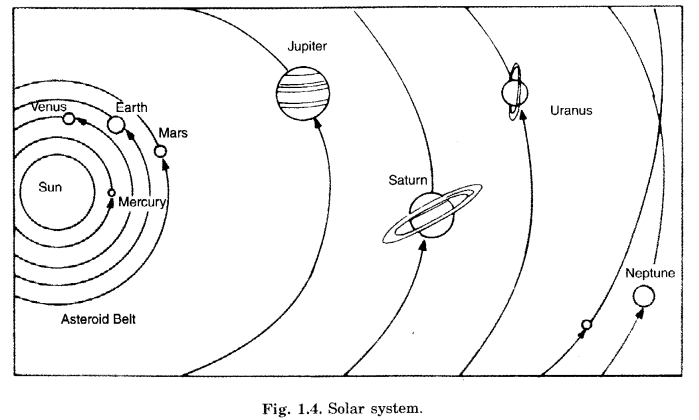
Describe The Sun and its planets with the help of a diagram.
Answer:
The Sun:
- The Sun is at the centre of the Solar System. It is the head of the Solar Family.
- It is made up of extremely hot gases.
- The Sun provides the gravitational pull that binds the Solar System.
- It is also a massive store house of energy. The energy is essential for life on the Earth.
- The Sun is about 15 crore km away from the Earth.
Planets:
- There are eight planets in the Solar Family.
- In order of their distance from the Sun they are Mercury, Venus, Earth, Mars, Jupiter, Saturn, Uranus, Neptune.
- Mercury is the nearest to the Sun, while Neptune is the farthest from the Sun.
The Earth in the Solar System Class 6 Extra Questions Multiple Choice Questions
Choose the correct answer:
Question 1.
How is the sky filled with after sunset and in the night?
(a) Bright objects
(b) Dim objects
(c) Both (a) and (b)
(d) None of these
Answer:
Both (a) and (b)
Question 2.
What is the name given to the full moon night?
(a) Amavasya
(b) Poornima
(c) Both (a) and (6)
(d) None of these
Answer:
Poornima
Question 3.
Which of the following name is given to the new moon?
(a) Poornima
(b) Amavasya
(c) Both (a) and ib)
(d) None of these
Answer:
Amavasya
Question 4.
What are celestial bodies?
(a) The sun
(b) The moon
(c ) All the shining bodies in the sky
(d) All of these
Answer:
All of these
Question 5.
The celestial bodies which have their own heat and light are called
(a) planets
(b) stars
(c) satellites
(d) all of these
Answer:
stars
Question 6.
Which is the most recognisable constellation?
(a) The saptarishi
(b) The moon
(c) The sun
(d) The mars
Answer:
The saptarishi
Question 7.
The star which indicates the north is called
(a) pole star
(b) pole
(c) north pole
(d) south pole
Answer:
pole star
Question 8.
The celestial bodies which do not have their own heat and light but are lit by the light of the stars are named as
(a) stars
(b) planets
(c) both (a) and (b)
(d) none of these
Answer:
planets
Question 9.
The word ‘planet’ has been derived from the word ‘planetai’ which is named as
(a) Latin word
(b) German word
(c) Greek word
(d) English word
Answer:
Greek word
Question 10.
Which celestial bodies form the solar system?
(a) The sun
(b) The planets
(c) The satellites, asteroids and meteoroids
(d) All of the above
Answer:
All of the above
Question 11.
All the planets move around the sun in fixed elliptical path, these paths are called
(a) axis
(b) orbit
(e) both (a) and (b)
(d) none of these
Answer:
orbit
Question 12.
Why is the shape of the earth geoid?
(a) It is slightly flattened at the poles
(b) It is spheroid at the poles
(c) Both (a) and (b)
(d) None of these
Answer:
It is slightly flattened at the poles
Question 13.
The earth is called a unique planet due to
(a) neither too hot nor too cold
(b) presence of air and water
(c) oxygen, light supporting gas
(d) all of these
Answer:
all of these
Question 14.
The earth is called a blue planet because of the presence of
(a) water
(b) blue colour
(c) brown colour
(d) red colour
Answer:
water
Question 15.
Why do we see only one side of the moon from the earth?
(a) Because of moon moving around the earth in 27 days
(b) 27 days also taken in one spin
(c) Both (a) and (b)
(d) None of these
Answer:
Both (a) and (b)
Question 16.
Why does the moon not have conditions favourable for life?
(a) because of non existent of water
(b) because of non existent of air
(c) both (a) and (b)
(d) none of these
Answer:
both (a) and (b)
Question 17.
Apart from stars, planets and satellites, there are numerous bodies which also move around the sun, what are these called?
(a) Stars
(b) Asteroids
(c) Meteoroids
(d) Planets
Answer:
Meteoroids
Question 18.
Asteroids are found between the orbits of Jupiter and
(a) Mars
(b) Earth
(c) Venus
(d) Neptune
Answer:
Mars
Question 19.
Meteoroids are made up of
(a) dust
(b) pieces of rocks
(c) gases
(d) none of these
Answer:
pieces of rocks
Question 20.
What is called a cluster of millions of stars, shining white in the starry sky?
(a) Stars
(b) Planets
(c) Milky Way galaxy
(d) Satellites
Answer:
Milky Way galaxy
Question 21.
What makes the universe?
(a) Millions of galaxies
(b) Millions of stars
(c) Earth
(d) Satellites
Answer:
Millions of galaxies