
NCERT Class 9 Maths Ganita Manjari Chapter 6 Solutions (New Syllabus 2026-27)
Class 9 Maths Ganita Manjari Chapter 6 Exercise Set 6.1 Solutions
Exercise Set 6.1
Unless stated otherwise, use the approximation 22/7 for π.
1. The perimeter of a circle is 44 cm. What is its radius?
Answer:
Perimeter of circle = Circumference = 44 cm
Formula for circumference C = 2πr
⇒ 44 = 2 × 22/7 × r [Using π = 22/7]
⇒ 44 = 44r/7
⇒ r = 44 × 7 / 44
⇒ r = 7 cm
Therefore, the radius of the circle is 7 cm.
2. Calculate, correct to 3 significant figures, the circumference of a circle with: (i) radius 7 cm (ii) radius 10 cm (iii) radius 12 cm.
Answer:
(i) Radius r = 7 cm
We know that C = 2πr
⇒ C = 2 × 22/7 × 7
= 44 cm
Therefore, circumference = 44.0 cm
(ii) Radius = 10 cm
We know that C = 2πr
⇒ C = 2 × 22/7 × 10
= 440/7
= 62.857…
Correct to 3 significant figures: C = 62.9 cm
(iii) Radius = 12 cm
We know that C = 2πr
⇒ C = 2 × 22/7 × 12
= 528/7
= 75.428…
Correct to 3 significant figures: C = 75.4 cm
3. Calculate the length of the arc of a circle if: (i) the radius is 3.5 cm and the angle at the centre is 60°, and (ii) the radius is 6.3 m and the angle at the centre is 120°.
Answer:
(i) Radius = 3.5 cm, angle = 60°
We know that Arc Length L = θ/360 × 2πr
⇒ L = 60/360 × 2 × 22/7 × 3.5
= 1/6 × 22
= 11/3 cm
= 3.67 cm
Therefore, arc length L = 3.67 cm
(ii) Radius = 6.3 m, angle = 120°
We know that Arc Length L = θ/360 × 2πr
⇒ L = 120/360 × 2 × 22/7 × 6.3
= 1/3 × 2 × 22/7 × 6.3
= 1/3 × 39.6
= 13.2 m
Therefore, arc length = 13.2 m
4. Find the perimeter of a sector (i.e., the curved portion as well as the two straight portions) of a circle of radius 14 cm and sector angle 75°.
Answer:
Radius = 14 cm
Sector angle = 75°
We know that the Perimeter of Sector = L + 2r
Now the Arc length L = θ/360 × 2πr
= 75/360 × 2 × 22/7 × 14
= 75/360 × 88
= 5/24 × 88
= 55/3 cm
Therefore the Perimeter = 55/3 + 2 × 14
= 55/3 + 28
= 55/3 + 84/3
= 139/3 cm
= 46.33 cm
Therefore, the perimeter of the sector is 139/3 cm or 46.33 cm.
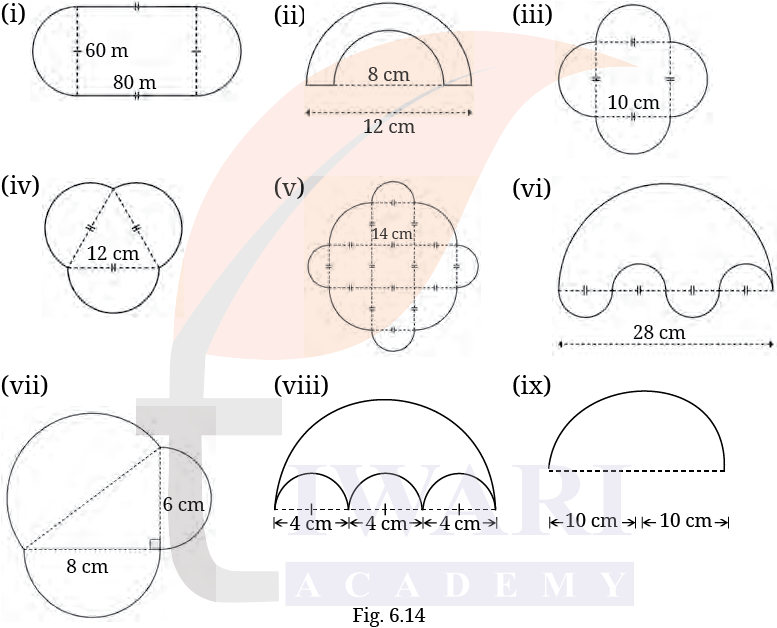
5. Find the perimeters of the following shapes (taking the arcs to be quarter or half or three-quarters of a circle, as appropriate) (Fig. 6.14i to 6.14ix).
Answer:
(i) The shape has:
Two straight parts of 80 m each
Two semicircles of diameter 60 m
So, Perimeter
= Two straight parts of 80 m each + Two semicircles of diameter 60 m
= 80 + 80 + π × 60 [Two semicircles make one full circle]
= 160 + (22/7 × 60)
= 160 + 1320/7
= 348.57 m
(ii) Outer semicircle diameter = 12 cm
Outer radius = 6 cm
Inner semicircle diameter = 8 cm
Inner radius = 4 cm
Two straight side parts: = 2 cm + 2 cm = 4 cm
Perimeter = outer semicircle + inner semicircle + straight parts
= π(6) + π(4) + 4
= 10π + 4
= 10 × 22/7 + 4
= 220/7 + 4
= 35.43 cm
(iii) The figure has 4 semicircles, each with diameter 10 cm.
Radius of each semicircle = 5 cm
Perimeter = 4 × semicircle length
= 4 × πr
= 4 × π × 5
= 20π
= 20 × 22/7
= 440/7
= 62.86 cm
(iv) The figure has 3 semicircles, each with diameter 12 cm.
Radius of each semicircle = 6 cm
Perimeter = 3 × semicircle length
= 3 × πr
= 3 × π × 6
= 18π
= 18 × 22/7
= 396/7
= 56.57 cm
(v) The figure has 4 semicircles, each with diameter 14 cm and 4 quarter circle, each with radius 14 cm.
Radius of each semicircle = 7 cm
Perimeter = 4 × semicircle length + 4 × quarter circle length
= 4 × πr + 4 × (1/2 πR)
= 4 × π × 7 + 2 × π × 14
= 28π + 28π = 56π
= 56 × 22/7
= 176 cm
(vi) The total base length is 28 cm.
For Large upper semicircle:
Diameter = 28 cm
Radius = 14 cm
For Small semicircles:
The base is divided into 4 equal parts. So, each diameter = 28/4 = 7 cm
Radius = 3.5 cm
Perimeter = large semicircle + 4 small semicircles
= π(14) + 4 × π(3.5)
= 14π + 14π
= 28π
= 28 × 22/7
= 88 cm
(vii) The figure has semicircles on the sides of a right triangle.
The perpendicular sides are 8 cm and 6 cm.
In right angled triangle
h² = 6² + 8² = 36 + 64 = 100
⇒ h = 10 cm
Now Perimeter
= length of semicircle with radius 6 cm + length of semicircle with radius 8 cm + length of semicircle with radius 10 cm
= π × 3 + π × 4 + π × 5 [Since Perimeter of semicircle = π × r]
= π × (3 + 4 + 5)
= π × 12
= 12π
= 12 × 22/7
= 264/7
= 37.71 cm
(viii) For Large semicircle:
Diameter = 12 cm
Radius = 6 cm
There are 3 small semicircles, each with diameter 4 cm.
Radius of each small semicircle = 2 cm
Perimeter = large semicircle + 3 small semicircles
= π(6) + 3 × π(2)
= 6π + 6π
= 12π
= 12 × 22/7
= 264/7
= 37.71 cm
(ix) For Large semicircle:
Diameter = 20 cm
Radius = 10 cm
There are 2 small semicircles, each with diameter 10 cm.
Radius of each small semicircle = 5 cm
Perimeter = large semicircle + 2 small semicircles
= π(10) + 2 × π(5)
= 10π + 10π
= 20π
= 20 × 22/7
= 440/7
= 62.86 cm
6. If the diameter of a car tyre is 56 cm, then: (i) How far does the car need to travel for the tyre to complete one revolution? (ii) How many revolutions does the tyre make if the car travels 10 km?
Answer:
(i) Distance in one revolution = Circumference of tyre
C = 2πr
= 2 × 22/7 × 28
= 22 × 8
= 176 cm
Therefore, the car travels 176 cm in one revolution.
(ii) Total distance = 10 km = 10 × 1000 × 100 = 1,000,000 cm
Number of revolutions = Total distance / Distance per revolution
= 1,000,000 / 176
= 5681.82 ≈ 5682 revolutions
Therefore, the tyre makes approximately 5682 revolutions.
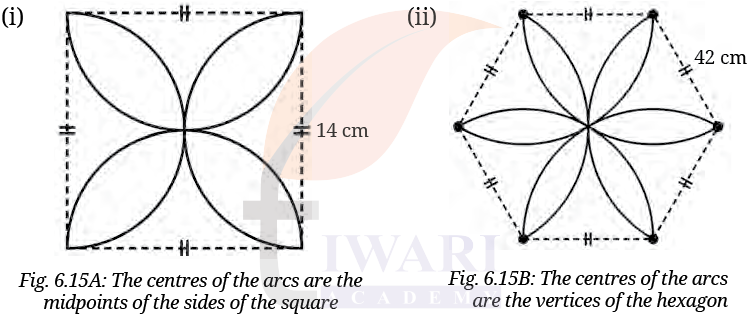
7. Find the total perimeter of all the petals in each of the given flowers.
Answer:
(i) The figure is a square of side 14 cm.
Each petal is formed by quarter circles whose centres are midpoints of the sides.
Radius = 14/2 = 7 cm
Each petal consists of 2 quarter circles = 1 semicircle
Total petals = 4
So total arcs = 4 semicircles = 2 full circles
Perimeter = 2 × (2πr)
= 4πr
= 4 × 22/7 × 7
= 88 cm
Therefore, total perimeter = 88 cm
(ii) The figure is based on a regular hexagon with side 42 cm.
Each petal is formed by arcs of circles with radius 42 cm.
There are 6 petals and each petal has 2 arcs of 60° each
(so total angle per petal = 120°)
Total angle for all petals:
= 6 × 120° = 720°
= 2 full circles
Perimeter = 2 × circumference of circle with radius 42 cm
= 2 × 2πr
= 4πr
= 4 × 22/7 × 42
= 4 × 132
= 528 cm
Therefore, total perimeter = 528 cm
8. The ratio of the perimeters of two circles is 5 : 4. What is the ratio of their radii?
Answer:
Given Ratio of perimeters = 5 : 4
Let the radius of first circle = R
Let the radius of second circle = r
According to question:
Perimeter of first circle : Perimeter of Second Circle = 5 : 4
⇒ 2πR : 2πr = 5 : 4
⇒ R : r = 5 : 4
Hence, the ratio of their radii is 5 : 4.
Class 9 Maths Ganita Manjari Chapter 6 Exercise Set 6.2 Solutions
Exercise Set 6.2
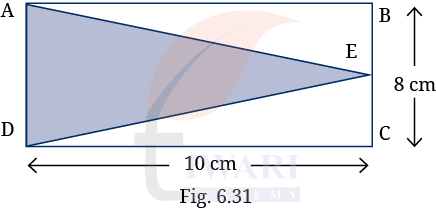
1. Find the area of triangle ADE in Fig. 6.31.
Answer:
From the figure:
AD = 8 cm
Distance from AD to E = 10 cm
Area of triangle ADE
= 1/2 × base × height
= 1/2 × 8 × 10
= 40 cm²
Therefore, area of triangle ADE = 40 cm².
2. The parallel sides of a trapezium are 40 cm and 20 cm. If its non-parallel sides are both equal, each being 26 cm, find the area of the trapezium.
Answer:
Difference of parallel sides = 40 − 20 = 20 cm
Since non-parallel sides are equal:
Half difference = 20/2 = 10 cm
Using Pythagoras theorem:
Height² = 26² − 10²
= 676 − 100
= 576
⇒ Height = 24 cm
Area of trapezium
= 1/2 × sum of parallel sides × height
= 1/2 × (40 + 20) × 24
= 30 × 24
= 720 cm²
Therefore, area = 720 cm².
3. Find the area of a triangle, given that its sides are 8 cm and 11 cm long, and its perimeter is 32 cm.
Answer:
Third side = Perimeter – (sum of two sides)
= 32 − (8 + 11)
= 13 cm
Now, sides of triangle are 8 cm, 11 cm and 13 cm.
So, the semi-perimeter s = 32/2 = 16 cm
Using Heron’s formula:
Area = √[s(s − a)(s − b)(s − c)]
= √[16(16 − 8)(16 − 11)(16 − 13)]
= √[16 × 8 × 5 × 3]
= √1920
= 8√30 cm²
Therefore, area = 8√30 cm².
4. The sides of a triangular plot are in the ratio 3 : 5 : 7; its perimeter is 300 m. Find its area.
Answer:
Let the sides be 3x, 5x and 7x.
Perimeter: 3x + 5x + 7x = 300
⇒ 15x = 300
⇒ x = 20
Now, the sides of triangle are 60 m, 100 m and 140 m
So, the semi-perimeter s = 300/2 = 150 m
Using Heron’s formula:
Area = √[150(150 − 60)(150 − 100)(150 − 140)]
= √[150 × 90 × 50 × 10]
= √6750000
= 1500√3 m²
Therefore, area = 1500√3 m².
5. One diagonal of a rhombus is twice as long as the other diagonal. If the rhombus has area 128 cm², find the length of the shorter diagonal.
Answer:
Let the shorter diagonal be x cm.
Then, the longer diagonal = 2x cm.
Area of rhombus = 1/2 × d₁ × d₂
⇒ 128 = 1/2 × x × 2x
⇒ 128 = x²
⇒ x = √128
⇒ x = 8√2
Therefore, the shorter diagonal is 8√2 cm.
6. ABCD is a parallelogram. P and Q are any two points on side AB. What can you say about the ratio area(△PCD) : area(△QCD)?
Answer:
Triangles PCD and QCD have the same base CD.
Since P and Q lie on AB and AB ∥ CD, their perpendicular distances from CD are equal.
So, both triangles have:
- Same base CD
- Same height
Therefore, their areas are equal.
Hence, area(△PCD) : area(△QCD) = 1 : 1.
7. O is any point on the diagonal PR of a parallelogram PQRS. Prove that the areas of triangles PSO and PQO are equal.
Answer:
In parallelogram PQRS, diagonal PR is drawn.
Point O lies on PR.
Triangles PSO and PQO have the same base PO.
Also, S and Q lie on opposite sides of PR in the parallelogram.
Their perpendicular distances from line PR are equal.
So, triangles PSO and PQO have:
- Same base PO
- Equal heights
Therefore, area(△PSO) = area(△PQO)
Hence proved.
8. If the mid-points of the sides of a 4-gon are joined in order, prove that the area of the parallelogram thus formed will be half of the area of the given 4-gon. (You may wonder whether the 4-gon thus formed is always a parallelogram, and if so, why? These questions will be tackled and answered in the chapter on quadrilaterals.)
Answer:
Let ABCD be the given 4-gon.
Let P, Q, R and S be the midpoints of sides AB, BC, CD and DA respectively.
Join P, Q, R and S in order.
So, PQRS is the parallelogram formed.
Now, draw diagonal AC of the 4-gon.
In triangle ABC, P and Q are the midpoints of AB and BC.
Therefore, by midpoint theorem: PQ ∥ AC and PQ = 1/2 AC
In triangle ADC, S and R are the midpoints of AD and DC.
Therefore, SR ∥ AC and SR = 1/2 AC
So, PQ ∥ SR and PQ = SR
Hence, PQRS is a parallelogram.
Now, the four corner triangles are △APS, △BPQ, △CQR and △DRS.
Each of these triangles has half the base and half the height of the corresponding triangle into which the 4-gon is divided.
So, the total area of the four corner triangles is half the area of the original 4-gon.
Therefore, the remaining middle parallelogram PQRS has the other half of the area.
Hence, area(parallelogram PQRS) = 1/2 × area(4-gon ABCD)
Hence proved.
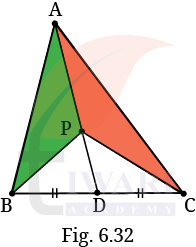
9. In △ABC, the midpoint of BC is D (Fig. 6.32). Median AD is drawn. P is any point on AD. Show that area(△ABP) = area(△ACP).
Answer:
Given: D is the midpoint of BC.
So, BD = DC
AD is a median and P is any point on AD.
Join PB and PC.
Now consider triangles △PBD and △PCD.
They have BD = DC and the same height from P to line BC.
Therefore, area(△PBD) = area(△PCD) …(1)
Now consider triangles △ABD and △ACD.
They have, BD = DC and the same height from A to line BC.
Therefore, area(△ABD) = area(△ACD) …(2)
Subtracting equation (1) from (2), we get
area(△ABD) − area(△PBD) = area(△ACD) − area(△PCD)
⇒ area(△ABP) = area(△ACP)
Hence proved.
10. Given a square ABCD, let P be a point within it. Join PA, PB, PC, PD (Fig. 6.33). What is the ratio of the areas of the red region (△PAB and △PCD) and the green region (△PBC and △PDA)?
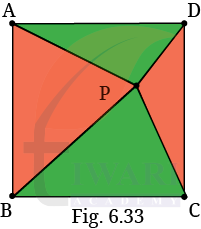
Answer:
Let the side of the square ABCD be a.
The red region consists of △PAB and △PCD
The green region consists of △PBC and △PDA
Now, AB ∥ CD and AB = CD = a.
Let the perpendicular distance of P from AB be h.
Then the perpendicular distance of P from CD will be a − h.
Area of △PAB = 1/2 × a × h
Area of △PCD = 1/2 × a × (a − h)
So, total red area:
= 1/2 × ah + 1/2 × a(a − h)
= 1/2 × a[h + a − h]
= 1/2 × a²
Similarly, let the perpendicular distance of P from BC be y.
Then the perpendicular distance of P from AD will be a − y.
Area of △PBC = 1/2 × a × y
Area of △PDA = 1/2 × a × (a − y)
So, total green area:
= 1/2 ay + 1/2 a(a − y)
= 1/2 a[y + a − y]
= 1/2 a²
Therefore, Red area = Green area
Hence, the required ratio:
Red region : Green region = 1 : 1.
11. In △ABC, D is the midpoint of AB. P is any point on BC, and Q is a point on AB such that CQ ∥ PD. PQ is joined (Fig. 6.34). Prove that Area(△BPQ) = 1/2 Area(△ABC).
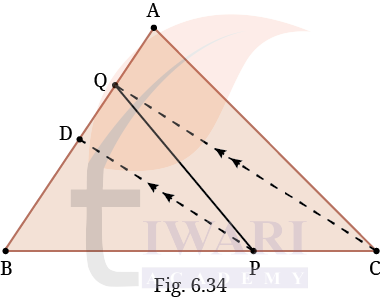
Answer:
Given: D is the midpoint of AB.
So, BD = DA
Since P lies on BC, triangles △ABP and △ABC have the same altitude from A to line BC.
Therefore, Area(△ABP)/Area(△ABC) = BP/BC …(1)
Now, in △ABP, D and Q lie on AB.
Since CQ ∥ PD and P lies on BC, by the basic proportionality idea in the figure,
Q is positioned so that △BPQ has half the area of △ABC.
As D is the midpoint of AB, so
Area(△BDP) = 1/2 Area(△ABP) …(2)
This is because triangles △BDP and △ABP have bases BD and AB on the same line AB and they have the same height from P to AB.
Now, since CQ ∥ PD, triangles △BDP and △BPQ have the same base BP and lie between the same parallels BP and DQ. So, their corresponding heights equal.
Thus, Area(△BPQ) = Area(△BDP) + Area(△DQP)
Using the parallel condition, the extra area exactly accounts for half of the remaining part of △ABC.
Hence, Area(△BPQ) = 1/2 Area(△ABC)
Therefore proved.
Class 9 Maths Ganita Manjari Chapter 6 Exercise Set 6.3 Solutions
Exercise Set 6.3
Unless stated otherwise, use the approximation 22/7 for π.
1. Find the area of a sector of a circle with radius 7 cm if the angle of the sector is 60°.
Answer:
Area of sector = θ/360 × πr²
Here,
r = 7 cm
θ = 60°
Area = 60/360 × 22/7 × 7²
= 1/6 × 22/7 × 49
= 77/3 cm²
Therefore, area of the sector = 77/3 cm².
2. Find the area of a quadrant of a circle whose circumference is 44 cm.
Answer:
Circumference = 44 cm
2πr = 44
⇒ 2 × 22/7 × r = 44 [Using π = 22/7]
⇒ 44r/7 = 44
⇒ r = 7 cm
Area of quadrant = 1/4 × πr²
= 1/4 × 22/7 × 7²
= 77/2 cm²
Therefore, area of the quadrant = 77/2 cm².
3. The length of the minute hand of a clock is 7 cm. Find the area swept by the minute hand in 10 minutes.
Answer:
Minute hand completes 360° in 60 minutes.
So, in 10 minutes, angle swept:
= 10/60 × 360°
= 60°
Radius = 7 cm
So, the area swept = area of sector
= 60/360 × πr²
= 1/6 × 22/7 × 7²
= 77/3 cm²
Therefore, area swept = 77/3 cm².
4. A chord of a circle of radius 10 cm subtends 90° at the centre. Find the area of the corresponding: (i) minor sector that subtends 90° at the centre, and (ii) major sector that subtends 270° at the centre. (Use π ≈ 3.14.)
Answer:
Radius = 10 cm
(i) Area of minor sector:
Area = 90/360 × πr²
= 1/4 × 3.14 × 10²
= 1/4 × 314
= 78.5 cm²
Therefore, area of minor sector = 78.5 cm².
(ii) Area of major sector:
Area = 270/360 × πr²
= 3/4 × 3.14 × 10²
= 3/4 × 314
= 235.5 cm²
Therefore, area of major sector = 235.5 cm².
5. A chord of a circle of radius 15 cm subtends an angle of 60° at the centre of the circle. Find the areas of the corresponding minor and major segments of the circle. (Use π ≈ 3.14 and √3 ≈ 1.73.)
Answer:
Radius = 15 cm
Angle at centre = 60°
Area of minor sector:
= 60/360 × πr²
= 1/6 × 3.14 × 15²
= 1/6 × 3.14 × 225
= 117.75 cm²
Since the angle is 60° and both radii are equal, the triangle formed is equilateral.
Area of equilateral triangle:
= √3/4 × side²
= 1.73/4 × 15²
= 1.73/4 × 225
= 97.3125 cm²
Area of minor segment:
= Area of minor sector − Area of triangle
= 117.75 − 97.3125
= 20.4375 cm²
So, Minor segment area = 20.44 cm² approximately.
Area of circle = πr²
= 3.14 × 225
= 706.5 cm²
Area of major segment = Area of circle − Area of minor segment
= 706.5 − 20.4375
= 686.0625 cm²
So, Major segment area = 686.06 cm² approximately.
6. A car has two wipers which do not overlap. Each wiper has a blade of length 28 cm and sweeps through an angle of 120°. Find the total area cleaned at each sweep of the blades.
Answer:
Each wiper cleans a sector of radius 28 cm and angle 120°.
Area cleaned by one wiper:
= 120/360 × πr²
= 1/3 × 22/7 × 28²
= 1/3 × 22/7 × 784
= 2464/3 cm²
Since there are two wipers and they do not overlap:
Total area cleaned:
= 2 × 2464/3
= 4928/3 cm²
Therefore, total area cleaned = 4928/3 cm².
7. A chord of a circle of radius r subtends an angle of 60° at the centre of the circle. Show that the area of the corresponding minor segment of the circle is equal to r²(π/6 − √3/4).
Answer:
Let O be the centre of the circle and AB be the chord.
Given: OA = OB = r
∠AOB = 60°
Since OA = OB and ∠AOB = 60°, triangle OAB is equilateral.
So, AB = r
Area of minor sector OAB:
= 60/360 × πr²
= πr²/6
Area of equilateral triangle OAB = √3/4 × r²
Area of minor segment = Area of sector − Area of triangle
= πr²/6 − √3r²/4
= r²(π/6 − √3/4)
Hence proved.
9. A square is inscribed in a circle of radius r. Show that the ratio of the area of the square to the area of the circle is equal to 2/π ≈ 0.637.
Answer:
Let the radius of the circle be r.
Since the square is inscribed in the circle, the diagonal of the square is equal to the diameter of the circle.
Diameter of circle = 2r
Let the side of the square be a.
Using Pythagoras theorem: a² + a² = (2r)²
⇒ 2a² = 4r²
⇒ a² = 2r²
Area of square = a² = 2r²
Area of circle = πr²
Therefore, Area of square : Area of circle
= 2r² / πr²
= 2/π
Hence, the ratio is 2/π ≈ 0.637.
10. A hexagon is inscribed in a circle of radius r. Show that the ratio of the area of the hexagon to the area of the circle is equal to 3√3/2π ≈ 0.827. Can you see why the answer is exactly twice the answer to Question 8?
Answer:
A regular hexagon inscribed in a circle can be divided into 6 equilateral triangles.
Each equilateral triangle has side r, because the radius of the circle is r.
Area of one equilateral triangle = √3/4 × r²
Area of 6 such triangles:
= 6 × √3/4 × r²
= 3√3/2 × r²
So, Area of hexagon = (3√3/2)r²
Area of circle = πr²
Therefore, Area of hexagon : Area of circle
= [(3√3/2)r²] / πr²
= 3√3/2π
Hence, the ratio is 3√3/2π ≈ 0.827.
Why is this exactly twice the answer to Question 8?
In Question 8, the inscribed equilateral triangle has area ratio: 3√3/4π
The regular hexagon is made of 6 equilateral triangles of side r, while the inscribed equilateral triangle is made of 3 such equilateral triangles.
So, the hexagon has twice the area of the inscribed equilateral triangle.
Therefore, 3√3/2π is exactly twice 3√3/4π.
Class 9 Maths Ganita Manjari Chapter 6 End-of-Chapter Exercises Solutions
End-of-Chapter Exercises
In the problems below, unless stated otherwise, use the approximation 22/7 for π.
1. Identities in algebra can sometimes be shown as area relationships. For example:
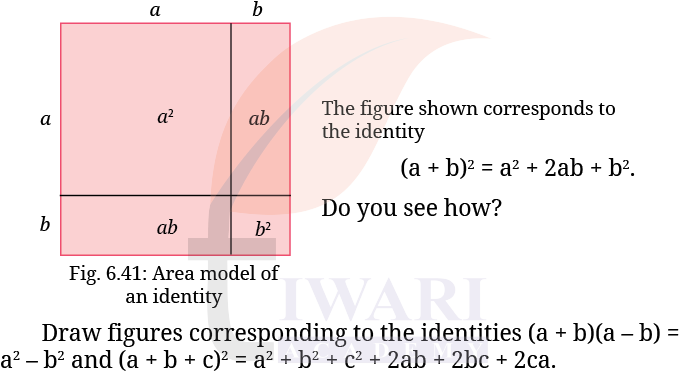
Answer:
(i) For (a + b)(a − b) = a² − b²:
Draw a square of side a.
Its area is a².
Now remove a square of side b from one corner.
The removed area is b².
Remaining area = a² − b².
This remaining region can be rearranged into a rectangle whose sides are:
(a + b) and (a − b).
So, (a + b)(a − b) = a² − b²
(ii) For (a + b + c)² = a² + b² + c² + 2ab + 2bc + 2ca:
Draw a large square of side (a + b + c).
Divide each side into three parts: a, b and c.
Now the square is divided into:
- one square of area a²
- one square of area b²
- one square of area c²
- two rectangles of area ab
- two rectangles of area bc
- two rectangles of area ca
Therefore, Total area = a² + b² + c² + 2ab + 2bc + 2ca
Hence, (a + b + c)² = a² + b² + c² + 2ab + 2bc + 2ca.
2. An isosceles triangle has perimeter 40 cm; the equal sides are 15 cm each. Find the area of the triangle.
Answer:
Equal sides = 15 cm and 15 cm
Perimeter = 40 cm
Base = 40 − 15 − 15 = 10 cm
In an isosceles triangle, the altitude bisects the base.
So, half of base = 10/2 = 5 cm
Using Pythagoras theorem:
Height² = 15² − 5²
= 225 − 25
= 200
So, Height = √200
= 10√2 cm
Area of triangle
= 1/2 × base × height
= 1/2 × 10 × 10√2
= 50√2 cm²
Therefore, area = 50√2 cm².
All Key Formulas in Class 9 Ganita Manjari Chapter 6
| Shape / Concept | Formula |
|---|---|
| Perimeter of rectangle | 2(a + b) |
| Circumference of circle | 2πr or πd |
| Length of arc | 2πr × (θ°/360°) |
| Area of rectangle | ab sq. units |
| Area of square | a² sq. units |
| Area of parallelogram | base × height = bh |
| Area of triangle | ½ × base × height = ½bh |
| Semi-perimeter (triangle) | s = ½(a + b + c) |
| Heron’s formula | √[s(s−a)(s−b)(s−c)] |
| Area of circle | πr² |
| Area of sector | πr² × (θ°/360°) |
| Area of triangle (circumcircle) | abc / 4R |
| Area of triangle (incircle) | r(a + b + c) / 2 |
| Semi-perimeter (cyclic 4-gon) | s = ½(a + b + c + d) |
| Brahmagupta’s formula | √[(s−a)(s−b)(s−c)(s−d)] |
The History of π – A Summary from Class 9 Ganita Manjari Chapter 6
One of the most distinctive features of this chapter is its rich historical account of how humans pursued the value of π across civilisations. Here is a concise timeline:
- 1900 BCE — Mesopotamia: Recognised π > 3 by comparing a circle’s perimeter to an inscribed hexagon. Used π ≈ 3.125.
- 1500 BCE — Ancient Egypt and Baudhāyana’s India: Used π ≈ 256/81 ≈ 3.16 through geometric methods for squaring circles.
- 250 BCE — Archimedes of Syracuse: Trapped π between inscribed and circumscribed polygons up to 96 sides. Proved 3(10/71) < π < 3(1/7).
- 150 CE — Ptolemy of Alexandria: Gave π ≈ 377/120 ≈ 3.14167 for astronomical use.
- 263 CE — Liu Hui (China): Circle-cutting method laid the groundwork for later Chinese advances.
- 480 CE — Zu Chongzhi (China): Used a 24,576-sided polygon. Discovered 355/113 ≈ 3.1415929 — the most accurate rational approximation with denominator under 15,000 — remaining world’s best for over 800 years.
- 499 CE — Āryabhaṭa (India): Gave π ≈ 62832/20000 = 3.1416, crucially describing it as asanna (approximate), suggesting it cannot be expressed as a simple fraction.
- 628 CE — Brahmagupta (India): Used √10 ≈ 3.1622 for its algebraic elegance.
- 1400 CE — Mādhava of Sangamagrāma (India): Discovered the first exact formula: π/4 = 1 − 1/3 + 1/5 − 1/7 + ··· — an infinite series that launched calculus and computed π to 11 decimal places.
- 1706 — William Jones (Wales): First used the Greek symbol π for the C/D ratio.
- Today: Using algorithms of Ramanujan and the Chudnovsky brothers, π is known to hundreds of trillions of digits.
Key Concepts Explained Simply – Ganita Manjari Chapter 6
- Why is π irrational?The digits of π never repeat in any pattern and π cannot be written as a fraction a/b where a and b are integers. This was proved by Lambert in 1761. The familiar 22/7 is only an approximation — π ≈ 22/7 but π ≠ 22/7. A far better approximation is 355/113.
- Heron’s Formula — when is it used?Heron’s formula lets you find a triangle’s area knowing only its three side lengths, without needing to know its height. Compute s = ½(a + b + c), then area = √[s(s−a)(s−b)(s−c)]. It is especially useful for scalene triangles where height is not directly given.
- Brahmagupta’s Formula and its connection to Heron’s:Brahmagupta’s formula for cyclic quadrilaterals, area = √[(s−a)(s−b)(s−c)(s−d)], becomes Heron’s formula exactly when d = 0 — because a triangle is simply a degenerate four-sided figure where one side has zero length. This is a beautiful example of mathematical generalisation.
- The Median Theorem:A median of a triangle (a line from a vertex to the midpoint of the opposite side) divides it into two triangles with exactly equal area — even though the two triangles are generally not congruent. This surprising result follows directly from the area formula ½bh.
- Arc Length and Sector Area:Both use the same idea — what fraction of the full 360° does the angle θ represent? Arc length = 2πr × (θ/360) and Sector area = πr² × (θ/360). These formulas come directly from the rotational symmetry of the circle.
- Baudhāyana’s Rectangle Squaring (800 BCE):This geometric construction finds a square equal in area to any given rectangle using only compass and straightedge — a remarkable achievement predating modern algebra by over two millennia. The proof relies on the identity ((a+b)/2)² − ((a−b)/2)² = ab.
Exercise-Wise Overview – Chapter 6 Ganita Manjari Class 9 Maths
- Exercise Set 6.1: Circumference from radius; arc length calculations; sector perimeter; perimeters of nine composite shapes involving quarter, half and three-quarter circles; tyre revolution problems; flower petal perimeters; ratio of radii from ratio of circumferences.
- Exercise Set 6.2: Area of triangles (including using Heron’s formula); trapezium area; triangular plots from perimeter ratios; rhombus diagonal from area; parallelogram area ratios; median-based area equality proofs; midpoint parallelogram area; median point area equality.
- Exercise Set 6.3: Sector areas; quadrant areas from circumference; minute hand area sweep; minor and major sector and segment areas; windscreen wiper area; starred proofs involving equilateral triangle, square and hexagon inscribed in circles.
- End-of-Chapter Exercises: 27 questions covering area models of algebraic identities, triangle area problems via Heron’s formula, bicycle wheel travel calculations, kite area, trapezium area proofs, congruent rectangle packing, circle-in-rectangle area fraction, nine-rectangle puzzle and advanced starred proofs involving semicircles on right triangles, concentric circles, and equal shaded region proofs.
Historical Mathematicians Featured in Class 9 Maths Ganita Manjari Chapter 6
This chapter is unusual in giving significant space to mathematical history. The following figures appear:
- Mādhava of Sangamagrāma — Kerala mathematician (c. 1400 CE) who discovered the first exact infinite series for π, effectively founding calculus two centuries before Newton and Leibniz.
- Āryabhaṭa — Indian mathematician (499 CE) who gave π ≈ 3.1416 and described it as approximate — the earliest recorded suggestion that π might be irrational.
- Brahmagupta — Indian mathematician (628 CE) who gave the area formula for cyclic quadrilaterals, a direct generalisation of Heron’s formula, and used √10 as an approximation for π.
- Baudhāyana — Ancient Indian mathematician (c. 800 BCE) whose Śhulbasūtra contains a geometric method for squaring a rectangle and an early approximation for π in circle-squaring constructions.
- Archimedes of Syracuse — Greek mathematician (c. 250 BCE) who proved A = πr² and bounded π between 3(10/71) and 3(1/7) using 96-sided polygons.
- Zu Chongzhi — Chinese mathematician (480 CE) whose fraction 355/113 remained the world’s most accurate value of π for over 800 years.
- Nīlakaṇṭha Somayājī — Indian mathematician (c. 1500 CE) who gave the beautiful visual “circle slicing” proof that the area of a circle is πr².
- Heron of Alexandria — Greek mathematician who discovered the formula for triangle area in terms of its three sides, now bearing his name.
Important Starred (*) Questions in Chapter 6 – For Advanced Learners
- Q7 (Ex 6.3): Prove that the minor segment of a 60° chord in a circle of radius r has area πr²(1/6 − √3/4).
- Q8 (Ex 6.3): Show that the ratio of an equilateral triangle inscribed in a circle to the circle’s area is 3√3/4π ≈ 0.413.
- Q9 (Ex 6.3): Show that the ratio of a square inscribed in a circle to the circle’s area is 2/π ≈ 0.637.
- Q10 (Ex 6.3): Show that the ratio of a regular hexagon inscribed in a circle to the circle’s area is 3√3/2π ≈ 0.827 — exactly twice the triangle ratio in Q8.
- Q21 (End): In a square with a quarter circle and two semicircles, prove that two created shaded regions have equal area.
- Q23 (End): For two concentric circles where a chord of the outer circle is tangent to the inner circle, show the annular region between them has area πl²/4, where l is the chord length.
- Q24 (End): Show that semicircles on the two legs of a right triangle together equal the semicircle on the hypotenuse — a beautiful generalisation of the Baudhāyana–Pythagoras theorem.
- Q25 (End): For two circles each passing through the other’s centre, find the enclosed region’s area in terms of r.